



Philadelphia has always been a city where Black Americans have fought for freedom, from the founding of the Free African Society in 1787 to the Civil Rights battles of the 1960s. Today, we face a new frontier in that eternal struggle: artificial intelligence. And make no mistake — what happens in the next five years will determine whether AI becomes the most powerful tool for Black economic mobility since the Civil Rights Act, or the most sophisticated system of discrimination since Jim Crow.
A groundbreaking new report from The Connect / The Connect AI, “Navigating the Double-Edged Algorithm,” reveals a stark reality that every Philadelphian needs to understand: AI is not neutral. It’s not “just technology.” It is simultaneously opening doors and slamming them shut — often for the same people.
The promise we can’t afford to miss
Here’s what most people don’t know: Black-owned businesses are leading the AI revolution. Eighty-four percent of Black entrepreneurs are already using AI tools — significantly higher than the general business population. In Philadelphia, where Black-owned businesses have long struggled against discriminatory lending and limited access to capital, AI is leveling the playing field in remarkable ways.
Consider this: AI-powered fintech companies led by Black entrepreneurs are disrupting the traditional banking system that has denied our community for generations. Companies like Lendistry used AI to analyze alternative data — cash flow, utility payments, community engagement — to approve significantly more Paycheck Protection Program loans to Black businesses than traditional banks ever would. Greenwood, an AI-powered banking platform for Black and Latino communities, is building a parallel financial ecosystem with inclusive lending criteria.
For the Black-owned beauty salon in Southwest Philly, AI means automating bookkeeping and inventory management. For the soul food restaurant in Germantown, it means 24/7 customer service through chatbots and personalized marketing campaigns. For the tech startup in University City, it means competing with Silicon Valley on marketing, strategy and customer insights — without their billion-dollar budgets.
This is not theoretical. Ninety-three percent of Black small business owners using AI say it has potential to close the wealth gap. This technology is a “life hack,” as one entrepreneur put it — a genuine equalizer.
The peril we cannot ignore
But here’s the terrifying flip side: While Black entrepreneurs embrace AI, AI systems are systematically discriminating against Black workers at every stage of their professional lives.
A University of Washington study found that AI hiring systems favor White-associated names 85 percent of the time. And here’s the gut punch: these systems never — not once — preferred names perceived as belonging to Black men over White men.
Think about what this means when 99 percent of Fortune 500 companies use these automated hiring tools. Every résumé submitted by a Tyrone or a Tanisha is being judged by an algorithm that has learned to replicate centuries of hiring discrimination — except now it happens at the speed of light, affecting millions of applications, with a veneer of mathematical objectivity that makes it nearly impossible to challenge.
And it gets worse. Twenty-four percent of Black workers are employed in occupations with more than 75 percent automation potential — jobs like cashiers, retail sales, administrative assistants, security guards. McKinsey projects that if current trends continue, AI could widen the racial wealth gap by an additional $43 billion annually by 2045.
Let me translate that: AI is systematically destroying the “gateway jobs” — positions that don’t require four-year degrees but offer stable middle-class salaries — that have historically lifted Black families into economic security. Jobs like training specialists, social service managers, and administrative coordinators are being automated away, and the new AI-generated wealth is flowing overwhelmingly to capital owners and high-skilled tech roles — demographics where Black Americans remain dramatically underrepresented.
When algorithms become oppressors
The discrimination doesn’t stop at hiring. AI systems now determine who gets arrested, who receives healthcare, who keeps their children, and who gets housing. Predictive policing algorithms have created a vicious feedback loop in Black neighborhoods: historical over-policing data trains the algorithm to predict “high-risk” areas, which sends more police to those neighborhoods, which generates more arrests, which feeds back into the algorithm, which “confirms” these are high-crime areas — a mathematically-justified cycle of surveillance and control.
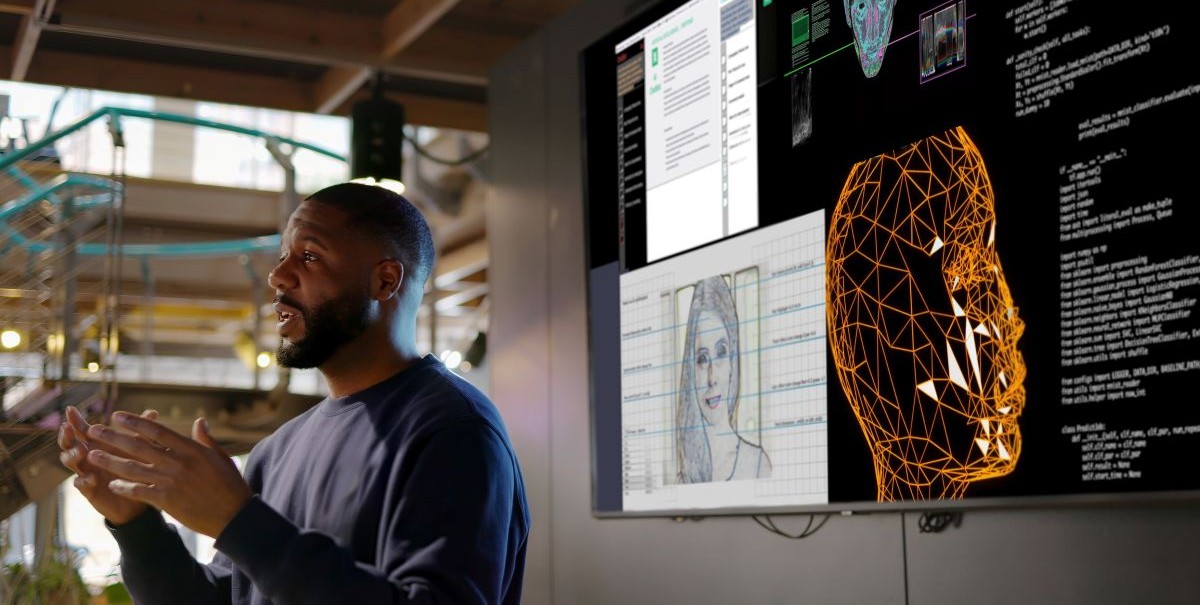
Facial recognition technology misidentifies darker-skinned women up to 34 percent of the time, compared to less than 1 percent for lighter-skinned men. This isn’t a minor technical glitch — it has led to wrongful arrests of Black men like Robert Williams in Detroit, detained in front of his family based on an algorithm’s mistake.
Perhaps most insidious: healthcare algorithms are denying Black patients critical medical care. A landmark study found that hospital algorithms systematically underestimated the health needs of Black patients because they used healthcare costs as a proxy for health — wrongly concluding that because Black patients historically receive less expensive care (due to systemic barriers), they must be healthier. The algorithm cut the number of Black patients eligible for extra care by more than half.
The Path Forward: Four Actions Philadelphia Must Take Now
This is not a predetermined future. The algorithm is not destiny. But justice requires immediate action:
- Demand Transparency: Philadelphia City Council must establish a public AI Registry — like Helsinki, Amsterdam, and San Jose have done — listing every AI system used in municipal services, policing, and social services, with plain-language explanations accessible to residents. We have a right to know when algorithms are making decisions about our lives.
- Invest in AI Literacy: AI literacy is not a luxury — it’s economic survival and civic power in the 21st century. Philadelphia’s HBCUs, community colleges, school districts, and professional organizations must prioritize AI education not just as technical training, but as civil rights defense. Understanding how these systems work is the first step to challenging them.
- Support Black-Led Tech: Philadelphia has a thriving Black tech ecosystem. City contracts, venture capital, and corporate partnerships must intentionally flow to Black-owned AI companies building culturally-competent solutions. When Black entrepreneurs build AI, they build it differently — with equity as a feature, not an afterthought.
- Ban What Cannot Be Fixed: Some technologies are too dangerous for deployment. Philadelphia should follow San Francisco’s lead and ban government use of facial recognition. We should prohibit the use of historically biased crime data in predictive policing. Civil rights cannot be sacrificed on the altar of efficiency.
Senzwa Ntshepe is CEO of The Connect, Philadelphia’s largest network of Black professionals. For more information and to download the full report “AI and the Black Community: Navigating the Double-Edged Algorithm,” visit https://theconnect.pro/ai-report
The Citizen welcomes guest commentary from community members who represent that it is their own work and their own opinion based on true facts that they know firsthand.
 MORE ON THE IMPLICATIONS OF AI