



In 1990, I was a first-year grad student at Penn, and one of the ways I afforded my grad school habits was working as a doorman at the legendary Smokey Joe’s at 40th and Walnut streets. Some of us who worked the doors were so concerned by the perceived and real safety concerns faced by students and residents of University City in those days that we actually often walked patrons home when the bar closed. I left Penn with an MA in 1993 and spent eight years in Baltimore. I returned to Philly in 2001 for a job opportunity, and my office was at 37th and Chestnut.
I was astonished at just how much had changed in the intervening period. What had happened? A guy named John Fry, who had become Executive Vice President at Penn when Judith Rodin took the presidency in 1994, led the formation of a special services district called University City District. By coordinating all of the considerable “anchor institutions” — then a brand-new term — UCD helped transform University City into a powerhouse through concerted strategic placemaking.
As an organization committed to the power of anchor-enabled economic development through our PAGE (Philadelphia Anchors for Growth & Equity) initiative, the Economy League of Greater Philadelphia is thrilled that John Fry is now at the helm at Temple University and poised to leverage his new institution’s economic powers strategically to give North Philly a long-overdue economic boost. ELGP is excited to work with him and many other partners like North 10 to develop a community-informed, anchor-assisted North Philly equitable growth strategy.
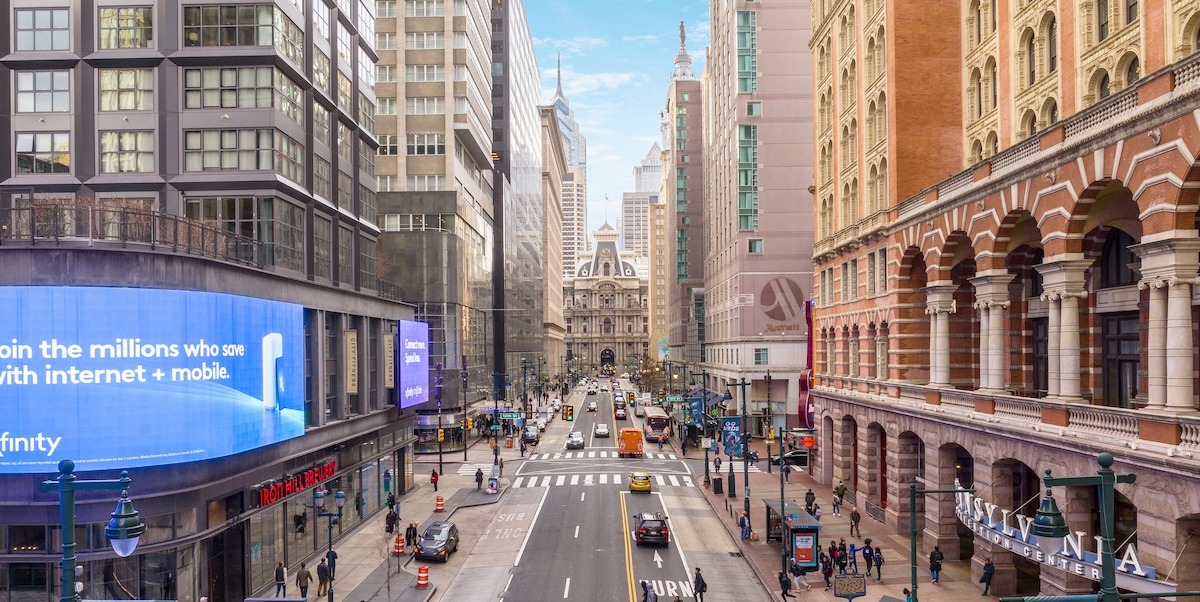
Which gets me to Market East, where, as it happens, the Economy League’s office is located. I read Philly Mag’s recent conversation among eight smart urbanists with great interest. Many interesting ideas were floated, though I was surprised, particularly given Fry’s participation in this forum, that the three major anchor institutions that call Market East home — Jefferson Health Systems, Macerich/The Fashion District, and the Convention Center (including Reading Terminal Market) barely registered as the key potential enablers of a Market East strategy — and the need for a special services district to drive it.
In short, in my mind there are three elements to a plan to turn Market East into the economic powerhouse it could and should be:
-
- Formation of a Market East version of UCD, let’s call it MED — Market East District.
- The designation of the entire district as a Keystone Opportunity Zone to provide deep incentives for private sector relocations.
- A commitment from the 3 core anchors — Jefferson, Macerich, and the Convention Center Authority — to support MED financially and strategically.
Before this can happen, a few core questions need to be addressed:
-
- What will anchor the eastern part of MED? It is my belief that Philadelphia needs a true public institution, a full-blown state university campus. MED needs a steady influx of people, and since the Sixers arena got kiboshed, how about converting the 1 million square feet of radically under-utilized space at three magnificent buildings — Lit Brothers, Strawbridge’s, and 714 Market — into an urban college campus serving Philadelphia’s working and middle-class families? (No shade on Temple, but its $20,000 annual tuition is more than double that of a Pennsylvania State System of Higher Education school like Kutztown University.) And of course the campus would have the best possible transit access of any university campus in the state, with over 1 million people a single-seat ride away.
- Does Jefferson still see itself as a Philadelphia-based anchor institution? With its rapid growth, its logo emblazoned on the tallest building in Market East, spearheading the $1 billion investment in the Honickman Campus and the mixed-use East Market development, which has struggled to maintain commercial tenants, Jefferson is already a powerful economic force but could be an even greater one if it so chose and helped to organize and focus resources.
- Macerich needs a real vision and plan for the Fashion District, in which it invested $500 million to create an attractive but radically underperforming mall. In my opinion we need more quality retail as well as perhaps a Liacouras Center-sized arena to draw people to ME on a consistent basis. Alternatively, or perhaps additionally, a portion of the Fashion District could be converted into the permanent intercity bus terminal, which could also create a steady flow of foot traffic for the benighted but very nice mall. The “temporary” terminal is across Filbert Street from the Fashion District, so perhaps it would be possible without too much major surgery — almost certainly less than the aborted Sixers arena — to stitch together this infrastructure, leverage existing assets, create a quality terminal, give Market East a boost, and right-size the mall.
- With the planned departure of the African American Museum of Philadelphia to digs more worthy of Philly’s crucial African American history, perhaps it is time to invest in a Philly history museum that truly honors this City’s place in the history of this country.
And of course, as the gathering of smart urbanists all pointed out, the district needs to be less car-friendly and more pedestrian oriented. We have plenty of examples from Barcelona to Bologna to Times Square of how this can be done, and the East Market project already sets a good example.
Let’s use the energy of the 250th to catalyze a Market East revival that would make John Wanamaker and the Lit Brothers proud!
Jeff Hornstein is executive director of the Economy League of Greater Philadelphia.
The Citizen welcomes guest commentary from community members who represent that it is their own work and their own opinion based on true facts that they know firsthand.
 MORE SOLUTIONS FOR MAKING MARKET EAST WORK