

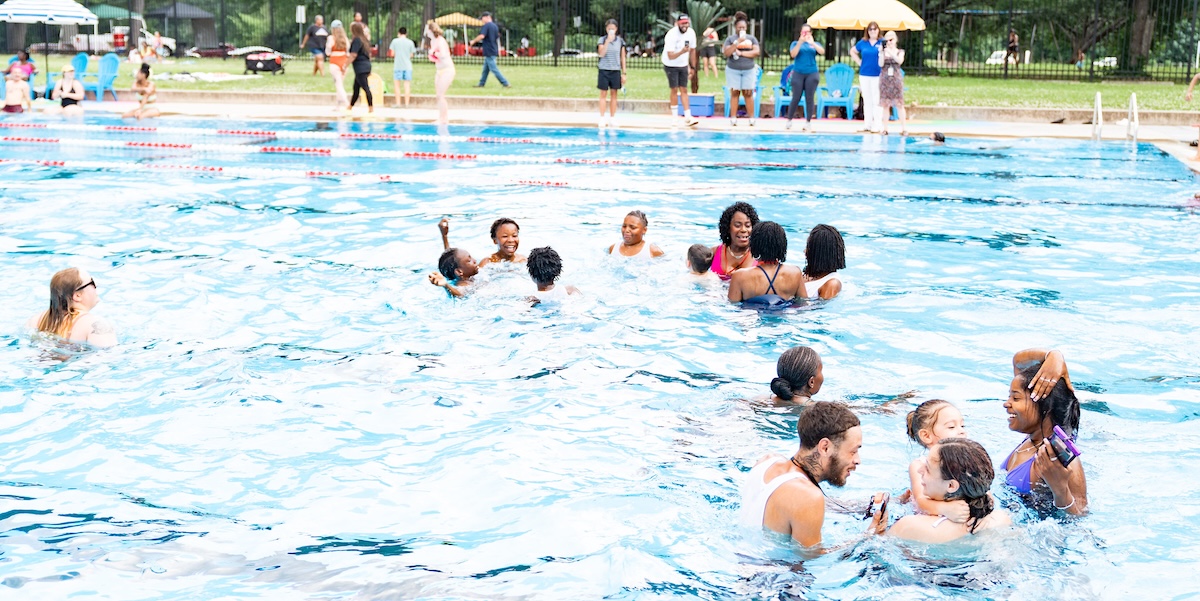


Did you know Philly has the most pools per capita than any other American city? This is just one fact of many I rattle off throughout the summer, as I encourage my friends and hapless strangers to spend time at their neighborhood pool. But to me, knowing the hours of adult swim or nearest pool with loungers, is about more than just about a dip in cool water. Pools are among the clearest places where I see democracy in action in this city. It’s why I believe everyone should make it to their neighborhood pool at least once this summer to remind themselves of the messy beauty of both democracy and city living.
In Philly, the public pools are some of the rare spaces where all are welcome, and indeed, all attend. On any given afternoon open swim, you can see families with young children, groups of adult friends enjoying an outdoor lunch break, teenagers hanging out together, and elderly folks swimming laps. Despite nearly every social demographic difference, when you’re at the pool, you are constantly reminded that you’re in a loosely tied, highly chlorinated community and that means you have to learn to get along with fellow swimmers.
We recognize each others’ common aims — the pleasure of summer, respite from the heat, well-deserved relaxation — and are reminded that we must abide by a social contract, enforced locally by the incredible neighborhood folks who operate the pools, in order to achieve those goals. The pool is not a lawless place, but its rules and regulations don’t have to be draconically enforced because we all hold each other accountable so that we can all equally enjoy the wonderful privilege of a free swim. How incredible would it be if we could do that on SEPTA, for instance?
In Philly, the public pools are some of the rare spaces where all are welcome, and indeed, all attend.
This social negotiation may be small, but it is a reminder of both the principles that animate any functioning democracy and our responsibility in actively living them out. Maybe it’s that the Philly humidity exhausts us, or the water evokes childlike whimsy, or maybe just the space inspires us to get along and be good democratic citizens, albeit briefly.
When I was a teacher, I learned to frame unique spaces (like the classrooms) as necessary sites of democracy, where essential values of community, empathy, and responsibility are modeled and practiced and where individuals are reminded of the ways they’re tethered to each other. These spaces not only explicitly reminded individuals of these values, but, most importantly, constantly modeled them in practice.
“A democracy is more than a form of government,” John Dewey wrote in Democracy and Education. “It is primarily a mode of associated living, of conjoint communicated experience. The extension in space of the number of individuals who participate in an interest so that each has to refer his own action to that of others, and to consider the action of others to give point and direction to his own, is equivalent to the breaking down of those barriers of class, race, and national territory which kept men from perceiving the full import of their activity.” Dewey reminds us that it is often in spaces that we don’t necessarily immediately associate with civic life that can be most conducive to its success and equally importantly, its renewal.
When you’re at the pool, you are constantly reminded that you’re in a loosely tied, highly chlorinated community and that means you have to learn to get along with fellow swimmers.
The pool is, of course, not always an idyllic paradise. Like all people, Philadelphians can be crazy and occasionally out of pocket. The teens get rowdy, the adults occasionally make an ill-advised joke in front of toddlers, the parents occasionally lose it on their misbehaving kids. But, rather than disheartening me, these mishaps are also necessary reminders of the challenging work it is to authentically engage politically — that is, collectively — with your neighbors. Any democratic institution, if it’s actually engaging the people, is inevitably going to be messy, but that doesn’t mean it’s not working; if anything, that friction can help us become better and more patient citizens.
If our concept of democracy relies on an idealized view of our neighbors — one in which they share our values, meet our expectations, respect our space, never splash strangers — then our sense of commitment to the actual people we’re bound to doesn’t stand much of a chance.
“Obviously a society to which stratification into separate classes would be fatal,” Dewey wrote, and, for many of us adults outside of the classroom, that stratification can be more apparent in our places of leisure than our memories of classrooms. The public pools — and other shared civic spaces like the public libraries and public parks — offer us necessary opportunities to practice democracy by refusing those artificial separations that become so inevitable the more our city changes and gentrifies. I’m so grateful that the city pools offer opportunities to expand those notions of the community city wide. And, it doesn’t hurt that they let me tan, relax, and connect.
Danny Maloney organizes the Philly Queer Book Club at PAT @ Giovanni’s Room, edits for Primer.Press, and works in education.
The Citizen welcomes guest commentary from community members who represent that it is their own work and their own opinion based on true facts that they know firsthand.
 MORE WAYS TO MEET YOUR NEIGHBORS