

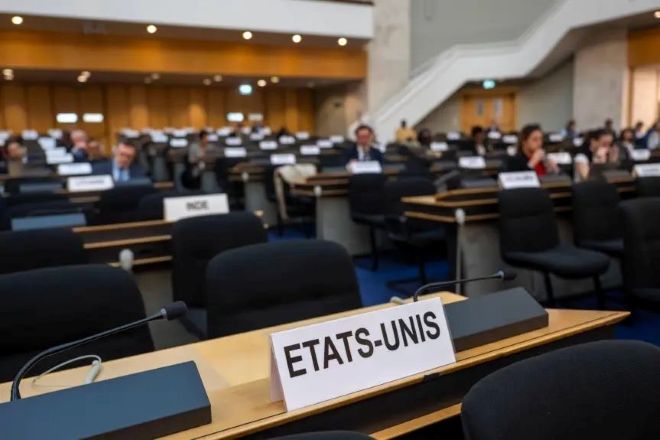
The chair in the United Nations’ Human Rights Council (UNHRC) reserved for the United States sat empty and loud, but we’d come to speak. As a member of a contingent of civil society organizations, I traveled to Geneva, Switzerland last month to participate in the UNHRC’s Universal Periodic Review.
The empty chair symbolized an abdication of leadership in the Trump administration’s refusal to participate in the Universal Periodic Review (UPR). Unsurprisingly, the administration abandoned its obligations to human rights protections domestically and internationally, in yet another sign of a descent into authoritarianism.
Because the U.S. didn’t show up, we showed up instead to forge alliances with international advocates and partners and to assure that the human rights violations occurring throughout the U.S. were well documented and heard.
Today, on International Human Rights Day, I think about how the seeds for my presence at the UNHRC were planted in the 80s as I was growing up in Philadelphia. From my mother I learned the importance of international solidarity in a home that was fiercely against the South African apartheid regime, where a portrait of Nelson Mandela hung on the wall and his plight was discussed at the dinner table. I watched and listened to my parents and other activists who took the anti-Apartheid struggle from the shantytowns of Soweto to international capitals of the world, and was dragged along to demonstrations against the Apartheid regime, as my mother’s generation built alliances and strategies that eventually resulted in the collapse of Apartheid in South Africa.
“Any man or institution that attempts to rob me of my dignity will lose because I will not part with it at any price or under any pressure.” — Nelson Mandela
Those activists knew the history of the United States as an apartheid state itself and that an international approach was critical since the United States was the blueprint for Apartheid South Africa and Nazi Germany. Both regimes had studied our system of Southern segregation and Jim Crow laws.
Today we can recognize that when Trump talks about making America great again, he’s talking about going back to apartheid, which by definition is a policy or system of segregation or discrimination on grounds of race. In the United States we have long had separate forms of justice, education, health care and representation based on the color of your skin. And with this administration, it is magnified to also include discrimination based on gender, all while waging war on the working class. His policies have positioned the United States as an international rogue on the world stage.
Partnering with global advocates and allies to stand with us is critical to beating back the forces attempting to return us to a new version of American Apartheid.
In Geneva, appropriately, the United States was condemned by the Human Rights Council. In a stunning development, China delivered a rebuke of the United States’ domestic human rights violations. China’s rebuke reflects a recognition of the end of U.S. moral leadership.
But, in a time when we see Big Law bending a knee to Trump and as municipalities, corporations, and philanthropy across the country eliminate DEI programs and social justice funds, we showed up and will not be cowed. We will speak up at the highest stages and forums for the marginalized, and suffer whatever repercussions will be because we know that just like the South African Apartheid regime, Trump’s American version is not sustainable.
In Geneva, we showed up to stand up against an administration hellbent on harm. And we didn’t show up alone. Elected politicians from Philadelphia, Los Angeles, Alaska and Chicago showed up on short notice, including Philadelphia’s District Attorney Larry Krasner and Chicago’s Brandon Johnson to stand in the Trump administration’s place.
There, we stood on the shoulders of those who have fought fascist, authoritarian governments before, whether it was fighting apartheid South Africa then or its modern equivalent in the Israeli government. And I brought with me the lessons from my upbringing which shaped my values exemplified in the words of Nelson Mandela “Any man or institution that attempts to rob me of my dignity will lose because I will not part with it at any price or under any pressure.”
Robert Saleem Holbrook, The Citizen’s 2024 A. Leon Higginbotham Social Justice Champion of the year, is the executive director of the Abolitionist Law Center, which is dedicated to abolishing race and class based discrimination and state violence within the United States criminal legal system. He is also a Lecturer of Law at the University of Pennsylvania Carey School of Law.
The Citizen welcomes guest commentary from community members who represent that it is their own work and their own opinion based on true facts that they know firsthand.
 ROBERT SALEEM HOLBROOK IN THE CITIZEN