


Four years ago, the team at Philadelphia’s Center for Black Educator Development (CBED) had an idea: Perhaps the best time to recruit aspiring educators was when these future teachers were still students themselves.
That year, they launched Future Teachers of Excellence Fellowship (FTEF), a program that provides the next generation of teachers with academic, social, and financial support before they even stand before their first room full of students.
There were four people in that pilot cohort. This year? 85.
That growth, and continued interest in the program, tells Center for Black Educator Development (CBED) founder Sharif El-Mekki that his organization is serving a real need.
“Demand has outrun us the whole way: More than 1,000 young people have applied in the last two years,” says El-Mekki, who launched the nonprofit in 2019. “Our goal is 500 fellows by 2030. We are almost halfway there!”
El-Mekki, who was a teacher and principal during his 26 years working in Philadelphia schools, says FTEF is one part of the Black Teacher Pipeline, a national initiative that recruits and trains the next generation of Black educators, giving them opportunities for practical experience and professional development as well as guidance and financial support. The fellowship is administered with the United Negro College Fund.
Other CBED programs feeding that pipeline are the Teaching Academy, which serves high schoolers during the academic year, and the Freedom Schools Literacy Academy, a five-week summer internship for college-aged students. Both initiatives have grown year upon year.
FTEF helps by giving its fellows up to $5,000 a year for college and a $20,000 stipend before the start of their fifth year of teaching. To date, CBED has raised more than $9 million to fund FTEF.
“The case is simple: A new teacher leaves college with debt and a starting salary well below similarly educated peers, and the research on what Black teachers do for students — Black students most of all — is overwhelming,” El-Mekki says. “Few investments for an engaged citizenry … return more.”
Addressing a teacher shortage
Philadelphia, like the rest of the country, has a teacher shortage.
In January 2026, the nonprofit Educators Rising found that more than 400,000 teaching positions nationwide were vacant or filled by an under-qualified candidate. In Philadelphia, one of three teachers in the District’s 50 lowest performing schools is not fully certified, according to a 2025 article in The Philadelphia Inquirer.
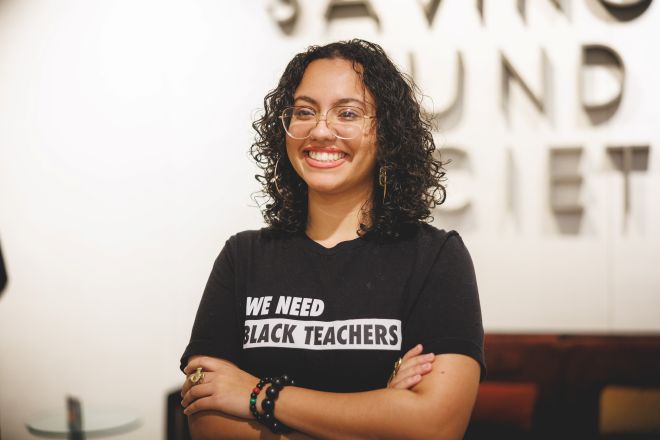
Philadelphia, like the rest of the country, also has problems attracting and retaining teachers of color. A 2024 USA Today article notes that while young people of color account for more than half the nation’s student population, about one-fourth of teachers and principals identified as people of color. Multiple research projects have concluded that all students thrive when taught by a diverse group of teachers. Research has also shown that children of color are the most negatively affected when taught by adults who don’t look like them. A 2016 report from the Yale Child Study Center found Black children in education settings can begin to experience the impacts of racial bias as early as age three.
The Center for Black Educator Development has been sounding the alarm over the lack of representation in education for years. El-Mekki, who originally planned to be a lawyer, is looking for committed young people who, like him, believe “the purest form of activism is teaching Black children well.”
Future Teachers of Excellence participant Regina Banks long thought she’d seek a career in the arts. That changed after she took an African American history class taught by a Black female teacher at the High School for the Creative and Performing Arts.
“She challenged me to think about the world I was living in and what my role in that world was going to be,” says Banks, a recent Howard University graduate now in her third year of teaching African American History at Samuel Fels High School. “Because of her and her class, I thought, This is how I can have impact for the rest of my life.”
Bryce Thompson, part of the first FTEF cohort, met El-Mekki when El-Mekki was the principal at Mastery Charter Schools–Shoemaker Campus and considers El-Mekki a mentor. Like El-Mekki, Thompson would like to be a teacher and an administrator in his hometown of Philadelphia.
“I really appreciate the way he challenges educators to think about education in terms of equity, opportunity, and community. To think about what kind of educational system we’re contributing to and what responsibility we have,” says Thompson, a graduate of Ohio’s College of Wooster now working as an assistant teacher at a Baltimore private school.
El-Mekki and CBED “helped me realize that my voice has volume. My story has weight,” Thompson says. “It’s not extra. It’s essential.”
The country’s current political leaders have repeatedly claimed that diversity and inclusion are negatives to be avoided and have even punished organizations promoting the idea. Meanwhile, enrollment in college- and graduate-level education programs continues to decline.
But CBED is growing steadily. Banks believes that’s because the organization’s commitment to its mission has never wavered.
“People are recognizing the vitality of it … especially in such an anti-DEI time right now, people are looking around and saying, OK. Who’s standing strong?” Banks says. “(CBED) is unapologetically always going to be for Black educators and work towards the success of Black educators and Black children. … That’s what’s propelling their growth.”
El-Mekki notes that the current anti-DEI sentiment comes from people who are ill-informed.
“We stand on evidence that even rational conservatives tend to agree with: Black students with even one Black teacher in elementary school are more likely to graduate and enroll in college,” he says, noting supporting research from Johns Hopkins University and an analysis by a professor from the University of Maryland – College Park.
“We stand on history and we stand on relationships with families, districts, colleges, and funders who see the results,” El-Mekki says.
A well-supported endeavor
One of the CBED’s many strengths is its ability to form partnerships with those who share goals, says Julie Paturzo, Senior Program Officer at Spring Point Partners, a social justice organization that’s supported CBED since 2019. (Spring Point is also a supporter of The Citizen.)
“Outside of the direct work that they’re doing, something that stands out is the collaborative way … they seek to work in a broad coalition with others,” Paturzo says. “They’ve been key advocates of the fact that young students need early exposure to the teaching pipeline. … They’ve really been a leader in that space in particular.”
In addition to Spring Point Partners, CBED works closely with organizations including the Ballmer Group, the William Penn Foundation, Elevate 215’s Citywide Talent Coalition, Teach Plus, the Pennsylvania Educator Diversity Consortium, and the School District of Philadelphia. CBED has also partnered with the Mayor’s Office of Education (MOE) and the Community College of Philadelphia (CCP) to highlight the Octavius Catto Scholarship, which gives qualified students funding for full tuition and course material at CCP, while also providing academic support, internship opportunities and career counseling.
“Catto gets a Philadelphian through two debt-free years at CCP. FTEF picks them up for four-year completion, certification, and the early years of teaching,” El-Mekki says. “It means a young person can go from a Philly high school to a Philly classroom on programs this city already built.”
This partnerships allow for a multi-faceted, long-term approach to education and economic development others would like to follow.
“Philadelphia has just done a very good job of community together as a community and analyzing our problems and developing strategies,” says Sharon Ward, the MOE’s Deputy Chief Education Officer. “I don’t want to be so bold as to say that other people are looking at us, but I think they are.”

Changing how students view teaching
“Once a fellow, always a fellow,” El-Mekki says.
“Our organization is based on an intergenerational approach. Fellows … come back to teach in Freedom Schools Literacy Academy, and mentor the cohorts behind them. While the last dollar scholarships and retention stipends have end dates, the community these Fellows and other alumni have contributed greatly to does not.”
Progress has been steady. The program continues to grow. As it’s still new, however, it’s difficult to measure impact. Most Fellows are still in college or graduate school and have yet to get certified and enter the workforce. The ones who have, however, report not just success in the classroom, but also a level of self-satisfaction and optimism for the future of Black educators.
Makiah Burroughs also knows El-Mekki from her days as a Philadelphia student. She became involved in CBED programs while in high school. A graduate of the University of Virginia, she’s now in her third year of teaching.
“Now I sit in roundtables and in conventions and share my experiences with people who are new to the pipeline or fellow teachers,” says Burroughs, who works in literacy support at Master Charter School Mann Elementary. “These are lifelong bonds, lifelong relationships, a lifelong journey.”
Having gifted young people choose careers in education is good for the profession, too. When Burroughs was in high school, friends weren’t supportive when she said she wanted to be a teacher.
“A lot of people were like, ‘But Makiah, you’re so smart. Be a nurse. Be a lawyer,’” Burroughs recalls. “Now I’m seeing students who are actually enthusiastic about wanting to be a teacher … We need teachers, quality teachers who want to do the work.”
Thompson says he’s sensing a similar vibe in Baltimore. One student confided that he wanted to follow Thompson’s path.
“He thinks it’s pretty cool that I’m the youngest teacher in the school,” Thompson says. “I’m probably 10 years older than him.”
 MORE STORIES ABOUT RECRUITING AND RETAINING BLACK EDUCATORS
