


Yuva Gambhir, a Philly native and senior at the University of Pennsylvania, was diagnosed at age three with Duchenne muscular dystrophy (DMD), the most common and most severe form of muscular dystrophy, a genetic, progressive muscle-wasting condition. This chronic, terminal diagnosis affects just one out of every 3,500 to 5,000 male births worldwide. The disease causes weakness and fatigue, decreased mobility, and as it progresses, cardiac dysfunction and respiratory issues.
So, as one might expect, Gambhir found it difficult to be a “normal” kid growing up in Philly. But he has not let the challenges of DMD hold him back. He found ways to pursue his passions, and help countless others in the process. Through perseverance and an indomitable spirit, he has refused to let the disease define him. In fact, the Gambhir family — Yuva’s mother, Sonal, father, Manu, and younger sister, Jasmine — have been working with the nonprofit CureDuchenne for over a decade on fundraisers and initiatives to increase awareness, provide comfort to families facing the diagnosis of a loved one, and raise funds for research and care access. And with the support of dedicated families and volunteers, Gambhir has raised over $3 million for the cause.
Beyond his advocacy, Gambhir is also a music producer and DJ, a tech startup founder, and a dedicated practitioner of mindful meditation — pursuits that reflect the curiosity, discipline, and joy he brings to everything he does.
For his advocacy, fundraising, mentorship, and more, Gambhir is this year’s Youth Citizen of the Year. He will be honored alongside his fellow Citizens of the Year at a dinner celebration on April 22, at Fitler Club Ballroom. (You can read about all of this year’s winners here, and find out about tickets and sponsorships for the star-studded event here.)
Uncharted territory
Most individuals with DMD become reliant on a wheelchair, and their life expectancy is barely 30 years. At 24, Gambhir would have been in the late stages of the disease, if not claimed by it already, had he been born a decade earlier. But new treatments being funded by exactly the kind of work CureDuchenne supports are dramatically increasing life expectancy.
“Even now, we’re in uncharted territories,” Gambhir says. “There are people who have been injected with new drugs, so that maybe in 10 to 20 years down the line, they could be doing far better than what’s expected. It’s an exciting time.”
Acknowledging that these new breakthroughs can change the course of lives for those born today, but are not available to help him, Gambhir addresses mortality without hesitation — and with more candor and maturity than most people decades older.
“It’s something that motivates me,” he says, “to live my life to its fullest.”
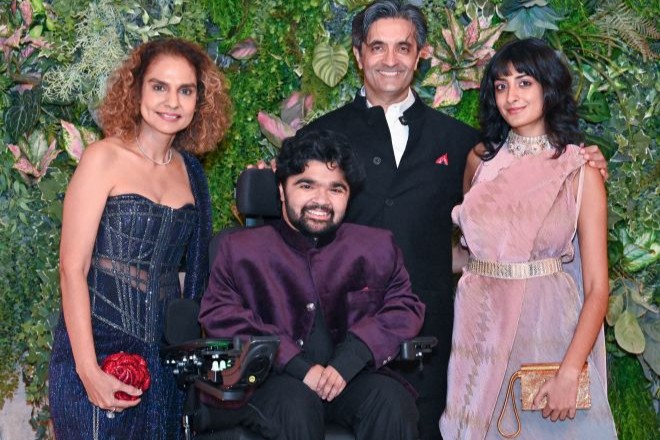
Turning a devastating diagnosis into advocacy
There are 15,000 individuals with DMD in the United States, and they are overwhelmingly male, as the gene whose mutation is responsible for Duchenne is on the X chromosome. Since the gene was identified in 1986, progress has been made with specialized newborn screening, genetic testing during pregnancy, treatments that can mitigate the progression of the disease, and new drug trials. Life expectancy for those with DMD has increased from 20 to nearly 30 years.
It was Gambhir’s love of music that led to his diagnosis. “Music was always a big part of my life,” he says. “I used to love to dance to EDM music. My dad would put it on the radio, and it would be some of that early 2000s music like Moby, Prodigy, and I would just go nuts. And then one day I was dancing, and I tripped and fell.”
That was actually an early sign of DMD, which is usually diagnosed in toddlers. As other kids his age developed better coordination, Gambhir became more unstable and lost energy. “As things progressed, life got difficult,” he says. “I ended up transitioning to a wheelchair. But the dance parties didn’t stop.”
A childhood diagnosis of a chronic and terminal illness can be devastating for families. But the Gambhirs embraced support networks and advocacy early on, encouraging their son to talk to others who shared his diagnosis about his experiences. “There was definitely a time when it kind of felt like a chore,” he says. But challenges have always motivated him, “a natural kind of fuel,” he calls it. Today he is a proud keynote speaker at CureDuchenne events.
“You [may] have a physical condition, but you’re making your life 10 times harder by not optimizing how you think through your challenges and deal with them. I had that ability, and I really wanted to pass it on to others,” he says. Hundreds of people come to conferences and fundraisers to hear him tell his story. He assures patients and their families that they can live well in spite of DMD, and encourages them to take care of their mental health by talking about how he combats isolation and copes with everyday struggles.
Debra Miller and her husband founded the nonprofit CureDuchenne after their son Hawken was diagnosed with DMD. The organization’s model is venture philanthropy, where their fundraising proceeds are invested in companies pursuing treatments for DMD and novel technologies for overcoming physical limitations. It’s an efficient way to speed results. Their community-building efforts provide a support network for families that also educates and advocates for best practices.
“I could just say inspirational, but that’s so overused,” Miller says of Gambhir. “I think he has his eye not [only] on Duchenne, but on his purpose.”
Families who have recently received a diagnosis and meet Gambhir at conferences are reassured by his presence, accomplishments, and positivity. “The main thing that we want for our children, and especially for our guys with Duchenne, where we all have anticipated a shortened life, is that we want them to have a life, while they’re with us,” says Miller. “We want them to have friends and a purpose.”
Miller’s son is a few years older than Gambhir, and they hit it off immediately when they met, long before they were center stage at conferences. The two families have become close through the work they do and the support they give to each other.
“He is such a good spokesperson that people come to the fundraising events because of Yuva,” says Miller. “He is the star of the show, and he is the reason that people are donating money there.”
Living a full, rich life
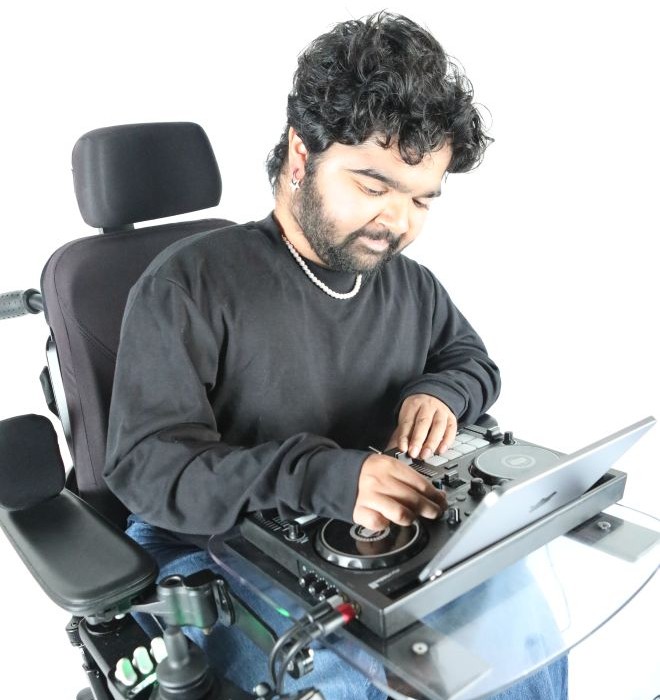
If you’ve never heard the story of Yuva’s Legendary Rager, you must listen to the TED Talk Gambhir gave in October 2024. It’s hard to believe, after hearing this story about the epic teen party he threw, that he considers himself a “shy guy” — especially since his love of EDM inspired an interest in DJing, a talent he shows off at parties and fundraisers.
Gambhir developed his own adaptive DJ setup by repurposing controllers and connecting them to his computer, complete with modulators and synthesizers you’ll find on the most complex decks. “Even now, I have very limited mobility,” he says “But you can see me at the club, moving like this, nodding my head, especially when I’m doing my set. It all kind of ties into my overall view on life, of still being able to party despite the challenges.”
Gambhir’s interest in technology goes back to when he was at Masterman High School and founded the artificial intelligence club. He’s a big proponent of today’s adaptive technologies that make his life easier. At Penn, he’s double majoring in cognitive science and computer science; he’ll graduate in May. In his early days at Penn, he worked in a gene therapy lab, getting hands-on experience in biology. But he was attracted to the funding side of medical research, and worked with two biotech companies on financing emerging therapies and financial projections.
“When curing diseases and researching conditions that we’ve had for millennia, and have never come close to tackling, there’s two different sides,” he says. “There’s cutting-edge research, and then there’s financing for companies who are pouring billions of dollars into cutting-edge research.”
Gambhir is also a startup founder, channeling his computer science skills and interest in AI into an app designed for anyone who has ever wanted to bond over sports but didn’t know how.
“One of the ways I’ve really found to connect with a lot of people is through sports. And especially in Philly, sports is like a unifying blanket that allows you to connect with anyone,” Gambhir says. “There’s so much information that you need to be able to consume and stay on top of to be part of the conversation. And feeling excluded and left out is something I’ve dealt with a lot personally, and I know it’s something no one wants to feel. So why don’t we make that a frictionless experience?”
His app, FanCoach (available now in the Apple App Store, and coming soon to Google Play Store), uses real time data from the NFL to break down every play, with definitions and explanations to help users understand the game. In the future he hopes to add more sports like F1 racing to the app.
He also got into meditation, becoming a certified guided meditation teacher leading sessions for others with DMD. At first skeptical, his practice of meditation and breathwork did in fact have a positive impact on both his mental and physical wellbeing. As he describes in his TEDTalk, it helped him “tap into an inner source of inner energy I didn’t know I had,” and helped him gain greater confidence. He has traveled to India, Germany, and North Carolina to learn new techniques.
While his advocacy is vital for fundraising, his openness to sharing his struggles and achievements gives hope and support to young people with DMD and their families. He lives a full, rich life, something many parents fear their children won’t have once they get that diagnosis. He gives them hope.
After graduation, Gambhir predictably has a full plate. He’s going “all-in” on FanCoach, hoping to grow his team, add more features, and raise capital. He is continuing his advocacy work. And he’ll continue to make music.
Gambhir doesn’t pretend his life is easy. There was a time, before he threw that TED Talk-famous party that the cops were called to, when he was comparing himself to other guys his age reaching milestones and dating and living in ways he felt he couldn’t.
“There’s always someone who is in their own situation and they’re wondering: Wow, I wish I had your life. I wish I had family members that supported me, or I wish I had really good friends and even nurses who are there to take care of me, so that definitely puts things into perspective,” he says “And I think with time, those comparisons go away. When you stop comparing yourself, it’s really freeing.”
 MORE YOUTH ACTIVISM