


A garage-full of flowers, empty vases lining the walls, and a fleeting thought: “What are we going to do with all this?”
But Leona Davis and her husband Tom weren’t about to let a little thing like scale stop operations in their tracks. They’d just secured their first Forget Me Knot order — 25 large hydrangea arrangements straight from a wedding at the Academy of Music — into their home for a repurposing journey that would change their lives.
Built on the premise of sustainability and driven by a desire to put smiles on peoples’ faces, Forget Me Knot repurposes wedding flowers into smaller bouquets for patients in hospice, nursing homes, and similar healthcare settings. What began as an idea in 2016 has truly blossomed into a thriving business, with Davis and her team having delivered flowers to thousands across Philadelphia and parts of New Jersey in the decade since.
“Faces just brighten up,” Davis of Gibbstown, NJ, says. “Now I get, ‘oh, here comes the flower girl, what kind of flowers does she have today?’ It’s so sweet and endearing that they’re just too grateful to see us come in with fresh flowers.”
From the spark of an idea to an active calling
Like all good things, Forget Me Knot began with a simple question: Where are these flowers going to go? Davis’ daughter would be walking down the aisle any day, and that question lingered for her and her family.
“Our daughter was planning her wedding, and we thought, okay, what are we going to do with these flowers at the end of the night, because they’re still going to be good. We’re only going to be using them for a few hours; they’re still going to be perfect,” Davis recalls.
According to the Sustainable Wedding Alliance, flowers make the top 10 of the biggest causes of wedding waste. Couples spend on average $2,700 on flowers for their weddings in the U.S., allotting eight to 10 percent of their total wedding budget to these living decorations.
As Davis alluded, the flowers themselves are used for an average of 12 hours. Most venues will throw them out at the end of the night, adding to the exasperatingly high amount of wedding waste already plaguing landfills. (For some perspective, a single wedding ceremony and reception produces upwards of 400 pounds of garbage. With 2.1 million weddings annually in the U.S., that makes weddings a disproportionate contributor to one-day-event refuse.)
Repurposing her daughter’s wedding flowers meant giving the flowers a second life, while simultaneously keeping them out of the landfill. At her daughter’s suggestion, the Davis family restyled the flowers into small bouquets and delivered them to their local nursing home.
“When we started distributing flowers, [we realized] it was much more than just distributing flowers,” recalls Davis. “The residents’ faces were lighting up and becoming alive. They started conversations with us about their gardens and the flowers they’ve received throughout their life.”
It was in that moment Davis felt a calling.
“I said to my husband, I think we’ve touched upon something that’s really needed and really important,” she says. “There is so much loneliness out there … the residents feel the love and light behind receiving flowers.”
At the heart of it
Like a seed in spring, this seemingly small gesture soon blossomed. Forget Me Knot was born not out of a desire to run a business, but from the call to serve her fellow human beings. Certainly, Davis wasn’t expecting to start an entire enterprise after 27 years of teaching music class to elementary school children — and raising three of her own. But with a combination of word-of-mouth and social media posts, she and her husband began securing couple after couple looking to give their wedding flowers new life.
Today, they continue to hand deliver bouquets and arrangements to dozens of operations, including the Ronald McDonald House, Penn Medicine, Laurel Manor Healthcare + Rehabilitation Center, Camden County Women’s Center, Jefferson Methodist Hospice, and more.
Susan Akinyi-Okumu, DNP MPA BSN RN CXP, AVP, for the Patient Experience Department at Temple University Hospital (TUH), can still remember the first time Davis and her team came to the facility.
A medical student got married and wanted to repurpose their wedding flowers for the patients who helped serve them on their doctor education journey. Davis called with the request. Akinyi-Okum says she “thought that was great. I love flowers; patients love flowers.”
The newlyweds brought the repurposed flowers to the hospital’s patient experience office, where the team joined the couple in hanging them out to patients in multiple units — and thanking them for being part of their journey. Akinyi-Okumo describes the experience as “phenomenal.”
What ensued was a lasting partnership. For the past three years, Davis and Akinyi-Okumu have collaborated to deliver hundreds of flowers, developed a partnership with the SPCA called Puppies and Petals, and created pop-up flower bars — stations of cut flowers and empty vases where staff can stop by to create arrangements for their patients. “It’s therapeutic for the nurses, doctors, patient care assistants — actually all Temple employees who want to participate,” says Akinyi-Okumu, adding “You can see the glee on the staff’s faces.”
In fact, flower therapy has been shown to have a positive effect on mood, creating a higher sense of enjoyment and satisfaction. Burnout in nursing is a serious issue, with almost two-thirds of nurses experiencing the strain, according to American Nurses Association data.
Akinyi-Okumu says she sees the positive impact on the staff and patients each and every time Forget Me Knot stops by: “You can see the glee on the staff’s face. This allows them to come and create a piece to take to their patients.”
Resourcing a repurposing business
Forget Me Knot operates as a nonprofit, requiring a small fee from its wedding clients that goes toward insurance costs, vehicle upkeep, rentals and other necessary transportation and safety items to keep the flowers moving. Davis has remained resourceful in keeping costs at a minimum, stemming back to that first order of hydrangeas, where Davis and her husband spent the entire night rearranging the flowers into smaller ones to distribute.
It proved a rewarding endeavor, especially for someone who had always enjoyed gardening and making homemade arrangements for family and friends. But Davis knew she and her husband could not sustain operations like this on their own, considering the volume of flowers from just one wedding. Another post, another call, and Davis began to build her team of volunteers.
“We could not do this without them,” she says. “We’ve had volunteers who have been with us for several years now, and they’re not people I knew in the past. They’re people who have come to us because they love flowers, they’re master gardeners. Some are here because they want to give back.”
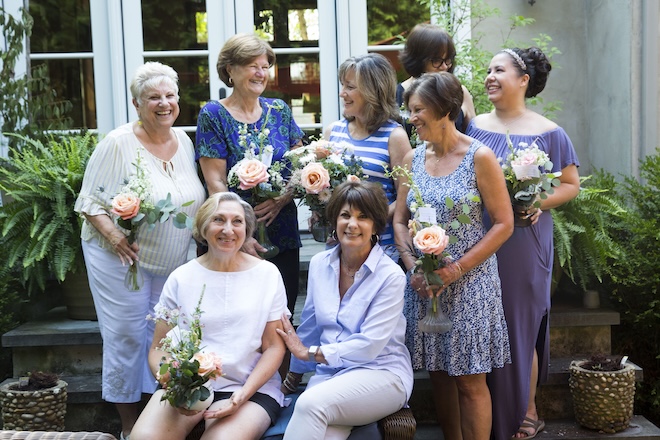
Her core group of volunteers sits at around 12, but Davis still opens her Haddonfield, NJ home to others who are looking to give back. She has relationships with local high school programs, the Girl Scouts, Rutgers University Greek life, local book clubs and more.
“When I put out the call, people just started coming. All these new faces, and they became a part of our family,” Davis says.
It’s a happy reminder that giving back and spreading joy doesn’t necessarily happen in a vacuum. What Davis has learned too is that Forget Me Knot is more than wedding flowers repurposed; it’s become a win-win-win-win, for the married couple, for the recipients, for Davis — and for her volunteers. “A full circle of love,” as she calls it.
“I am a frequent volunteer to those in need, am thrift-driven and have a passion for gardening and beautiful flowers. How delighted was I when I met Leona Davis and the volunteers. Beautiful flowers everywhere! Lovely, giving people to spend a morning [with],” shares volunteer Sharon Patterson, who’s been involved with Forget Me Knot for five years.
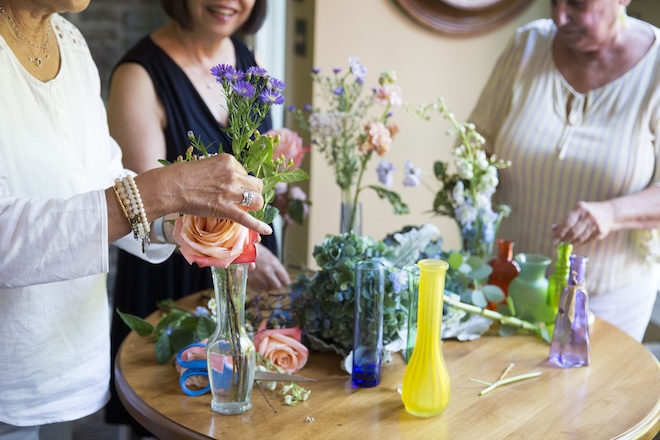
Patterson has returned to Davis’ home time and again, bringing family and friends, building memories, and receiving joy in an intangible but beautiful way: “We repurpose wedding flowers by giving a fresh cut to all blooms and greens, and arrange them in smaller containers. Can you imagine the surprise of such a beautiful gift from a stranger? It’s the best all around. Giving to those who most need a pick-me-up is so rewarding.”
Davis’ calls to action don’t stop with her volunteers; she has also found her wedding clients through these word-of-mouth and social channels, building relationships with local vendors who recommend her to their sustainable-minded and philanthropic couples.
She also sources nearly all her containers through digital communication, with volunteers and their friends donating slightly-loved vases, cups, bottles, cans and anything else that will hold an arrangement.
A meaningful impact
Even when the Covid-19 pandemic barrelled through our doors, she never stopped.
“We purchased the flowers to take to nursing homes, to help those needing an emotional boost feel seen and heard,” she shares of that time in 2020, where large weddings became backyard events, and nursing homes and healthcare facilities faced devastating loss.
The lives she’s touched through this process are innumerable. Humble and sincere, Davis shared the ever-lasting impact on her life as well. One instance stands out above the rest, the time Davis and team brought flowers to a women’s shelter.
“They had never received fresh flowers before, so this was something new coming to them … we presented the flowers to them individually,” Davis shared with tears in her eyes. “It was so beautiful to watch. So many girls said, ‘We’re getting flowers!’ and another one said, ‘They’re real flowers!’
“It’s things like that that I know what we’re doing is important and so very needed in our world today.”
 MORE CITIZENS OF THE WEEK