


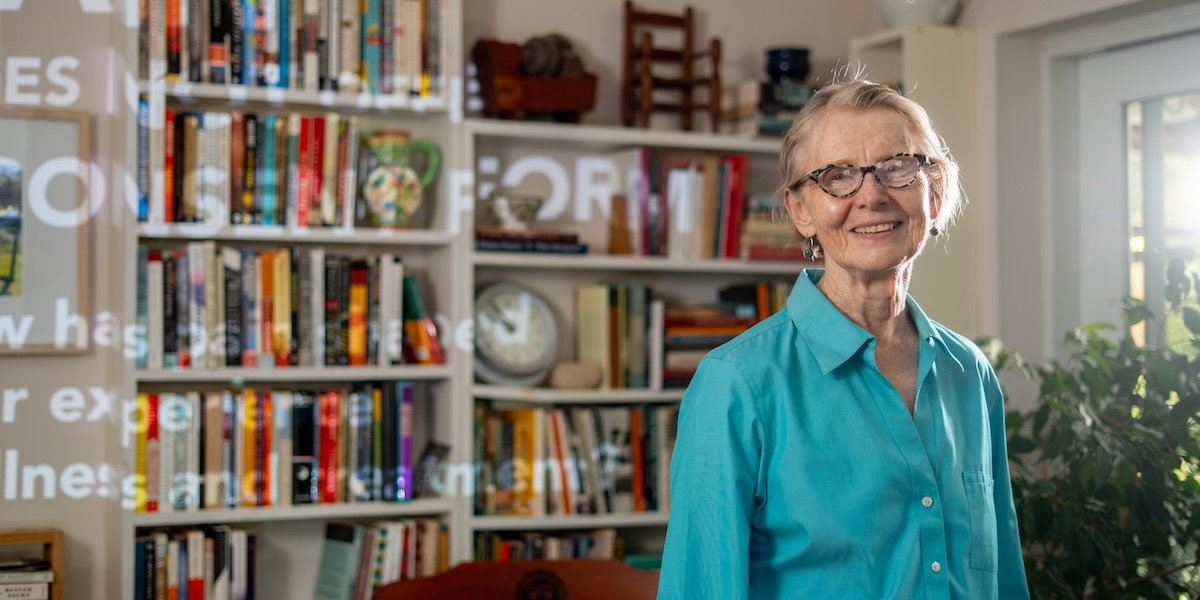


Getting ready for a memorial service, Deborah Burnham, PhD, put on a black dress with a scoop neck. She was surprised to see the lump where her infusion port was — she had never seen it exposed that way before.
Burnham isn’t the sort of person to worry much about what people think, but still, she wondered if she wanted to show it to the world — and if so, how?
In the end, she ruled the dress inappropriately formal and saved herself from making the decision. But later, she opened her laptop and wrote an expansive prompt for Writing a Life, the Abramson Cancer Center workshop she has volunteered to lead for over 10 years.
When cancer and treatment leave their rude and intrusive imprints on our bodies, what do we do? Ports, PICC lines, drains … baldness, prostheses … Do we hide them? Do we let them show, but pretend they aren’t there?
On the other hand, maybe cancer has left your body unmarked on the outside. You might be deeply scarred on the inside — your heart, your gut, your lungs. Or your very sense of self, your very soul.
Then, on a Friday in May, Burnham got on Microsoft Teams and shared what she had crafted with a group of about 10 Penn Medicine patients, inviting them to contemplate the marks of their disease on their bodies and minds.
Emotional stories emerged about what cancer had stolen, and the traces it had left behind. The compression sleeves. The end of long, flowing hair. The feeling of being exposed.
Reading aloud was voluntary — “This isn’t school,” Burnham always says. — but those who chose to read received wise and tender comments.
Writing to heal
Someone who has lived with chronic pain for years once remarked that pain does not offer a consent form. What would it feel like to sign a pain consent form? Would you try to impose limits by saying “up to and including _____ but no more?” Would you think back to the kinds and degrees of pains you’ve had and say “this, but not that?”
Abramson Cancer Center’s Patient and Family Services began offering the Writing a Life program in 2015 to provide a guided writing space for patients with a cancer diagnosis. In the early years, sessions were held in Penn’s Kelly Writers House; now the group meets virtually every three weeks.
“I feel a kind of wordless support from these folks, just being there with them. It’s not something I understood at first, but it definitely makes a difference. These are my people.” — Deborah Burnham
Since almost the beginning, the writing portion of the group has been led by Burnham, a retired associate undergraduate chair of English at Penn. Oncology social workers co-facilitate, providing in-group emotional support to participants and administrative support to the group between sessions. The Cancer Center has offered versions of Writing a Life to patients, caregivers and families, physicians, and medical students, all with a similar structure — and all with Burnham’s original prompts.
Writing a Life is “therapy, stress relief, and a place to air grievances and heal wounds that cancer treatments cannot cure and frequently cause,” said Cathy Kunzinger Urwin, PhD, who joined in 2016, three years after a diagnosis of advanced ovarian cancer.
That is largely due to Burnham, who creates a “precious space for writing, sharing and healing,” through “magical” writing prompts that help surface “what is in you that needs to be said,” said Lisa Wise, M.Ed., who lives with B-cell lymphoma and became a published writer after joining the group.
Connecting the cancer tribe
Did you ever feel that you were not given information that you wanted? Or should have been given, even if you didn’t want it? On the other hand, were there times when you really didn’t want to know?
In 2015, when Burnham volunteered to help lead Writing a Life, she hadn’t yet experienced her own cancer diagnoses and treatments and hadn’t worked with a patient population before. But she had taught literature and writing her whole adult life, to students of all different ages and backgrounds, which had given her a strong sympathetic instinct.
In the early days, Burnham cringes to recall, she invited participants to write about the moon, colors, and generic things like that. She had to build up the courage to have the group write about illness and treatment.
Even then, she could tell how much the group meant to people. There was emotional power in writing, sharing, and listening to each other’s stories in a room where everyone had received that same diagnosis: cancer.
“People needed to be with members of their tribe, even if they had extremely sympathetic doctors and nurses — and many of them did — and even if they had family members who were loving and attentive,” Burnham said. “The opportunity to express themselves on some specific aspect of illness and treatment was good for them, and eventually, they formed some real community.”
The power of a prompt
Write about five things you wish people wouldn’t say about cancer.
How do you feel about plastic hospital wristbands?
What are the spaces in your life — making art, listening to the rain, walking your dog—where cancer can’t enter?
Burnham has written well over 200 original writing prompts during Writing a Life’s 11 years. She jokes she has a “prompt angel” on her shoulder that tells her what to type. It’s a little like that; she is constantly jotting down ideas, whether from literature, news, stand-up comedy routines, comments made in the group — or like that one Friday, her own personal experience. Cancer provides an endless well of material.
The moment of diagnosis, side effects of treatment, and pain are frequent topics—heavy subjects but presented with a note of levity. In one prompt, which she called “So Much Stuff,” she invited the group to write about all the items accumulated during treatment.
“She gives permission to everyone to say what’s on their mind.” — Lisa Wise
Maybe, she said, it all went into the trash. “Or maybe,” she countered, “you were so grateful for your walker that you hung bells on it. Maybe you used old compression socks to tie up your tomatoes.”
That’s Burnham, said Wise, who joined Writing a Life in 2018.
“Deb is a very, very unusual combination. She has this gentle quietness that allows her to be in very, very sad, difficult, dark places with people — we’ve lost a lot of people—but then she’s also got this really funny, irreverent side,” Wise said. “She gives permission to everyone to say what’s on their mind.”
For those too scared to do that, Burnham is there to help. Donna Wadsworth Armstrong remembers attending one of the group’s first meetings when she was recuperating from treatments and complications related to mantle cell lymphoma. She wanted to share the poem she had written about her sister, who had been by her side during her illness, but she was too nervous.
“I told Deb I couldn’t read it, and she said she would read what I wrote,” said Armstrong. “I felt so much love.”
Burnham crafts each prompt to be as inclusive as possible, acknowledging the various ways that a person might connect. She knows the illness experience is unique; for every person screaming “F cancer,” there is one who would rather not say the “C word” out loud or who views their illness as a gift.
“And I always say, ‘If there is something on your mind and heart that you want to write about, ignore the prompt, because I’m not checking,’” she said.
But they rarely do.
Joining the tribe
Write about simple days, days when you feel that you have all you want to have. If those days are in the past, or if you never experienced that sort of day, you could write about one vibrant moment — with joy, regret, anger, or all of the above.
In 2021, Burnham got her own cancer diagnosis: chronic lymphocytic leukemia. Burnham didn’t tell the group, because that was a “nothing burger,” but “when lymphoma joined the party,” she sent a quick email saying she had joined their tribe.
She’s currently on maintenance medication and downplays her illness, saying that — with the exception of when she landed in the intensive care unit with sepsis — it is “zip, zero, zilch” compared to “absolutely appalling experiences” group members have shared.
“I might have felt a little bit sick. I might have felt I was tired or whatever,” she said. “Sure, I lost my hair; big deal — it comes back.”
Even so, the group has been a source of silent comfort.
“I feel a kind of wordless support from these folks, just being there with them. It’s not something I understood at first, but it definitely makes a difference,” Burnham said. “These are my people.”
Burnham has missed the group twice — once when her mother was dying, and the other time when she herself was gravely ill (and even then, she managed to send the group a prompt and “they went on with it, so I’m not indispensable.”)
The sessions get emotional. After a particularly tough one, Burnham finds it helpful to talk with the social workers or do something physical, like work in her garden or cook a meal. No matter what, she leaves each meeting thinking, “Thank you.”
“I just feel so privileged and so honored to listen to these people,” Burnham said. “It’s enormously important to me. I love them.”
This article first ran on Penn Medicine’s website.
 MORE AMAZING PHILADELPHIA CITIZENS