

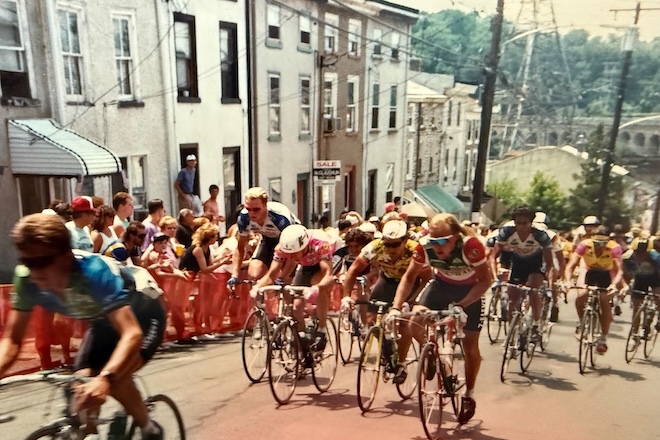
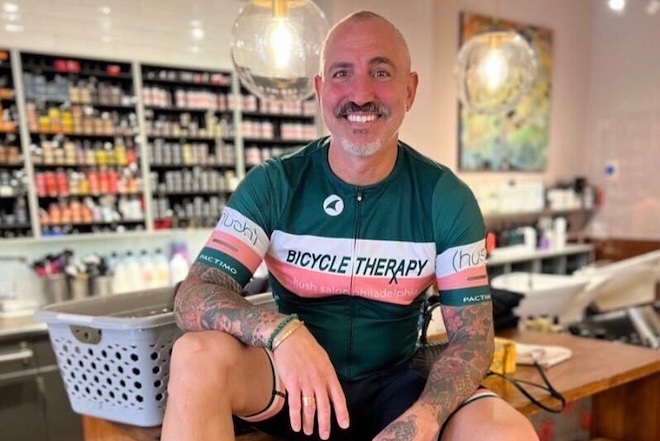
Early one afternoon at Hush Salon Philadelphia in Old City, Carlos Rogers is mentally at the starting line. Not a proverbial, get-through-the-work-day kind of starting line, but an actual one. Spectators are lined up along the Benjamin Franklin Parkway in summer, watching the sinewy bodies, shaved legs, and nylon uniforms of professional cyclists erupt in a thunderous whoosh.
It’s a scene that Rogers recalls fondly from years of attending the Philadelphia Cycling Classic, a premiere race for international cyclists, which hasn’t run since 2016. “I’m not trying to build a bike race. I’m trying to resurrect what was,” Rogers says, chatting in between haircuts at the salon he owns with his wife.
For 31 years, the Philly Cycling Classic was one of the city’s marquee outdoor sporting events. The internationally-renowned course attracted top teams and riders like Lance Armstrong and Greg LeMond. Its iconic feature was the Manayunk Wall, a grueling half-mile stretch where cyclists faced a 17-percent incline.
In the 2010s, the race faded into obscurity like many other prestigious events held in the U.S. Pro cycling’s already-tenuous popularity in the country cratered once Armstrong admitted to doping in 2013. (He was stripped of seven Tour de France titles and banned for life.) American sponsors quickly pulled out of the sport, eventually leading to the demise of races like the Tour of California and the Philly Cycling Classic in the proceeding years.
Rogers witnessed this slump as an amateur competitor within the sport. While he understood that the economics of a pro cycling race were becoming increasingly difficult, he also felt like there was some untapped good will and nostalgia in the area’s cycling community. Since 2011, Rogers has organized the annual Historic Riverton Criterium, a sanctioned bike race in New Jersey, where he lives, which has served as a reminder of the passion and community surrounding sport. There have been other reminders, too.
With each passing year, Rogers saw people reminiscing on Facebook about the Philly Cycling Classic. And then, one day in 2022, he looked in the mirror and seriously asked himself the question he’d been wondering for a long time: “How can you rebuild the race in a way that is fundamentally strong, even with a business model that makes no sense?” he says, referring to the fact that the event has no ticket sales or television revenue.
Well, Rogers cracked the code. This August 30, following a decade-long hiatus, the Philly Cycling Classic will return — Manayunk Wall and all — thanks to the multi-year quest of Rogers, who never left his day job. The salon, in fact, played an integral role in bringing the race back. Unable to get any traction with sponsors in the first couple of years, he was encouraged by a colleague at the salon to share his vision with one of Hush Salon’s clients, Eric M. Robbins, an entrepreneur with deep ties in the city.
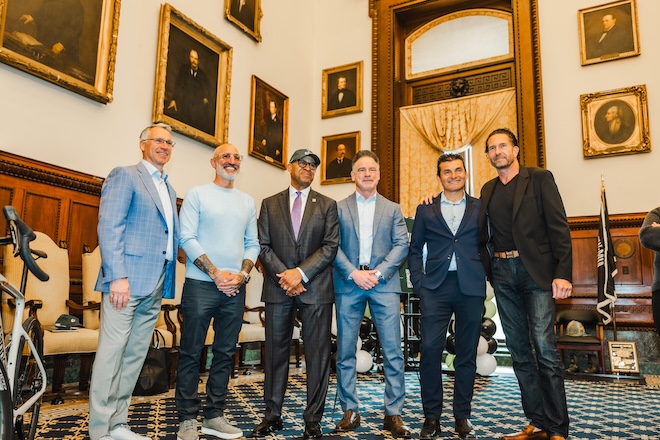
Eric Robbins. Photo by Ron Short.
Call it a comeback
“Nobody loves a comeback story like Philadelphia,” says Robbins, sitting next to Rogers on a couch at the salon. “I immediately said, ‘We have to do this.’”
Though he didn’t know much about the business of cycling, Robbins had a strong relationship with someone who did: Former Mayor Michael Nutter, who had been involved with the Philly Cycling Classic for decades, first as the city councilmember whose district included Manayunk and then as mayor. One thing led to another, and the trio of men teamed up to form Race Street Partners, the entity putting on the 2026 race. They eventually secured a title sponsor, AmeriGas, which is headquartered in King of Prussia, along with support from civic leaders including Mayor Cherelle Parker. Plus, they pulled it off without accepting any public money.
“This is the people’s race,” says Robbins of the event, which is returning just in time for the country’s Semiquincentennial. Amidst a sea of sporting events this upcoming summer, like the World Cup, Robbins is quick to note that the Philly Cycling Classic is “the only one that’s free, and the only one that’ll be back again in ’27.”
The uniqueness of this sport is that it brings the stadium to the streets.” — Carlos Rogers
More than anyone, the event’s return is owed to Rogers, a big-hearted citizen who’s not taking a dime from the event. “When I was going through the peaks and valleys of this journey, I was sometimes ready to throw in the towel,” he says. “But if I stopped, it would all be over.” He spoke to The Citizen about the comeback story of the event. This interview has been condensed and edited for clarity.
Malcolm Burnley: So, how the hell did you pull this thing off?
Carlos Rogers: I felt some kind of calling, because nobody was telling me to keep going. I had some [early] conversations with executives that were movers and shakers in the city. They both declined. And I thought, what am I doing? I would have imposter syndrome, because nobody knows me. After putting in so much effort, so much time meeting with people, I had nothing to show for it. That’s when my co-worker suggested that I reach out to Eric [Robbins], who is a client of ours. He’s really good friends with [former Mayor] Michael Nutter. It was a big moment when I pitched him and he said, “I love this bike race. I love this city. And I believe in you.”
Prior to that, how did you originally get the seed of the idea?
I watched the Maryland Cycling Classic in 2022. After years of races being cancelled in the U.S., it was the first [Union Cycliste Internationale] UCI-sanctioned race that we had in this country. [UCI is the top international tour.] I began to feel jealous. So I reached out to Robin Morton, a pioneer and race director who lives in Central New Jersey. [Morton was previously the race director for the Classic.] We got on the phone and we started with nothing but a concept, which was to pound the pavement. And I started with contacts that clients would feed me, making phone calls in between haircuts.
It sounds like you didn’t expect to spend more than three years on this.
No, I thought that it would be easier to entice some executives or businesses to be sponsors. That was based on the 31 years of history with the race and how exciting it was for the city when it was here. That was part of my own naivete, because I have no body of work behind me to prove that I can do this, besides the smaller race that I do in Riverton, New Jersey. With the help of a graphic designer down the street and a printer that I use, I just started pulling stuff from online and created a deck, so it was a little more professional. I sent hard copies via FedEx to various executives, knowing that it probably wouldn’t get to their table.
What was the secret to securing AmeriGas as your lead sponsor?
The trick was to focus on relationships, at least for us. Eric sent an email introducing Mayor Nutter to Bob Flexon, the CEO of [AmeriGas parent company] UGI, who is a cyclist. What I didn’t know is that UGI — which is headquartered in King of Prussia — started here in the late 1800s. There was great alignment, so it was off to the races.
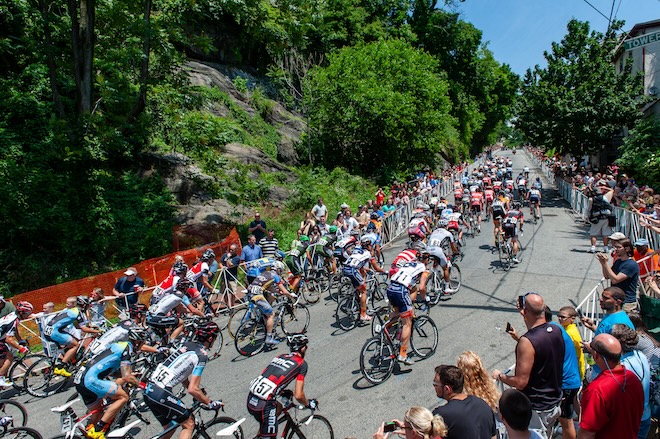
I’ve never been to a cycling race. What am I missing?
Cycling creates a web of connectivity, whether it’s people seeing each other at events or communicating at the local bike shop or sharing a passion for racing. And you know, the uniqueness of this sport is that it brings the stadium to the streets. Now, you’ll have a couple of generations who will be able to come together and share that in Philly.
For those who’ve been to past races, what will be different this time around?
During the last four years of the race [2013-2016], they cut out the [Benjamin Franklin] Parkway, and so the race finished at the top of the wall in Manayunk. And as a spectator, when I watched the race during those iterations, it had less of a grandiose feeling. My goal was always ‘go big or go home. If I can’t do it with the Parkway, then we’re not gonna do it.’ So in ’26, we’ll be once again ending the race along the Parkway.
Also, we’re trying to create a whole weekend of events. We’re doing a fan festival which will take over part of the Art Museum area with vendors and food and family-friendly fun. The morning of the race, we’ll also be hosting a charity ride to benefit the American Association of Cancer Research.
After all this time, how sweet will that moment be at the starting line in August?
When I was having to motivate myself on this journey, I was motivated by the imagery of the starting line on race day: the motorcade of police motorcycles, the rumble of the cyclists, the helicopter overhead. And I kept that in my back pocket, because to me, that’s the finish line. It’s the start line for the riders, but it’s the finish line for me.
 MORE CITIZENS OF THE WEEK