




When Donna Bullock first became president and CEO of Project HOME, her walk to the bus stop every morning took her past a man and his dog sitting on a neighbor’s stoop.
“One morning, [another neighbor] stopped me and said, Don’t you have that new job at Project HOME? This gentleman is actually homeless, and he’s been living on this porch step,” she recalls.
Listen to the audio edition here:
Bullock struck up a conversation with the man. She told him about her job and asked if a member of her outreach team could contact him. At first, he sent them away, but when Bullock agreed to wait with him, he opened up, and shared that he was worried about finding a place to stay that would take both him and his dog.
Project HOME had encountered this situation before, was was able to help him find stable, dog-friendly housing. It was just one less person living on the street, but also an example of how our city has been relatively successful in resolving homelessness.
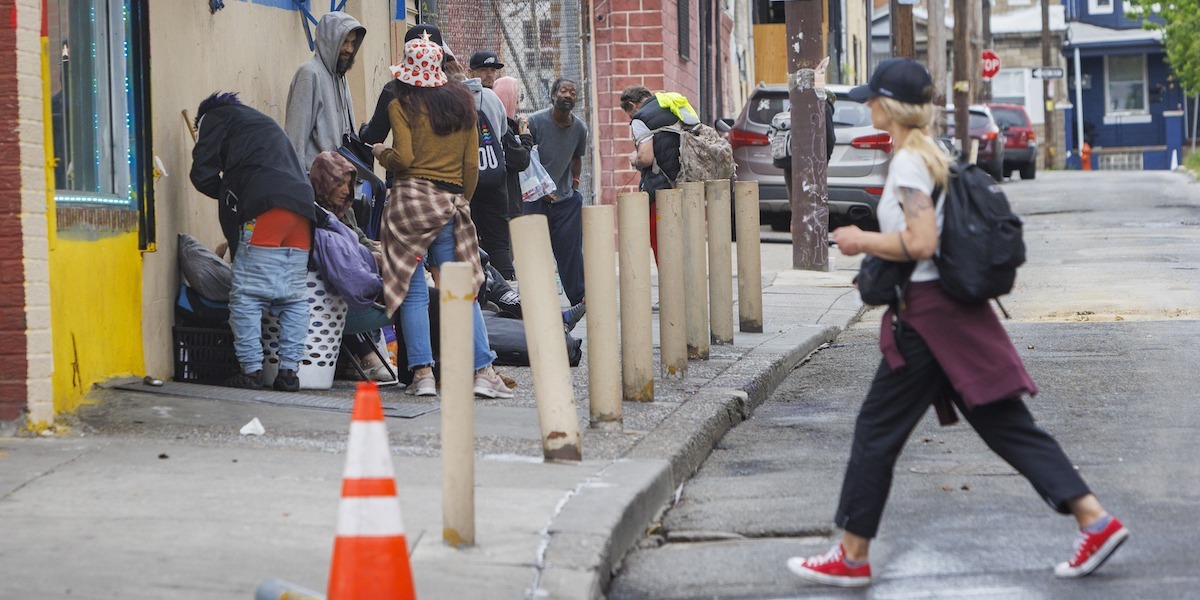
This man’s experience represents the most visible kind of homelessness: unsheltered or street homelessness. There are plenty of other ways to be homeless. There’s sheltered homelessness — staying in a temporary shelter; staying with friends or family or couch surfing while seeking housing, living in a vehicle, lodging in a motel. And then, there are the people who have housing, but are only a paycheck or extra expense away from losing it.
None of these problems is easy to solve. But, Philadelphia might have an edge on other big cities on actually doing that, which begs the question: Could Philly be the first major U.S. city to effectively end homelessness?
Homelessness in Philadelphia today
The number of people experiencing homelessness in Philly has decreased since 2016. Despite having the highest rate of extreme poverty of the 10 largest U.S. cities, Philly has the lowest rate of street homelessness. There were 976 people living on the streets, and 4,215 more staying in shelters (a total of 5,191 people), during the 2024 Point-in-Time (PIT) count, the most recent year for which this data is available. In 2016, the PIT count was close to 5,700.
Although our numbers are still down from a decade ago, over the past three years, they’re slowly creeping back up. The reasons for these increases are myriad, but many point to the opioid epidemic in Kensington, where 35 percent of Philly’s unsheltered homeless population lives.
Moving from streets to shelters
When cities try to end homelessness, most are working toward a goal of “functionally zero” or “effectively ending homelessness.” These terms don’t mean that no one ever becomes homeless; rather, they mean a city has the systems in place to ensure that homelessness is brief, rare and nonrecurring.
Compared to the costs of letting people live on the street, the costs of ending unsheltered homelessness are low. Permanent supportive housing for one person over one year costs approximately $12,800. The costs associated with one homeless individual living on the street, according to the National Alliance to End Homelessness, is $35,578 annually in police and emergency services, healthcare and other costs.
“Every Philadelphian has a role in connecting with people who may be unsheltered in our city. We have to find a way to stop the funnel from pouring more folks into the homeless system.” — Donna Bullock, Project HOME
For most cities, ending homelessness starts by getting people off the streets and into shelters. That approach, known as a housing first model, has been proven to work across the country, including in Philly. Since the mid-1980s, Project HOME, with funding from the City’s Department of Behavioral Health, has managed the Outreach Coordination Center, which includes a hotline anyone can call to have an outreach worker connect with someone living on the street to offer shelter and address other immediate needs.
Neighborhoods like Center City, which have large numbers of unsheltered people, have additional support. There, outreach teams made up of Project HOME team members, Center City District team members and crisis intervention-trained police make rounds to offer people assistance. Between 2018 and 2022, the City reports that these efforts decreased the number of unsheltered people by 27 percent citywide.
“It’s critical to meet people where they are and find ways to bring them into shelters,” Bullock says.
Once people are sheltered, they move into supportive transitional housing, where there are resources to help them find jobs or treat health conditions, before they can move into houses or apartments of their own. Last year, Project HOME housed 341 new residents in its facilities; 386 adults participated in education courses; and 333 received treatment for opioid use disorder.
Some people experiencing homelessness, like the elderly, people with some forms of disability or other complex needs, require permanent supportive housing, which is both affordable and has care resources. Ninety-eight percent of residents in Project HOME’s permanent housing remained stably housed for one year or longer. These steps help make sure that homelessness is nonrecurring.
Two keys to solving homelessness
Local experts contend there are two main improvements, other than adding facilities, expanding outreach — generally, doing more of what we’re already doing — we need to end homelessness in Philly:
-
Set a goal.
Municipalities that have successfully ended homelessness often begin with setting, and publicizing, a goal. A public push can help increase coordination between the public, private and nonprofit sectors and between city, state and federal governments. It can also increase accountability. If the Mayor were to publicly promise to end homelessness by a given year, folks will pay attention to see if she did it.
We’ve already seen how this can work. In 2014, Mayor Michael Nutter took on a challenge from then-President Barack Obama to end veteran homelessness. Under Nutter’s leadership, the City publicly accepted the challenge, then leveraged a Veterans Coalition of nonprofits that already offered services to veterans experiencing homelessness, created by Project HOME in 2011.Working together, and keeping their eyes on the prize, by the end of 2015, Philly had all but eliminated homelessness among veterans.
Making it a priority helped organizations that were already helping veterans form partnerships, rather than working in silos. They used a flexible, housing first approach, addressing challenges like addiction and mental health issues alongside homelessness amongst veterans, so that they could meet people’s needs and set them up to succeed.
Dianne Johnson, chief program officer at Broad Street Love, which provides a number of services to people in need, believes any administration — municipal, state or federal — that openly prioritizes the issues of poverty and homelessness has taken a crucial first step in the right direction. “It has to be seen as a priority and it has to be supported on every level of government,” she says.
-
Improve data collection
Then, there’s the problem of data. Once you have a goal, you need to be able to effectively track progress. The PIT is where most cities begin, but it’s imperfect. For one thing, it takes place in January, when fewer unsheltered people tend to be outside.
Cities such as Bakersfield, California, and Bergen County, New Jersey have implemented better, real-time data systems for identifying and helping homeless people. The nonprofit Community Solutions runs Built for Zero, a national campaign that helps cities implement data systems to achieve their goals to end homelessness. These systems identify people who are experiencing chronic homelessness and those at-risk of becoming homeless and help them connect with the resources they need to get back on their feet. So far, five participating communities have ended chronic homelessness, including Lancaster city and county in PA.
We have one of these systems — the Homeless Management Information System (HMIS) — but not all service providers in the city have access to it, says Johnson. So, when homeless people try to seek support from different providers, they’re often having to repeat basic information, like their date of birth, which can be exhausting and cause people to give up on seeking help. If more providers have access, it would make it easier for those experiencing homelessness to get the support they need.
The number of people experiencing homelessness in Philly has decreased since 2016. Despite having the highest rate of extreme poverty of the 10 largest U.S. cities, Philly has the lowest rate of street homelessness.
Then, there’s the problem of Kensington.
Philly already has a lot of the support systems it needs to effectively end homelessness, but the opioid crisis in Kensington remains a major challenge. People who are homeless and struggling with addiction need more wraparound support services to get healthy, find stable employment and secure housing. Between 2023 and 2024, the neighborhood saw a 23 percent increase in the number of people experiencing unsheltered homelessness. We need more supportive housing for people who are struggling with addiction so that they can get help.
Here, the City and Project HOME have already gotten to work. Project HOME recently partnered with all three hospital systems to better assist homeless people with opioid use disorder. The City is currently turning a formerly vacant property in Holmesburg into the Riverview Wellness Village, a municipally run, 336-bed recovery center, offering a temporary place to stay, addiction treatment and job support.
Preventing homelessness
Homelessness, says Dr. Vincent Reina, the founder and faculty director of the Housing Initiative at the University of Pennsylvania, is fundamentally a housing issue. Even if everyone living on the street went into transitional supportive housing, not having enough affordable housing units would put them at risk for becoming homeless again. Right now, Philadelphia is undergoing an affordable housing crisis. According to his research, Philadelphia is short 64,549 units for our lowest income residents — those making less than 30 percent of the area median income (AMI) which is just over $34,000 per year for a family of four.
“Traditionally, there’s been a stock of affordable housing that essentially becomes a place to help folks avoid homelessness,” Reina says.
Mayor Cherelle Parker has touted her revised-this-year housing plan, which currently proposes creating or preserving 30,000 units of affordable housing — as one of her signature policy goals. But it doesn’t really come close to addressing this issue.
For starters, her plan is focused on units that are affordable for Philadelphians earning less than $100,000 a year, not those who need it most. The plan provides for just 1,800 new rental units, another 7,200 to “preserve,” and no new homes for purchase earmarked for the city’s lowest income households.
Doubtless, housing is an ecosystem. The more housing available at all levels, the more affordable housing can become. But given that most of the units the city needs are for families earning just over $34,000 per year, shouldn’t we be focusing on creating units that are even more affordable?
A separate plan from the Philadelphia Housing Authority seeks to build or preserve 20,000 units for the city’s lowest income residents, about half of which will count under Parker’s plan. Given that both plans seek to “build or preserve” we might not even be building that many new units to close the gap. Some of PHA’s preservation work will involve redeveloping properties to make them more dense, but others just involved repairing existing homes.
Can we end homelessness?
Bullock would like to see some support from the state government for affordable housing in the form of an increase in home ownership programs, low-income housing tax credits and supportive housing services. Some states — North Carolina, Arizona, New York, Washington — have Medicaid waivers that cover supportive housing services. PA could try that as well.
Such supportive programs “can make a big difference in supporting people who are experiencing homelessness and other medical challenges, like those very vulnerable populations that we’re seeing in Kensington,” Bullock says.
Federal cuts to SNAP, Medicaid and other programs in Trump’s H.R.1 could very well make this the work of helping homeless people and preventing homelessness more difficult and imperil Philly’s affordable housing plans. “Reducing the amount of money people receive, or finding certain people ineligible for the service, is going to result in our organizations getting an influx of individuals needing our services,” Johnson says.
“Every Philadelphian has a role in connecting with people who may be unsheltered in our city,” Bullock says. “We have to find a way to stop the funnel from pouring more folks into the homeless system.”
 MORE ON HOUSING THE HOMELESS IN PHILLY