


Lilly Chen vividly remembers the disconnect she felt on January 6, 2021, when on one of her computer monitors she watched a mob of thousands attack the U.S. Capital…
… and on the other, she watched Mark Zuckerberg talk about the Metaverse.
Chen was a machine learning engineer at Facebook and the company was having an all hands meeting that day. The chat was blowing up with questions about the attack and what Facebook would do. Social media companies faced pressure to delete false and misleading content from politicians, including President Trump, throughout the pandemic and the 2020 election. As she watched on January 6, Chen remembers messaging people, “holy crap. Has anybody seen this?”
In the ensuing weeks and months, details about how groups like Stop the Steal used social media platforms, including Facebook, to organize the protest and attack emerged. Facebook had shut down the original Stop the Steal Group, but soon it was a game of whack-a-mole. When they shut down one group, another popped up. Plus, the company disbanded the Civic Integrity team, the group that helped shut down violence and misinformation ahead of the 2020 election, basically as soon as that election was over. Employees, including Chen, felt like Facebook wasn’t doing enough to stop political violence.
She also felt like Facebook was clashing with her own values — nonviolence, caring for others, wanting to make the world a better place — but that seemed like it would be a problem at any big tech company. She was also young: Facebook was one of her first jobs out of college. She was using her income to support not just herself, but her parents and sister as well. “I was really struggling to figure out, what do I do now?” she says. “I did not think I could work there any longer. … Nothing made sense to me anymore.”
So she set out to found a different kind of tech company. One that aligned with her values. She left Facebook in 2021 and started work on what would become FSH Technologies, a software firm that leverages AI to help local governments better serve their constituents. For her work, Chen was a nominee for the 2025 Innovator of the Year Award.
The Philly-based firm went through a few different iterations, but today it has upgraded the cafeteria software for Pittsburgh schools and built a recruiting and hiring platform for the City of Sommerville, Massachusetts, that slashed the time it took to onboard new employees by 60 percent, amongst other projects for more than 300 municipalities, benefiting 10 million citizens.
Last fall, it landed a contract with the City of Philadelphia to build the tech behind the Philadelphia Free Business Tax Preparation program, which matches business owners with tax professionals who will prep their returns, all with the City footing the bill.
An accidental startup founder
Chen took a circuitous path toward becoming a startup founder. She wasn’t teaching herself to code from her high school bedroom or “tinkering with computer parts” in her garage like Bill Gates, she says. Instead, she dropped out of high school at 16, moved to China with her family and lived as a Buddhist monk for a few years, before returning to the U.S. and studying math and economics at Colorado College.
Sure, she’d worked at Facebook, notorious for its “move fast, break things” startup ethos, but it’s “a pretty big gap between working at a big tech company and starting your own tech company,” she says. When she was toying with the idea of quitting, she decided to work on a side project with some friends. The goal was to build something quickly — in 48 hours or so. They made a customer relationship management platform for influencers, helping them track and retain subscribers and within a weekend she and FSH co-founder Johnson Lin had each made $89,000.
“Everyone we work with cares so, so much about making the world a better place, about our cities, our communities.” — Lilly Chen
That product is obviously very different from what they are working on today, but it taught them they could build their own company. They started thinking about what it would look like to build a tech company that aligned with their values. Today, FSH builds government services platforms, education management systems and software tools for nonprofits and impact organizations. The name is a nod to Chen’s time as a monk, referencing the Buddhist saying, “be the pond, not the fish,” which encourages people to look at the full picture, not individual problems or emotions.
“It was the first time that I realized that maybe if I can’t find a place to work that aligns with my values and does things that I care about, I could make a place that aligns with my values and what I care about,” Chen says. “Everyone we work with cares so, so much about making the world a better place, about our cities, our communities.”
“Slow change is smooth change.”
FSH bids on contracts for a range of municipal technology projects. That could mean building a learning management system for trade workers, like electricians and engineers, that helps them keep up-to-date with continuing safety education certifications and OSHA standards from their phones, as they did in Austin and Denver. Or a platform that manages the logistics of the 22,000 meals served daily across 54 Pittsburgh schools.
The goal of each product is to build something that suits a municipality’s unique needs, is easy to use and can be implemented without disrupting existing services — while making use of the latest technologies. Chen isn’t trying to “move fast, break things.” In a City, if you break something it has real impacts for people’s lives. “Remember when we didn’t get our trash picked up?” she quips. Her goal is to build tools that are transformative — without being disruptive.
“Technology has changed, and people’s expectations and behaviors have changed,” Chen says. “We like to say slow is smooth, and smooth is fast. And that’s how change works.”
Just because their process is mindful, doesn’t mean it isn’t speedy, however. Chen says clients will often tell her and her team, “I didn’t expect to get this out within the year, much less within a month or a couple weeks.”
She also wants to help taxpayers get the most value for their dollars. Chen has witnessed how inefficient the request for proposals process can be — and how tech innovators often shirk it altogether, preferring to sell to private companies or individuals instead. FSH is an affordable company that is willing to work with cities and their systems. Contract sizes vary based on what work a municipality needs from FSH, but they average $50,000. Chen says the business is profitable, but declined to share revenue figures. They have four, full time employees in their Chinatown office.
“This RFP process creates a really terrible strain on the vendors, and so what you really get is not the vendor that provides the best service. You get the vendor that is best at filling out RFPs,” Chen says. “When you get a newish company that’s been around for a couple years, they would just rather sell to private individuals through a subscription base, then go through the RFP process.”
Free tax help for Philly business
FSH’s partnership with the City on the Philadelphia Free Business Tax Preparation program began in November 2025. The idea was that the Commerce Department wanted to scale a free tax prep pilot program that had served about 130 businesses over four years into one capable of serving hundreds if not thousands of businesses within a single year.
The reason? For the first time in many years, businesses would be heading into tax season without the Business Income and Receipts Tax (BIRT) exemption, which allowed a company’s first $100,000 in earnings to not be taxed. One citizen’s back-of-the-napkin math estimates a business making $95,000 will owe $4,600 in new taxes this year — all while navigating a complex new form. This program will hopefully reduce some of that sting. The City has allocated $7.5 million for the program this year and they plan to continue it for the next five years.
“Everyone’s going to get stuck with an unexpected bill. I don’t think the word has gotten out to all those little businesses yet,” says Erika Tapp Duran, director of Temple’s Small Business Development Center, one of the organizations selected to prepare business taxes through the program. “This program is going to make sure that these small business owners get in the hands of a high quality provider. It can be a little bit of work to deal with your taxes, but it’s going to set them up for longer term success.”
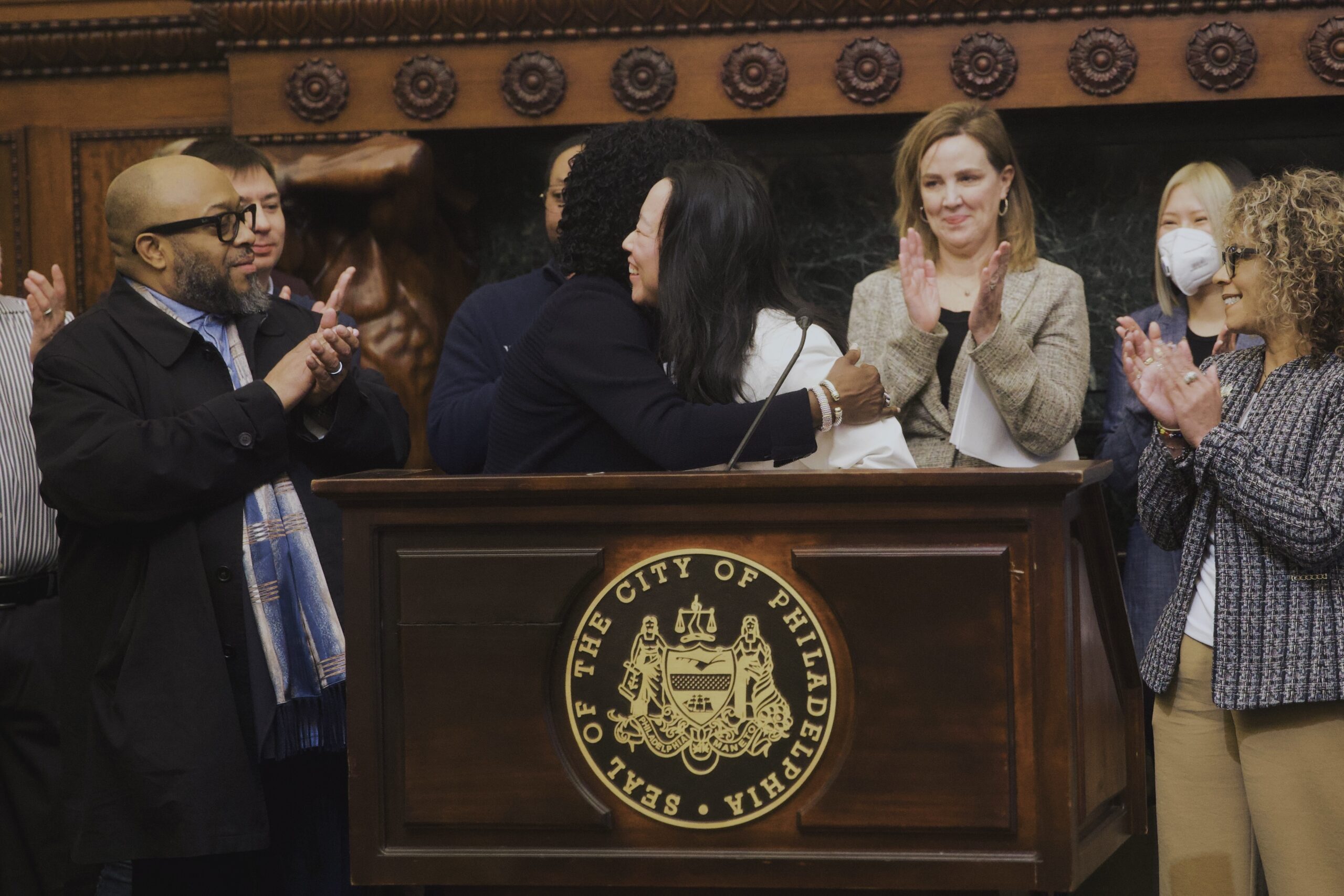
Scaling a program that served 130 businesses over four years to one ready to help hundreds, if not thousands, in a single year meant the City needed new tech. Chen and her team got to work, building a platform ready to serve thousands of business owners in 13 different languages in about two months. Chen— who served on a steering committee as a technical advisory for Mayor Parker in 2024 — appeared with Parker to officially launch the program on January 15.
“For any human being, taxes create anxiety,” Kelly Fleming says. “It is really a nice thing for business owners to know that there’s a possibility of getting that assistance for free and being matched without having to shop around and do and figure out who’s going to help you.”
A look at the tech
The application, built by Chen’s team, is simple and is designed to be completed within less than 20 minutes. To apply, businesses need to make less than $250,000 per year in revenue and be based in Philadelphia. Landlords and property management companies aren’t allowed to apply, but any other kind of business can benefit. It’s mobile friendly, so a business owner can apply on their phones over their lunch break, if needed.
Companies can track their progress from when the application is submitted through when they are matched and tax preparation begins.
“We’ve been hearing from businesses who have been using [the FSH tool], and it’s so simple.” — Karen Fegely, acting director of the Department of Commerce.
On the tax preparer’s side, they can keep track of the different businesses they’ve been matched with. The City can track everything through the platform, so that they can pay invoices to tax professionals and make sure things are running smoothly.
“It really has changed the way that we’re going to manage our programs,” Kelly Fleming says. “We say it takes 20 minutes, but the average time I’ve heard and seen people do it is like five minutes. It’s very quick. It’s very simple.”
Interest has been strong. More than 625 businesses have applied and 490 are already working with tax professionals. The Commerce Department is continuing to get the word out, working with neighborhood and business development organizations. They plan to host virtual events, as well, in the lead up to tax season.
“We’ve been hearing from businesses who have been using it, and it’s so simple,” says Karen Fegely, acting director of the Department of Commerce. “This is simple. It’s straightforward. It’s very transparent. You can see what you get. You’re going to get matched up with somebody. It’s a private transaction. We’re just footing the bill for you.”
Chen is excited to see the program help small businesses. After the tax prep program ends, businesses will remain in the Commerce Department’s system, which can help connect them to other resources, like the Catalyst Grant program.
“We want the cost of running the service to be as small as possible, so that the most amount of [City] money goes back to real people,” Chen says. “We strive to reduce the amount of time that you have to wait on hold, print out a physical piece of paper, and take it to City Hall. We aim to reduce the number of headaches that you have to that you go through. … All those little frictions that we have just accepted as part of our life with our local government FSH aims to fix.”
 MORE BUSINESS FOR GOOD