



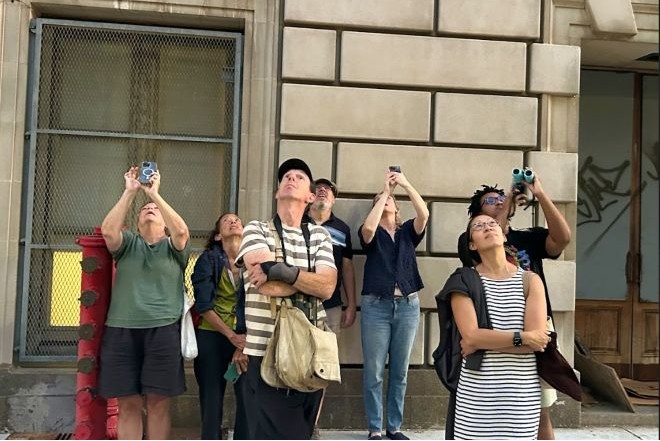
On Thursday September 18, about 40 people gathered on Wood Street, faces lifted to the sky. For 45 minutes, thousands of migrating chimney swifts spiraled above the old J.W. Hallahan High just north of Logan Circle, wheeling out before cascading back in to form a funnel, and then — nearly all at once — vanishing into a single chimney.
Each year the swifts return in large numbers to roost in favorite chimneys. But that night, the ordinary city evening gave way to something unexpectedly rare and magnificent. You didn’t need to be a birder to feel the pull of it. Swifts are nearly five inches long and look like plump, trim Philly blunts. Field guides describe their calls as “rapid short chips” — but that’s one bird. Multiply it into a widening circle, thousands high over the city at dusk, and it becomes something else altogether: not noise, not birdsong, but a force of nature.
Listen to the audio edition here:
That evening, the quick chatter of swifts mixed with the hum of an HVAC system from a nearby charter school. Their swirling choir was breathtaking — though at first slightly grating, like a failing fan belt whining from blocks away, then swelling into something wild and magnetic. The high-pitched chittering rose as overtones from hundreds, even thousands of birds forming a tornado-like funnel, melding into an ambient mass. But after the last birds piled into the old brick stack, a long hush followed.
A few things I learned: Chimney swifts leave the roost each morning and do not land again until dusk, sometimes covering hundreds of miles in a day. It’s true — they mate on the wing, and some even sleep in the air. Their legs are barely there, but their claws cling tightly. The name says it all — swifts: here and gone, faster than the eye can follow. My favorite fact concerns their habitat: “Open sky, especially over cities, towns; nests and roosts in chimneys.” Home, for them, is the sky.
Birding helps Philadelphians see their city
I got word of the Swift Watch from Robert Karchnyak of BirdPhilly and the Delaware Valley Ornithological Club, whom I first met two years earlier at FDR Park.
But what struck me that night was how the gathering stretched far beyond birders. Editors from the art and ideas magazine Root Quarterly also turned out with friends, alongside neighbors, kids, and even a few dog walkers looking up. Right now, the fall migration brings a striking variety of birds to the city as many species stop over on their way south. Swifts roost at dusk, but birders say early morning is prime time to spot the many other migrating birds.
Birdwatching in Philadelphia is having a moment. Since the pandemic, more people have turned to binoculars and bird walks, finding in them not just a pastime but a way of locating themselves in the city’s living fabric. Birdwatchers are seeking not only rare, dramatic sightings, but also the everyday ones.
Longtime birders still marvel at a wonderful warbler, but many are just as quick to light up a red-winged blackbird calling from the reeds or a bluebird flashing through the trees. What’s unfolding is how birding is helping Philadelphians see their city anew.
“We’re a bunch of citizen-scientist types. We love birds, we do stuff, and we get involved in the community.” — Robert Karchnyak
In the years after 2020, eBird checklists more than doubled to 1.3 million by 2023, and Merlin Bird ID app users jumped fivefold to 1.5 million. Birding is a meeting place for science and poetry and people and nature. As one local noted, “Covid brought a lot more birders into the mix.” In Philadelphia, the uptick in birdwatching reminds us that contact with the natural world isn’t just out there, but threaded through the city itself. Birding makes that attention visible every day.
Many birders go out solo or with one other friend. Poet and intrepid Philly birder Jim Cory insisted on real-world encounters, even as he asked, “Who goes to the woods to socialize? If anything, you’re there for the exact opposite reason — to get away from people — or like Thoreau, to meet yourself.” Birders have an independent stripe, yet they also self-organize. What begins as a hobby often grows into something larger — a way of finding purpose and belonging.
You can see it in the breadth of groups: the Feminist Bird Club Philly and In Color Birding Club. Then there’s Philly Queer Birders whose recent Swift Watches with BirdPhilly have started to feel less like bird outings and more like block parties. Bird Safe Philly adds advocacy to the mix, working to make bird-safe window glass and to turn off lights in the all-glass buildings during migration, which is peaking right now.
Together they form a scene that is social, celebratory, and serious all at once. One recent event from In Color Birding captures that spirit: it asks, “Curious about WEIRD SPARROW SEASON?” The group led a tour at Pennypack on the Delaware with Riverfront North Partnership. What sounds like a bit of whimsy is exactly the point: encounters with the odd and overlooked all around us.
Alongside these newer groups there is the Delaware Valley Ornithological Club (DVOC). Founded in 1890, it is among the oldest ornithology organizations in the country. For more than 125 years its members have met at the Academy of Natural Sciences and published the journal Cassinia, still going strong today. Through its BirdPhilly program and resource site, the club also leads a year-round schedule of field trips across the city and region.
Robert Karchnyak, a member, put it plainly: DVOC is birds and citizens: “We’re a bunch of citizen-scientist types. We love birds, we do stuff, and we get involved in the community.”
Bird watching at FDR Park
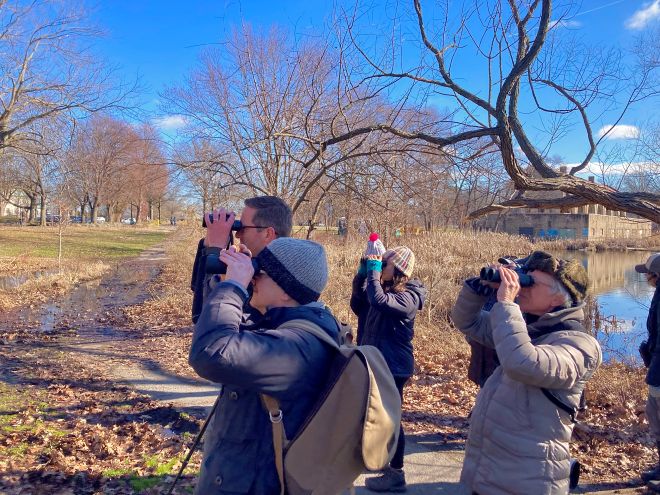
FDR Park on the edge of Broad Street in far South Philadelphia draws birds not only for its fields and canopy but for its location: a meeting point at the confluence of two rivers, a corridor that ties its lakes and wetlands to the Atlantic Flyway from Canada to South America. With 229 species logged on eBird, it ranks third in Philadelphia, after the John Heinz National Wildlife Refuge and Pennypack on the Delaware. Walk the park with birders and you glimpse how an urban park can serve as both a haven and a civic common.
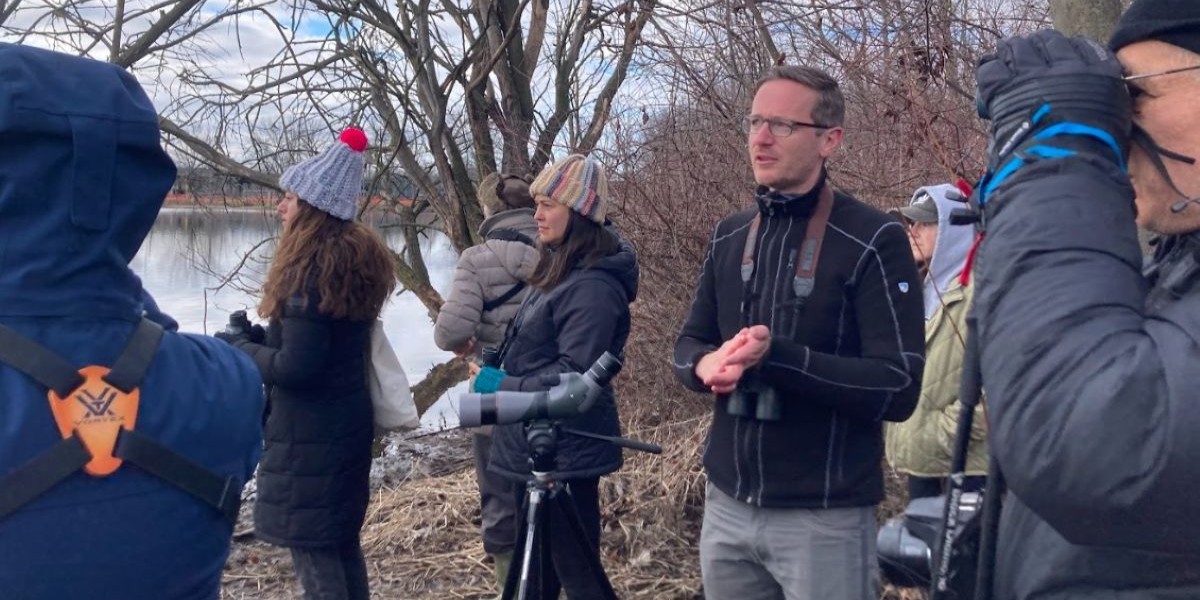
One cold and clear morning in February 2024, I found myself at the outer edge of a walk at FDR led by the well-known regional birder Holger Pflicke. A fixture of Philadelphia birding, Pflicke is as much a guide to the city’s birds as he is to its parks: Pennypack, Poquessing, and the sleepier stretches of West Fairmount.
He leads walks for BirdPhilly, the Fairmount Park Conservancy and the Free Library’s Birder Backpack program, and edits DVOC’s magazine Cassinia, tying their long history to the city’s present. Throughout the walk, Pflicke set up his spotting scope on a tripod to locate waterfowl, and invited not only the group but anyone passing by to take a look. That small gesture summed him up: precise in his birding, openhanded in sharing it.
Throughout the walk, whenever Pflicke wished to solicit another layer, or fill in a blank he turned to Robert Karchnyak. At 46, Karchnyak — cochair of DVOC’s conservation committee and manager of BirdPhilly’s Instagram — lives near FDR with his wife and knows the park as well as anyone. Out in the field, he’s easy to spot: tall, wiry, black cap, canvas bag, and binoculars. A few conversations reveal a fingertip feel for bird life that makes him as much a chronicler of the park as of its birds. The numbers back it up: on eBird he leads FDR’s “Checklist” and “Species” boards, with hundreds submitted and more than 200 species tallied.
“Who goes to the woods to socialize? If anything, you’re there for the exact opposite reason — to get away from people — or like Thoreau, to meet yourself.” — Jim Cory
On the February waterfowl tour, Karchnyak pointed with his binoculars across Meadow Lake to “An American Wigeon.” At first it looked like the other ducks. Someone guessed a female. Then, he simply added: “The head.” Through our binoculars, the patterned black speckling around the bird’s darkened eye came into focus. It is the kind of detail detail-obsessed German painter and printmaker Albrecht Dürer might have traced, exact and shimmering — confirmed by the eye, and then also ID-ed by someone else’s Merlin app.
That day, ducks changed. Before then, they were mostly the same: male and female Mallards. Then came the Gadwall, the Bufflehead, the Wigeon: black rump, white crowns, and shadowed eyes.
Beyond birding, Karchnyak is advocating for habitat. In a recent Inquirer op-ed he urged the city to designate FDR as protected “stopover” habitat along the Atlantic Flyway — a vital refueling spot for migrants. In the “Ideas We Should Steal” category: the city might look to Memphis, where a section of Tom Lee Park is being reimagined as the “Memphis Flyway” — a reminder that the migrations deserve not only safeguarding, but celebration.
In person, Karchnyak puts it simply: “The best way to understand it is as a kind of highway — an easy route for birds to take up the coast, with no mountains in the way.” That highway helps explain why Philadelphia sees more migrants than the rest of Pennsylvania. “Once you move further west, the mountains get in the way,” he says. “Raptors can ride thermals, but the little guys don’t do as well, so they stick to the coast.” The Delaware and Schuylkill rivers meet at FDR, a landmark for those travelers. “It helps a migratory bird to look down and see two rivers coming together.”
Ospreys over the wetlands
Two years ago, the creation of the park’s 33-acre wetland project drew strong opposition. Today, many observers regard the revamped site as a win for biodiversity and hydrology — a new habitat stitched into the city’s naturalized systems. On a walk with Karchnyak in May by the new wetland, a shape hovered above the water. Then another.
“Ospreys,” he said. The mighty sea hawks were oscillating and floating with nearly motionless wings, as they scanned the water below.
“They’re nesting somewhere in the Navy Yard. They hover like that to hunt, living almost entirely on fish. Sometimes bald eagles will swoop in and steal their catch midair right out of their talons.” He paused, watching them circle. “Wildlife — some of it’s brutal.”
Ospreys and bald eagles spotted over the wetlands signal a return of healthy biodiversity. If Karchnyak gave me the birder’s guide to the wetlands, a week later over Zoom, Franco Montalto gave me the environmental engineer’s view. A Drexel professor who specializes in urban water systems, Montalto has followed the project closely as both a professional and a South Philly resident. They both showed me that attention, too, is a kind of return.
“That whole part of the park was essentially poor quality habitat,” Montalto said. “It wasn’t really serving much in terms of ecosystem services. What I see now is very different: the vegetation looks good; the birds look good; the drainage looks good. As long as the water in tidal wetlands is coming in and going out, you’re getting water quality improvement. The water is biologically treated as it moves through, and fish can come and go, which means new breeding grounds that weren’t there before.”
He admired the progress. He also stressed that the wetland’s future will depend on upkeep and care. “It looks great now, but maintenance is critical. The water control structures can clog; invasive species can come in, and this system is connected by pipes rather than directly to the river. To keep it thriving, FDR will need specialized maintenance over the long term.”
Yet he praised the overall design. “They’ve created a mosaic of habitats — open water, emergent marsh, mudflats, and nearby forest. That diversity of ecotones is what you’re looking for.”
 MORE ON ANIMALS AND WILDLIFE IN PHILLY