

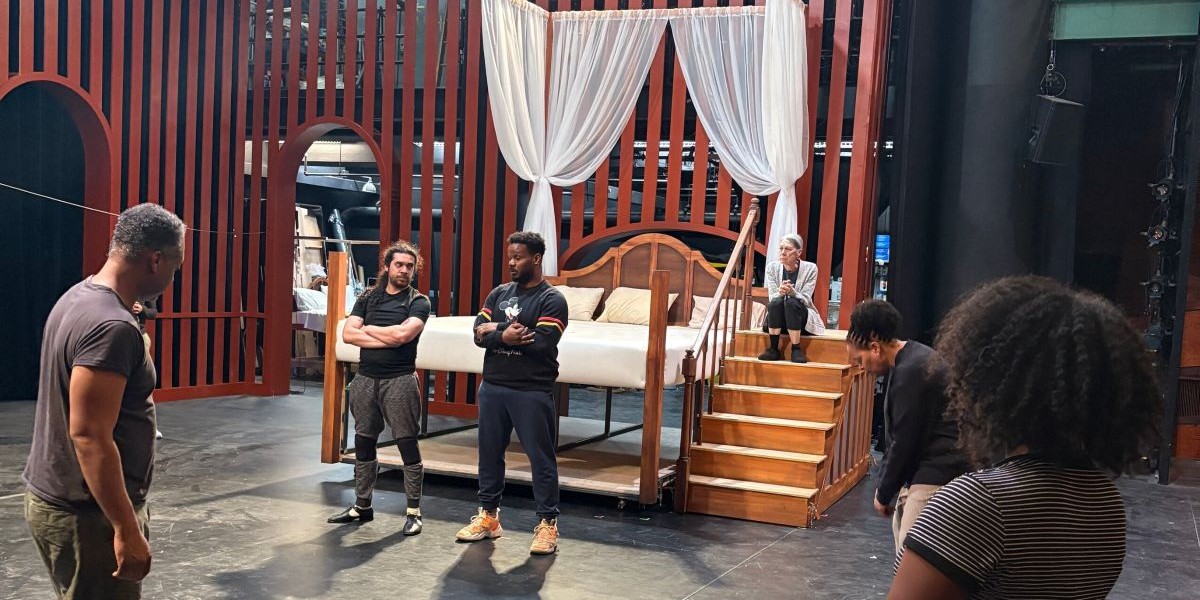


A year ago, my fellow co-artistic directors and leadership at the Wilma Theater considered how to acknowledge our country’s 250th anniversary as a theater that is known for adventurous, visceral and challenging plays. Our celebration would never be an unquestioned view of the United States of America, so we decided on the season theme of “interrogating the American experience.” Our next two productions, The Most Spectacularly Lamentable Trial of Miz Martha Washington (March 17-April 5, 2026) and The America Play (May 19-31), felt urgent and fitting for this theme, but we could not have imagined the relevance they’d gain in a year.
Now, with rehearsals are underway for Miz Martha, I cannot shake the appalling image of National Park Service workers removing the slavery exhibit from the President’s House on Independence Mall. The Trump administration’s attempted removal of this exhibition is the latest in their long list of deliberate acts of whitewashing history. From the first days of his second term, Trump has made concerted efforts to eradicate Black and Brown bodies from the image of America. As a refresher, he has ended all federal DEI programs, pressured the Smithsonian to eliminate any mention of slavery, deleted federal environmental justice data, legalized racial discrimination by immigration officers and explicitly plans to silence minority stories at the (now renamed) Kennedy Center, to name only a few.
Right across the street from the President’s House, the Independence Visitor Center is promoting what we’ve dubbed the Citywide James Ijames Pass, a celebration of our local, Pulitzer Prize-winning playwright and three of his plays being produced this year in Philadelphia. Miz Martha — our contribution to the Citywide Pass — is a raucous satire that takes place in the final hours of life for an ailing Martha Washington. She is confronted by the enslaved people who were considered property of the Washingtons during their lives and promised freedom upon her death (not just for the play, this was written into her will). It will be a laugh-inducing and entertaining show as Ijames’s plays are, but it is also one that is poignant and unnervingly timely. We had no idea when we chose the play that the people enslaved by the Washingtons would be at the center of a large-scale erasure of American history such as the one happening at the President’s House.
In May, I am directing and acting in the Wilma’s production of The America Play by Tony Award-winning playwright Suzan-Lori Parks. The poetic script explores the life of a Black man who impersonates Abraham Lincoln in hopes to be recognized as a great man in his own right. He runs a sideshow at a replica of a fictional tourist attraction called “the Great Hole of History,” which is a physical hole or grave that represents the many uncomfortable stories excluded from the canon of American history. As I pour over the play in preparation for its production, I cannot deny the eerie and horrific poignance of the removal of the President’s House Site exhibit.

We are witnessing a deliberate and systematic plan to reshape the national identity. Trump’s narrative of restoring America’s past “greatness” comes at the cost of not only sanitizing slavery but also the Trail of Tears, the Tulsa Massacre, Japanese Internment Camps, the Dakota 38, and countless other holes in American history that are uncomfortable to hear. But we must hear them and own them to understand why our present exists in the way that it does. Theater artists make these stories visible through art on stage throughout our incredible city. Our audiences own it by witnessing plays like The Spectacularly Lamentable Trial of Miz Martha Washington and The America Play, discussing them after and voicing their concerns in the streets and at their dinner tables.
I landed in Philadelphia and at the Wilma because I wanted to tell stories that are often lost to the holes of history. The art I want to make is entertainment, but it is also uncomfortable and communal. As my colleague, Nataki Garrett Myers, board chair of Theatre Communications Group, brilliantly stated, theater was created to “place art and the artist at the center of civic life; to treat performance as a form of civic engagement; to engage, disrupt, and provoke reflection; to create a public space where audiences are invited to reckon with power, contradiction, and possibility.” I have been heartened to see the vehement response of Philly residents as they attempt to replace and recite the names and stories of the people who sacrificed so much at the President’s House.
I invite audiences to reckon with the holes in our American history by visiting the current site at 6th and Market streets, adding your own message to it, and then sitting with us in the theater as we continue to breath air into the stories that must be told and repeated in 2026 and beyond.
Lindsay Smiling is a Philadelphia-based actor, director, educator, and Co-Artistic Director of the Wilma Theater, recipient of the 2023 Tony Award for Best Regional Theatre. He is a founding member of the Wilma HotHouse Acting Company and has performed in more than 20 productions at the theater since 2003, in addition to serving as an Adjunct Professor at Temple University and a founding member of the Black Theatre Alliance of Philadelphia.
The Citizen welcomes guest commentary from community members who represent that it is their own work and their own opinion based on true facts that they know firsthand.
 AT THE INTERSECTION OF ART AND HISTORY