

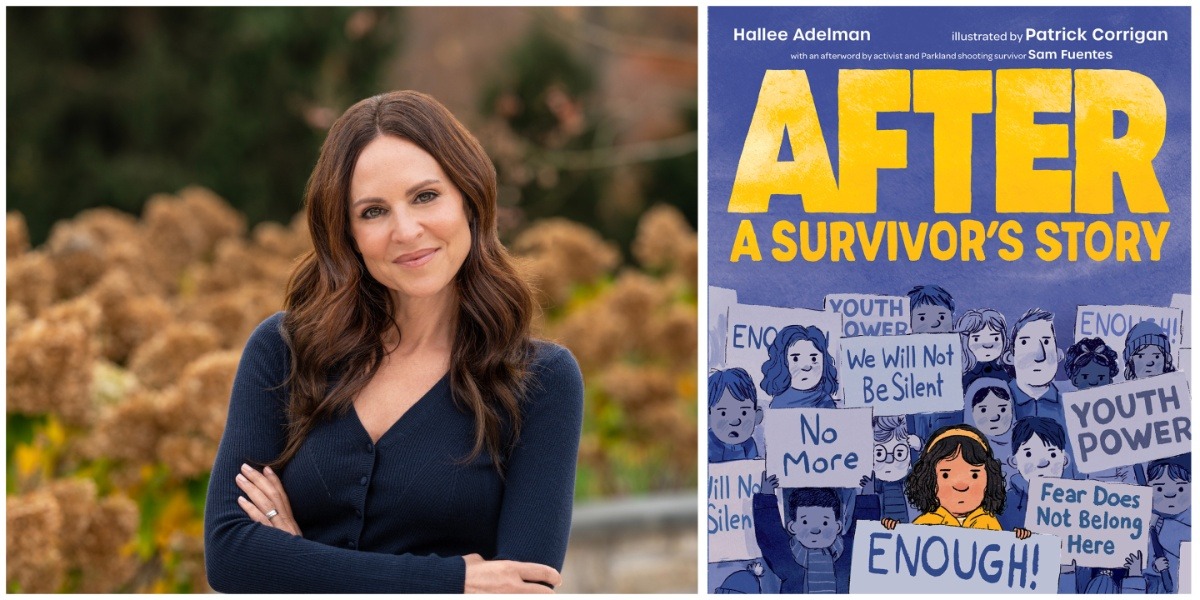


You don’t know the name of the main character in After: A Survivor’s Story, a children’s book released this month by author, documentary filmmaker, and educator Hallee Adelman. You also don’t know exactly what she’s been through. Instead, the book (for ages 4 to 8) follows her in the wake of a traumatic experience — referenced throughout as “The Horrible Day” — and traces how it impacts her life, including a newfound fear of loud noises and a hard-to-shake sadness.
Although the book was inspired by the traumas of gun violence, including school shootings, Adelman chose to avoid any direct mention of that source material. She felt it might distract from the end goal, which was to help children process the complexities of trauma — and not necessarily to weigh in on hot-button debates, which the word “gun” would inevitably invite.
“No offense, but sometimes the media has a way of sensationalizing traumatic issues, and what people deal with, in a way that doesn’t allow us to have the real conversations that we need to have,” says Adelman. “With this book, I wanted all children who had a traumatic experience to be able to approach the book and feel cared about.”
Adelman, who previously authored a series of children’s books about big feelings — one of them singularly focused on shame, another on loneliness, another on fear, etc. — was an elementary school teacher before earning her PhD and instructing at the university level. Adelman has also been a producer on several acclaimed documentaries, including the Netflix hit The Social Dilemma, and is the co-founder of World of HA Productions.
“I’m excited that the book can make kids feel loved,” she says. I caught up with Adelman last week to talk about her new book. This interview has been condensed and edited for clarity.
It feels strange to use the word “inspiration” for this book, given the subject matter. But how did this project start?
I was actually approached to write this book by [children’s book author and publisher] Sue Tarsky. I had previously worked with Sue on the “great big feeling” books, which try to normalize having big feelings and give kids options for how to handle big emotions.
Sue came to me, and I originally said, no, I don’t think this is my book to write. But obviously, in our nation, there is just a mounting need to know what to say to kids. I mean, I remember as a mom after Sandy Hook, there was that same need as parents for how to talk to kids.
To me, it is always important to not look away from the people who are so gravely impacted. And in our city — and you know this firsthand, because you guys are living it, and you’re seeing this news — there are kids shot every day. So I told her: Let me talk to people who have been impacted. I will come back to you in six months and let you know if I can write this book.
What was that research process like?
I had already worked with Kim Snyder, an amazing documentary filmmaker, and Sam Fuentes, one of the survivors of the Parkland shooting, on a documentary called Us Kids. That film followed some of the students after the Parkland shooting as she found some healing and empowerment by sparking the March for Our Lives movement. [Snyder and Fuentes] were my first call. I got a chance to do a lovely deep dive with Sam about her experience of what happened after the shooting. What did she feel? What was insensitive? And what did she need when it happened?
I then spoke to Anton Moore, of Unity in the Community, because he’s been doing work on the ground. He’s working on prevention and conflict resolution for children. So I spoke to him about how can we lay the foundation for them to handle feelings better? After that, I was also connected to a young boy in our city — I’ll call him HK — who had been shot outside his home. I was able to meet with him and his mom and talk about what that was like for him. He was sharing to me how even a car pulling up now freezes his body and is a trigger for him.
I can see that in the book. You note how car sounds affect the main character. Did you find that you drew upon those interviews a lot while writing it?
Yes, and I even shared pieces of the writing with [those I interviewed] as I made progress. I asked them to let me know what I’m getting right and what I’m getting wrong. I was lucky that the publisher let me embrace the level of care that I wanted and supported me with that level of care.
With children’s books, you don’t have a lot of words to work with. Was it hard to explore such a nuanced topic within those limitations?
I view it as a way for me to be there and then step aside. I like to start conversations or make someone feel hugged, or make someone feel understood. I think it’s just starting with a feeling and then stepping back a little, so that kids, families, counselors and teachers can have a fuller conversation. I feel like I don’t need to say it all. I try to be community- and kid-minded in that way. This is one very small sliver, and hopefully this makes kids feel like strength doesn’t have to be perfect.
Why did you land on “The Horrible Day” as a concept, instead of specifying the trauma that the characters have gone through?
I think there are multiple reasons. Nancie Atwell is this amazing educator who teaches writing to kids. And she always talks about the importance of finding a pebble instead of a rock — the importance of being so specific. And so it’s interesting, because you’re saying that The Horrible Day is kind of general, but I think what I wanted to be specific on was the feeling.
Also, the vagueness around The Horrible Day is doing a couple of things. One, it’s trying to eliminate triggers. Second, I also wanted to make sure I wasn’t pigeonholing the book for any child, any type of child. I wanted all children who had a traumatic experience to be able to approach the book and feel cared about.
I remember a book from years ago called Terrible Things. It was an allegory of the Holocaust. For me, it was a really powerful book, but it was really about a bunny rabbit who was alive during a time period where her people were being persecuted. And they called it Terrible Things, but it’s just an allegory. I found that to be powerful, because I also felt like it didn’t have to be read as an allegory of the Holocaust specifically. It captured that feeling of someone being a bystander, what sometimes the impact of that is. We want to be sensitive, what we thought was effective, what and what we want to do to kind of just reach people with care.
Sometimes it’s easier to process our experiences through a stand-in.
It’s funny, because some members of our team really wanted me to have “gun” or “gun trauma” in the title. And then we went through a very long back and forth about what to settle on. I’m proud of the title and how it’s reaching kids too.
There’s a heartfelt afterword to the book, written by Sam Fuentes, one of the Parkland survivors. Why did you think that was important to include?
Well, first of all, every day I’m amazed by kids like Sam, who is an incredible human being. When it’s very hard to speak about, when it’s very hard to step forward again and again, Sam uses her experience to keep stepping forward. She is so passionate about wanting things to change so the next generation can feel strong and unencumbered by all of this. We need more of Sam’s insights. We need more of Sam. Sam’s journey and the fact that she was willing to be so open, not just to make sure the resource could exist for children, because she knew she wanted to have a resource like that.
With all of your books, you’ve made a point to donate copies to children and teachers who might benefit from them. Will this book be any different?
I remember, as both a kid and as a teacher, you just couldn’t get every book you want. They’re not always accessible. So it is important for me to get books into the hands of kids — not just my own books, but I’ve often partnered with other orgs. We just did a teacher back-to-school bundle giveaway with BookSmiles in New Jersey. They’re doing great work. If you have a teacher membership, you can roll in with a suitcase and fill it up with upcycled books.
I also like to send a note to some people I know in the space that are working directly with kids. I’ll let them know that the book exists. And I said, If there are any kids that you think need this book, and you need some free copies of the book, let me know. So that we can get books into the hands of schools and teachers and communities who need them. Anybody can reach out to Way Past Books if you want to connect!
 MORE LITERATURE COVERAGE FROM THE CITIZEN