



As with every great industrial leap, the race among states to lead the AI revolution is reaching a fever pitch. We are living through a transformation that could shape the 21st century even more profoundly than railroads and steel defined the late 19th century, or the personal computer and the Internet transformed the close of the 20th. We are now entering the steep part of the hockey-stick curve for AI innovation — when breakthroughs move from research labs and pilot projects into the physical world, driving exponential changes in how we produce energy, manufacture goods, move people and freight, and secure national defense.
In this age of “future shock” innovation, progress is inseparable from energy and infrastructure — and infrastructure, in turn, is inseparable from political will. The states that will win are those able to cut through permitting bottlenecks, align policy with industry needs, and move capital to the ground quickly. Speed, strategy and scale — mirroring the first movers in tech’s Magnificent Seven — will decide who builds the competitive platforms that fuel generations of growth.
A big-deal AI gathering — in PA
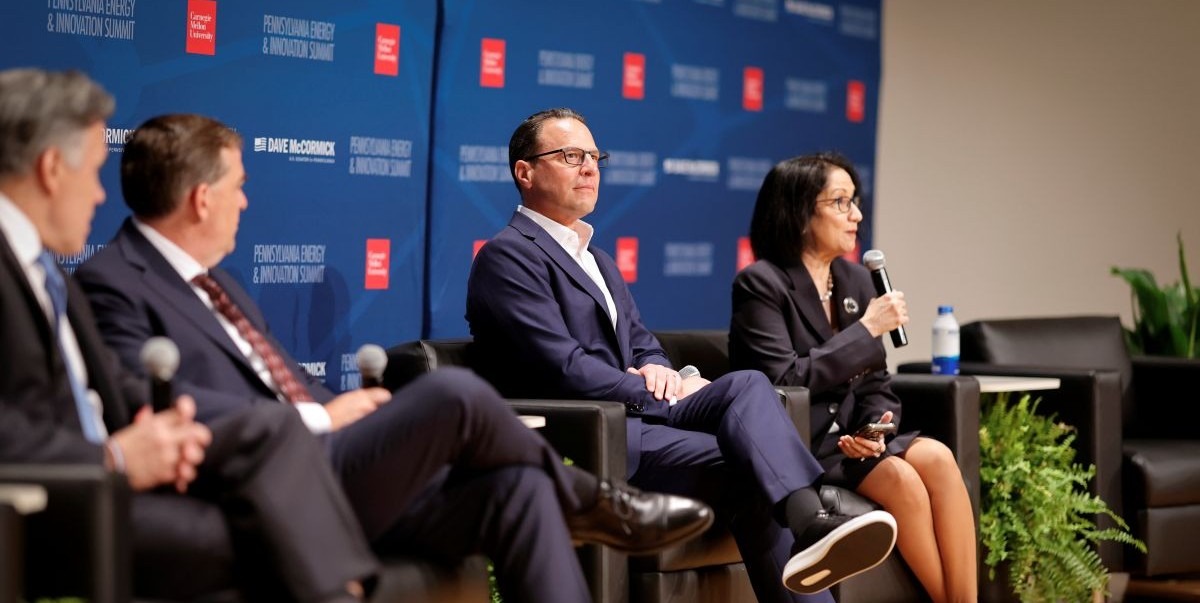
Pennsylvania disrupted this competition with a bang last month. On July 15, U.S. Senator David McCormick hosted the inaugural PA Energy and Innovation Summit at Carnegie Mellon University. The event didn’t just draw President Trump and key Cabinet officials; it brought together one of the most formidable concentrations of capital and influence ever seen in the Commonwealth, and perhaps in any state. Leaders representing trillions of dollars in market value and investment capacity — from Blackstone President Jon Gray, with over $1 trillion in assets under management, to executives from the UAE’s sovereign wealth fund — sat alongside CEOs of the nation’s largest energy companies, top labor leaders and senior executives from the world’s leading technology firms.
For a day, PA became the meeting ground for global capital, industrial might, and cutting-edge AI innovation, positioning the Commonwealth to play a defining role in the new AI economy. The spectacle amplified momentum already building under Governor Josh Shapiro, layering more than $90 billion in new data center, energy and workforce announcements on top of prior wins. In a rare moment of unity, Shapiro, a Democrat, sat alongside McCormick, a Republican, projecting bipartisan resolve in the nation’s most competitive swing state.
Speed, strategy and scale will decide who builds the competitive platforms that fuel generations of growth.
But the real value of the Summit’s network effect will be measured not in photo ops, but in how effectively PA’s leaders turn it into sustained economic advantage. Just weeks later, the White House released its national AI Action Plan — and PA remained in the headlines. In Washington, the All-In Podcast featured Pittsburgh-based Gecko Robotics as one of its first presenters, showcasing how AI-powered systems can modernize heavy industries. U.S. Commerce Secretary Scott Bessent noted he had visited Pittsburgh twice in four weeks — first for the U.S. Steel-Nippon reinvestment and then for the Summit — pointing to the “juxtaposition” of abundant, low-cost energy and heavy industry alongside top-tier universities and cutting-edge innovation. He also underscored that the U.S. is in the midst of a $300 billion annual capital expenditure surge on AI and that by 2026, this CapEx boom will give way to a productivity boom.
The question is whether PA will be ready to lead and capture it.
But first, strategize
His remarks crystallize the Physical AI story: the convergence of AI and autonomy with the real-world industries that power our economy. PA’s unique mix of assets — from energy abundance and industrial land to engineering talent and applied R&D — is precisely where the next wave of economic growth must be built. AI’s productivity curve isn’t about experimental chatbots or consumer novelties. It’s about intelligent systems that move, sense, adapt, and act in the real world. In manufacturing, energy, logistics, and defense, Physical AI is already reshaping processes, boosting productivity, and creating new markets. PA — home to one of the world’s largest concentrations of roboticists in Pittsburgh, industry leaders like legacy powerhouse Ansys (now part of Synopsys), and dozens of cutting-edge autonomy companies — is ahead. Aurora, for example, just completed the world’s first successful commercial driverless truck trip, with its full tech stack built in Pittsburgh. But in the face of relentless global competition, today’s lead will not last without decisive, coordinated action.
What PA needs now is a unified strategy: a PA Physical AI Playbook that aligns leadership, policy, and investment across infrastructure, innovation hubs, workforce, capital, and execution. Infrastructure is where the stakes are clearest and where the state has an obvious advantage, thanks to abundant natural gas and nuclear innovation. The rapid expansion of AI systems is driving record capital investment in data centers, chip manufacturing, cooling systems and power infrastructure. In the past year alone, Microsoft, Amazon, Meta and Google have spent more than $100 billion, almost entirely to build the backbone needed to run AI at scale. This revolution is not just about software; it’s also about steel, energy and land. Former industrial sites across the state offer what hyperscalers crave: abundant power, available space and permitting flexibility.
But leadership means more than hosting someone else’s infrastructure. PA should pre-permit and expedite zoning for industrial land in exchange for commitments to reserve a portion of compute power for Pennsylvania-based researchers, university spinouts and scale-ups. It should anchor downstream manufacturing — racks, cables, components — near data center sites to keep jobs and tax revenues local, and treat the energy grid as a strategic economic asset. Failing to act risks PA becoming a “digital colony,” housing infrastructure but losing the value creation to other states.
What PA needs now is a unified strategy: a PA Physical AI Playbook that aligns leadership, policy, and investment across infrastructure, innovation hubs, workforce, capital, and execution.
The Physical AI Playbook must also invest in place: innovation geographies that bring companies, researchers, universities, investors and governments together. In Pittsburgh, an AI Innovation Corridor is already emerging along Penn Avenue, from Duolingo’s headquarters to Bakery Square, home to Google, the U.S. Army’s AI Integration Center, CMU’s Tech Transfer Office, and a growing roster of AI companies. Just a mile from Carnegie Mellon, it’s primed to become a Federal AI Campus, with embedded units from major defense contractors, Armed Services branches, and intelligence agencies.
Philadelphia could follow suit by leveraging the innovation district in University City and building a Broad Street corridor that links Temple University’s hospital and campus to the Navy Yard. These hubs are where interdisciplinary collaboration, rapid experimentation, and scaled deployment can happen in real time.
The workforce challenge is equally pressing. Carnegie Mellon University is ranked #1 in the nation for AI and is home to the Software Engineering Institute, the Robotics Institute, and Advanced Robotics for Manufacturing — centers that work closely with the Department of Defense, major corporations, and investors. Penn State, as a University Affiliated Research Center, has deep defense ties, while Pitt, Penn, Temple, and Drexel bring niche strengths that, if coordinated, can amplify statewide impact. An AI University Cabinet within the governor’s office could align these assets for maximum effect. Beyond higher ed, the state must tap community colleges, skills providers, and K-12 schools. Pittsburgh’s emerging startups that use AI to boost student learning could scale statewide. A PA AI Challenge could accelerate skills-focused AI ventures, modeled after programs like MassChallenge.
Capital is the fourth pillar. Too many PA companies head west for late-stage investment, taking jobs and wealth with them. Ohio’s O.H.I.O. Fund shows what’s possible — $250 million raised from 80 in-state investors, with $133 million already invested. PA could launch a PA AI Growth Fund, tapping corporations, financial institutions, philanthropies, and family offices to back later-stage companies and strategic projects. The public sector, through the Treasury and public pension funds, should co-invest, with commitments to build, hire, and scale in Pennsylvania.
Finally, leadership. Pennsylvania’s momentum has been supercharged by the network effect created by McCormick and Dina Powell McCormick, former U.S. Deputy National Security Advisor and Goldman Sachs partner, whose global relationships helped bring unprecedented capital and influence to the state. That network has created a rare opening. Now is the time for McCormick and Shapiro to form a bipartisan, statewide PA AI Leadership Council to make the Commonwealth the global leader in Physical AI. Pittsburgh should be its anchor, but its reach must extend to manufacturers, energy producers, and innovators across the state. Yes, the politics will be tricky. But transformative opportunities rarely arrive without risk. The Council could coordinate across the Playbook’s priorities; link state agencies, federal procurement, universities, investors, and industry leaders; and ensure near-term wins translate into long-term positioning.
The tech giants are vertically integrating by the day, controlling compute, talent, data and infrastructure. The moat is growing, and the risk of permanent dependence is real. PA has the assets to flip the script: real industries, real talent, real land, real power — and a people who still know how to build.
Every American industry had a birthplace. The automobile had Detroit. Software had Silicon Valley. Aerospace had Southern California. Physical AI can have Pittsburgh and PA — if we move fast enough to define it. We’ve done it before. We can do it again. But only if we act with the speed, vision, and unity this moment demands. Now is the time to lead.
Joanna Doven is the Founder and CEO of the Pittsburgh AI Strike Team. Bruce Katz is the Founding Director of the Nowak Metro Finance Lab at Drexel University.
 MORE ON WHAT ARTIFICIAL INTELLIGENCE CAN AND CANNOT DO