


When Philly native Nafees Norris was laid off from his role as a cell culture scientist in 2024, he faced two options: Return to biotech, or start something entirely different.
On one hand, Norris had already cultivated a successful — and trailblazing — career as the first Black student accepted into Thomas Jefferson University’s Biopharmaceutical Process Engineering Master’s Program — launched in 2019, a first of its kind in North America.
On the other hand, biotechnology wasn’t a very diverse industry. Black people like Norris make up just 9 percent of those employed in STEM jobs. White people, by comparison, make up 67 percent of the industry. Hispanic people make up eight percent. “I felt like my people weren’t getting a chance,” he says.
Instead of looking for a new role similar to his old one, Norris decided to start his own venture geared towards exposing young people — particularly those underrepresented in STEM fields — to his specialty.
“I walked away from [industry work] completely because I didn’t see too many people that looked like me,” he says. “I was trying to figure out why that was, and there were absolutely no bioprocessing programs in the country that were geared towards kids.” Bioprocessing — the method of using living organisms to make usable products such as medicines or food ingredients — isn’t commonly taught to young students.
So, he launched his own. Norris founded the education nonprofit Nafees Innovations in 2024. The company has since partnered with schools and organizations like University City Science Center, B+ Labs to offer more than 150 interactive workshops for more than 2,000 students.
STEM education for all
Norris started with a simple pitch to University City Science Center. He asked to host Saturday workshops for about six kids to teach biotech through understandable projects like making soap and manufacturing medicine — real biotech jobs.
But they weren’t “regular workshops where they get to watch and just do one little thing here and there,” Norris says. Instead, it was hands-on, mimicking the industry enough so that, he says, “My 10-year-olds know how to run a clinical trial.”
He had confidence in his methods but wasn’t sure what to expect as far as results or reactions. Then, a friend brought her son and shared a few videos she took of the class on TikTok. Two hours after the posts went live, Norris had 15,000 followers.
Schools started calling. Workshops filled up. “It was just nonstop from that point,” he says.
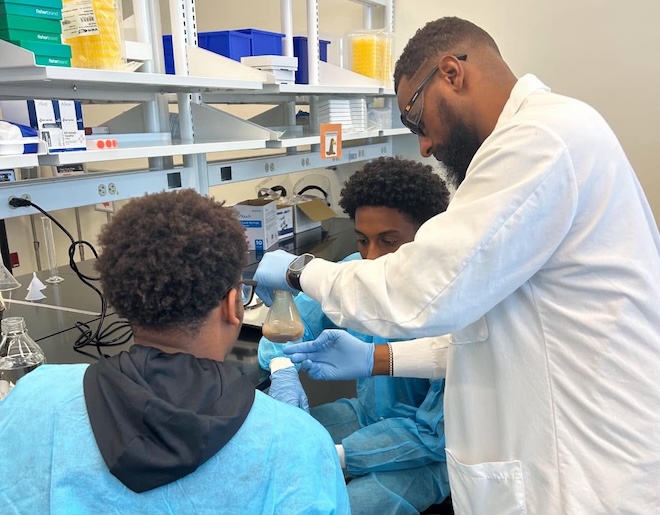
Today, Nafees Innovations operates mobile STEM workshops, bringing science learning opportunities directly to schools, and provides professional development services for teachers, offering curriculum consulting for educators and nonprofits interested in developing more engaging science programming. They’ve also expanded programming to include speaking engagements and STEM birthday parties.
In a typical workshop, students don lab coats and other PPE to work on experiments that Norris continues to keep it as “real world” as possible. Lately, he’s been teaching bioprocessing — the method of using living organisms to make usable products, like medicines or food ingredients. The programs vary in difficulty based on age, which spans preschool through high school. The workshops range in cost from $40 to $50.
“I wanted to be of help, even if it was at risk to me. So we didn’t make any money for seven months, and we kind of struggled a little bit after that,” Norris says. More than a little bit, however. He considered stopping workshops altogether, when another 10-year-old brought more magic.
Norris’s 10-year old godson, a regular participant, facetimed, dressed in a lab coat. He’d been assigned a school project — dress up as someone you admire — and he’d chosen to go as Norris.
The future of Nafees Innovations
The moment pushed Norris to fight for his business. He reached out to the life science incubation space B+ Labs, who decided to use their grant funding from the state through the Pennsylvania Biotechnology Center’s AIZ program to host Nafees workshops.
B+ Labs director Matthew Burkhardt says their pivot to biotech was necessary. “Everyone thinks about life sciences as microscopes and complicated equipment and like multi-syllable words, and that’s not for everyone,” he says. “But [Norris] started integrating things like cosmetics and perfume and golf balls right into his curriculum and programs, and it’s a super great way to really engage individuals, either at a specific age or at a specific interest level, in terms of what science can be.”
Burkhardt is confident that Nafees Innovations has had — and will continue to have — a vital impact on Philadelphia’s youth. “It takes 30 seconds of his introduction to his classes and programs, and you’re like, this guy gets it,” he says. “He’s very charismatic, and that’s a trait that usually lets you be successful.”
Norris’ goal is ambitious: Expose thousands more students to more scientific fields in order to smooth their paths into STEM careers. And start as early as possible.
“Here’s the thing: would you rather take the basketball player that’s been playing since he was two, or the basketball player that started when he was 22?” Norris says.
“If you think about your world’s greatest Olympians and athletes and favorite singers, they didn’t start in their craft when they were in their 20s. They started when they were very young and they got exposure. They got hands-on training. The more reps they get, the better they’ll be at this craft.”
Correction: The previous version of this article stated the workshops were now free of charge; this has been updated to reflect the $40-$50 fee.
 MORE PHILADELPHIA CITIZENS DOING GOOD
