


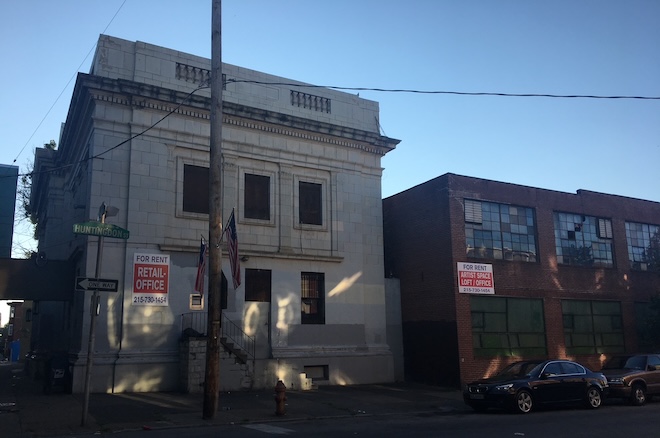
The historic National Textile Bank at the corner of Kensington Avenue and Huntingdon Street is a prime example of what real estate developers mean when they say a building has good bones.
Though partially obscured by the El, the Classical Revival facade, replete with a sculptural panel and a pair of Corinthian columns framing the front door like sentries, stands imposingly on the corner. A pigeon perches on the ornate clock.
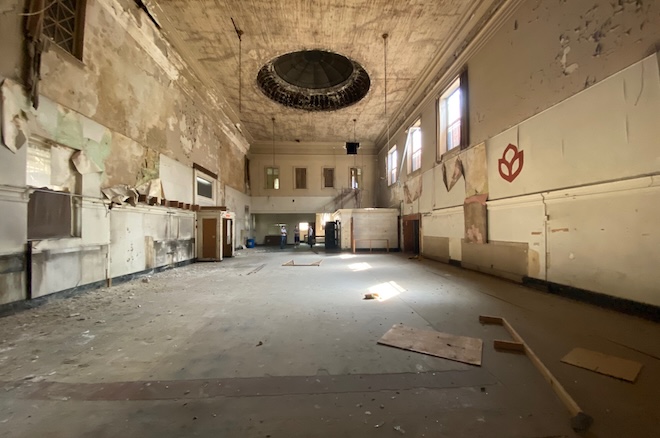
Inside, sepia-hued light pours in from the windows and the stained glass skylight. The walls — though covered in layers of dirt and graffiti — feature marble wainscoting that, once power-washed, will provide a glimmering backdrop for any number of events.
“When I walked in today, the first thing I thought of was a wedding,” says Natasha Strother Lassiter, as we step around puddles, rusted nails and other detritus. She’s the chief strategy officer for the catering and food-service company Strother Enterprises, a three-generation, family business. As we walk, she describes a long, serpentine banquet table stretching through the room. In one corner, she envisions a modular bar. In another, a stage.
“We can create the space based on what the client wants,” she says. When we spoke on the phone a few weeks before the site visit, she warned me: “It requires a lot of vision right now because it’s an old bank building, but I could see it could be a really beautiful event space.” She’s already planning weddings, corporate events, and luncheons.
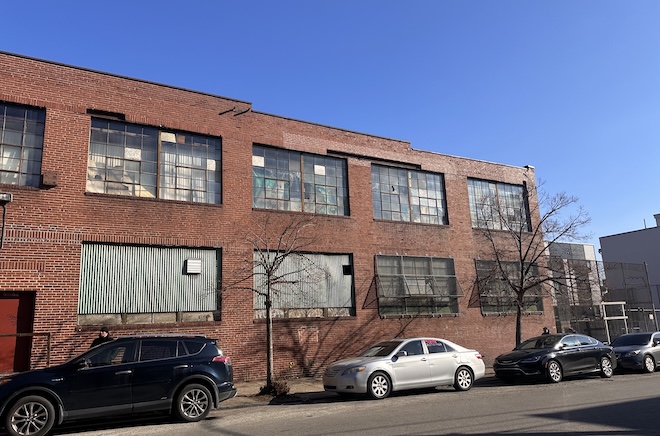
In a few years time the bank will be Strother Enterprises’s new home. They’re the anchor tenant in serial entrepreneur Tayyib Smith and real estate mogul Jacob Roller’s adaptive reuse redevelopment of the 8,000 square foot space. In addition to the event space, Strothers will operate a commercial kitchen in the basement and will be moving their headquarters to the site. Smith & Roller is also redeveloping the adjacent 36,000 square foot abandoned factory and adjacent 13,000 square foot parking lot, with plans for housing and retail on the two sites. The two projects are a $35 million investment.
But Smith and Roller have something more ambitious than your warehouse-turned-condos in mind. They’re working with the nonprofit Impact Services to develop a workforce training component to the project. Impact Services will train kitchen workers for Strother’s. The partners estimate the project will create 70 full-time and more than 200 indirect employment opportunities.
The development will also create growth opportunities for local businesses owned by people from underrepresented groups. Strother, as well as the other tenants — Bower Cafe and a new concept from Kurt Evans, the chef behind Down North Pizza and Black Dragon Takeout — are all Black owned-businesses. Sixty percent of the 109 apartments will be designated for people who earn 80 percent or less of the Area Median Income (AMI), about $68,750 for one person.
With this project, Smith and Roller join a cohort of developers in Philadelphia — including in Kensington — reconsidering how development can interact with and impact communities. Socially-conscious developer Shift Capital has been working to reimagine how development can benefit communities in Kensington for more than a decade. In 2015, D3 Developers opened an apartment complex in East Kensington with the goal of making it cheaper and easier for teachers. Jumpstart, which began in Germantown and has expanded across the region, trains people to buy and renovate residential properties in their neighborhoods.
Their new project is an answer to a question Smith and Roller have long pondered: What does it look like when private development doesn’t just inhabit a neighborhood, but acts as a tool for community wealth-building?
Can developers help communities build wealth?
Smith and Roller have long gotten used to telling the story of their “meet cute.”
They first crossed paths at a jazz festival in Brewerytown more than a decade ago. Roller, who worked in real estate development in the neighborhood, was one of the festival’s organizers. Smith’s marketing agency Little Giant Creative convinced his client Heineken to sponsor it.
At the time, Smith was asking a number of developers “well-intentioned, naive questions about how do you do development without displacing people,” he says. He knew a lot of Philadelphia’s grim statistics: the 20.3 percent poverty rate, the gulf-like racial wealth gap, wherein the median household income in 2024 was 48,275<spanstyle=”font-weight:400;” target=”_blank” rel=”noopener”>forBlackPhiladelphiansand<ahref=”https://www.pew.org/en/research-and-analysis/reports/2026/04/philadelphia-2026″ target=”_blank” rel=”noopener”><spanstyle=”font-weight:400;” target=”_blank” rel=”noopener”>81,282 for White Philadelphians.
Smith, a lifelong Philadelphian, had also seen businesses — Continental in Old City, Silk City in Northern Liberties, Johnny Brenda’s in Fishtown — become anchors for neighborhood change, and oftentimes gentrification. He wondered what it would take for developments to benefit communities.
“People think they know what a real estate developer does, but outside of the negative connotations of the term for a lot of community members, most people don’t know what the machinations of development are,” Smith says.
He attended Chicago-based activist and artist Theaster Gates’ Ethical Redevelopment Salon and dipped his toes into real estate with the Center City coworking space Pipeline, but he was still learning about development and its potential impacts. Roller “was one of a handful of people who answered me with empathy, curiosity and some sense of commitment to the communities he was working in,” Smith says. So one day he showed up at Roller’s office, ready to ask him some questions. The meeting started a conversation that continued over coffee and beers right through to today.
Unlike Smith, Roller had grown up around the world of real estate. His father Jerry Roller is the founder of the architectural firm JKRP; Roller the son has worked in development for more than 20 years. When he and Smith met he was also grappling with questions about development and its impact on neighborhoods. Roller likes to compare the flow of capital into hot neighborhoods as similar to water. Investment dollars, like rain during a downpour, is coming to neighborhoods like Kensington no matter what. Roller’s question: How can we direct that flow so that it helps, rather than harms, existing residents?
“When we build, we ask how do we direct water to where we want it to go so that it doesn’t cause damage? That could be as simple as putting a pitch on a roof or having a gutter and a downspout,” Roller says. “What we’re saying is here’s this big capital investment. How does it benefit more than just the developer and the lenders and the contractors?”
In 2019, they formed their partnership, Smith & Roller, with the goal of taking on “ethical” real estate development projects. That could look like projects that tackle the racial wealth gap or those that invest money into improving communities for the residents who already live there. Their first deal was an investment in J-Centrel, a mixed-use housing and retail space from Shift Capital.
The historic National Textile Bank project
The bank came into the picture early on in their partnership — neither Smith nor Roller remember exactly what year. The New Kensington CDC invited them out to tour the property and meet the owner.
Built in the 1900s, the National Textile Bank was one of several banks built during that era to finance the city’s burgeoning industrial and manufacturing industries. Two other banks from the neighborhood — the Ninth National Bank and Industrial Title and Savings Trust Co. — were torn down and redeveloped in the 2010s after being left derelict for years. But the National Textile Bank survived.
Roller remembers being struck by the building’s beauty (“everything is strong and stone and has a monumental feel,” he says), but also its location. It stands right across from the Huntingdon El stop and is near Temple Episcopal hospital.
“It was just so dramatic it took my breath away,” Roller says. “We’re hoping to bring positive energy and life to this really important connector street.”
They were intrigued by the site, but the owner wasn’t interested in selling yet. When it did go on the market, Smith and Roller immediately put in an offer. They closed in winter 2024.
From there, they started planning. The Bank is on the National Register of Historic Places and Philadelphia’s Historic Register, so they needed to get their plans approved by both the City and the National Park Services.
In the meantime, Smith and Strother Lassiter connected through a mutual friend: Jill Scott. They both know the Philadelphia-born R&B singer, attended one of her local concerts a few years back, and struck up a conversation over drinks after the show.Strother Lassiter told Smith about her business and he told her about the project.
“I’m excited about the impact that I hope that we can make in the community,” Strother Lassiter says. “I don’t want to oversell it. I know there’s a lot of work to be done in that neighborhood, but even if we’re just a small part, I’m excited about being a part of it.”
Smith also knew Casey O’Donnell, president and CEO of Impact Services. The two were both founding board members of Kensington Corridor Trust. Impact Services has created a variety of workforce training programs for people recovering from addiction or returning from incarceration. They also provide loans and offer a variety of housing services.
O’Donnell appreciates Smith and Roller’s efforts to integrate workforce development from the earliest stages of the project. One thing he’s noticed in his years working in Kensington is that there aren’t a lot of job options for people in the neighborhood who are recovering from addiction or returning from prison. Businesses or developers who try to add workforce development components at the end of a project don’t succeed, O’Donnell says.
“Often there’s no mechanism to help people move towards the next phase of life once they’ve entered recovery,” O’Donnell says. “Culinary work isn’t super high paying, but it’s a way to get back into life and employment.”
An investment from the state
It’s too early to say what broader effect Smith and Roller’s redevelopment of the historic National Textile Bank will have on Kensington or Philadelphia’s racial wealth gap. The project hasn’t yet broken ground. They plan to start construction this fall and then there will be a year or so of renovations before Strothers can occupy the space.
But everyone involved, from Smith and Roller to Strother Lassiter to O’Donnell, is optimistic.
“The Huntingdon stop continues to be really rough, and there needs to be an anchor project to help stabilize that intersection” O’Donnell says. “This project fits with this place-based, people-focused strategy to stabilize that area.”
Pennsylvania’s government also has faith in the project. Smith & Roller received $1 million from the state’s Redevelopment Assistance Capital Program. State Senators Nikil Saval and Vincent Hughes, State Representatives Joe Hohenstein and Ben Waxman, and Councilmember Mark Squilla all supported the allocation.
Smith and Roller aren’t the only community-minded developers in Kensington. Since 2019, Kensington Corridor Trust (KCT) has bought properties in the neighborhood and placed them in a “perpetual trust,” to preserve affordability. Tenants pay below market rate rents and neighbors vote on what the properties should be used for. KCT owns 32 properties, worth more than $10 million and they’re poised to acquire J-Centrel from Shift Capital.
“The history of Kensington is rich. This was a community that was once called the workshop of the world,” says Jasmin Velez, development and communications manager, KCT. “What we hope for the community is that we are revitalizing or at least activating spaces again in ways that are going to benefit the community.”
Neither Smith nor Roller claim that this project is a panacea. Kensington is still dealing with a polysubstance crisis — opioids, fentanyl, medetomidine. It will take government, nonprofit and public health interventions, in addition to private investment to tackle all the challenges the neighborhood faces.
But Smith and Roller see their project as one piece in a broader puzzle that brings together nonprofits like Impact Services, businesses like Strother, and the many community groups, government efforts, and yes, other private development efforts to revitalize a long-neglected neighborhood.
“I don’t claim that it’s going to be an easy road,” Smith says. “But it’s one we’ve already committed many years to, and we’re going to continue to work on.”
 MORE DEVELOPMENT FOR GOOD
