


Last weekend, federal agents arrested a 21-year-old Pennsylvania man from the suburbs of Pittsburgh, who they say was preparing to carry out an ISIS-inspired mass shooting. According to prosecutors, Jonathan Hunter Kramer had repeatedly pledged allegiance to ISIS online, shared extremist propaganda, and told others that he was ready for a “mission” as soon as he could obtain a weapon. Kramer obtained a semi-automatic weapon in a Walmart parking lot from another individual, then purchased 190 rounds of ammo from Dunham’s Sports, bought a disposable phone, and was then arrested outside his hotel room, where the FBI found these items, 30 knives, and a note that said, “I can’t live in constant Fear!”
Thankfully, Kramer was stopped by the FBI and PA State Police before he could conduct the mass shooting he talked online about doing. He previously was arrested as a delinquent minor for a separate mass casualty plot and has a history of coordinating violence using encrypted platforms by discussing chemical poisons, drone delivery explosives, and firearm attacks. Luckily, an individual reported his behavior to law enforcement.
No doubt getting this ISIS surrogate Jonathan Hunter Kramer off the streets before he did harm this week was a good thing, but it does bring up the balance of using frontier technology, including AI, to empower law enforcement to fulfill the most sacred duty of our government — to keep our families safe — while abiding by our Constitution.
Flock cameras are a bad AI use case
Benjamin Franklin, who later delivered the closing speech at the Constitutional Convention, had warned decades earlier about the tradeoff between liberty and security. In 1755, he wrote, “Those who would give up essential liberty, to purchase a little temporary safety, deserve neither liberty nor safety.” While Franklin was referring to taxes at that time, imagine the Orwellian horror of knowing every time you drove your car you were being secretly recorded.
That is the controversy surrounding Flock cameras, automated license-plate readers now deployed across the country. It is one thing to know that police can run your license plate. It is another to learn that cameras may be logging where your car appears, over and over again, and storing those sightings in a searchable system. The technology is bringing Americans closer to a form of pervasive surveillance long associated with more intrusive states, where the government can build a detailed record of where ordinary people go and when.
PA is now having this argument in real time. Flock cameras are already in use across the state, and the backlash has been strong enough that Governor Josh Shapiro has joined calls to restrict or ban them. The fight is bringing a broader concern into focus about technology giving government new powers faster than the rules governing those powers can keep up. The cameras record license plates along with details about passing vehicles, including when and where they were seen, creating a searchable record of a car’s movements. More than 120,000 Flock cameras are deployed nationally, according to the company, while thousands of automated license-plate readers have been identified across PA.
At an AI summit in Pittsburgh last Thursday, Shapiro called for federal regulation of AI, comparing it to the safety standards imposed on pharmaceuticals and commercial aviation.
For years, much of the AI debate focused on what the technology might someday become. PA is confronting the more immediate problem of what happens when AI enters institutions that already hold enormous amounts of information and power.
Police departments argue that this kind of network can help locate stolen cars, identify suspects, and solve crimes more quickly. Civil liberties advocates worry that the same infrastructure can create an enormous record of innocent people’s movements without them ever knowing they entered a database.
Shapiro sided with the skeptics. “This is not something in the public interest,” he said, while making clear that law enforcement still needs effective tools to keep communities safe.
This past weekend, Governor Shapiro weighed in on an even larger AI debate after Anthropic CEO Dario Amodei warned about the risks posed by increasingly powerful systems. Shapiro called the warning a “bright red flashing light” for Washington and argued that development of the technology should not be left entirely to private companies.
Taken together, the two episodes capture where the politics of AI is heading.
For years, much of the AI debate focused on what the technology might someday become. PA is confronting the more immediate problem of what happens when AI enters institutions that already hold enormous amounts of information and power.
AI now describes such a wide range of technology that the term can obscure more than it explains. A camera network that creates a searchable record of people’s movements raises very different concerns from software that helps a detective search hundreds of hours of body-camera footage.
The better way to judge these systems is by what they actually allow government to do. Do they create new surveillance powers, make consequential decisions on their own, or help human beings work more efficiently with information they already possess?
Flock makes the distinction easy to see. A license-plate reader is not especially remarkable on its own. Once thousands of cameras continuously record vehicles and those sightings become searchable across jurisdictions, the scale changes the nature of the power.
A tool that might be perfectly reasonable in one investigation can become something different when it produces a historical record of everyone’s movements.
This is also why it would be a mistake to treat every use of AI in law enforcement as another version of Flock.
Good use of AI in law enforcement
Federal prisons already generate an enormous amount of recorded phone traffic that law enforcement is legally allowed to review. In practice, that can mean asking someone to sit through hundreds of hours of calls, listening for the few minutes that may actually matter to an investigation or prosecution. It is tedious work, and not exactly the kind of job people are lining up to do.
This is the kind of problem Flash AI is built to solve. The Ohio company uses AI to search and analyze evidence investigators already lawfully possess, including jail calls, body-camera footage, witness interviews, documents and phone extractions. Instead of replacing the investigator, the software helps narrow a mountain of material into the pieces that deserve human attention. In an Ohio statewide corrections deployment that has been running for more than three months, the company says the system has processed more than 300 million minutes of inmate call audio. Whitehall Police Department has separately reported an average reduction of roughly 80 percent in caseload time, literally saving days of man-hours to just hours utilizing their technology.
That makes it fundamentally different from the Flock surveillance system that is constantly collecting new information about people who are suspected of nothing. Flash is designed to help investigators understand an existing case more quickly while keeping its conclusions traceable back to the original evidence, which is a more ethical model for AI because it makes government more capable without giving it a new power to watch the public.
That does not remove the need for scrutiny, but it gives us a better standard for judging AI: whether it helps people do their jobs more effectively while preserving human accountability, limiting unnecessary surveillance, and abiding by our constitutional protections under the Bill of Rights.
The fight is bringing a broader concern into focus about technology giving government new powers faster than the rules governing those powers can keep up.
I have become wary of technological debates that begin with the name of the technology rather than the power being exercised. The invention of a new tool does not repeal old democratic principles. Government should still have to justify searches and, in most cases, have to get court approval. Evidence should still be reviewable. Trial decisions and rules of evidence must still have accountable human beings behind them. Citizens should still know when the state acquires powers that would have been unimaginable a generation ago.
At the same time, government cannot reasonably respond to every new technology by delaying thoughtful implementation. We must understand that law enforcement executes the most sacred duty of government — keeping our families safe.
Police departments confront enormous amounts of digital evidence. Body cameras alone can generate hours of footage from a single incident. Investigators may have phone records, videos, documents, audio files and interviews scattered across different systems. There is a legitimate public interest in giving professionals tools that let them find relevant evidence faster, especially when those tools make the reasoning more transparent rather than less.
This is where the next stage of AI policy becomes harder and, I think, much more useful.
The goal should be to get the benefits of new technology without giving institutions powers that outrun the rules meant to govern them. Sometimes that will mean rejecting a particular use. In other cases, it will mean allowing the technology with clear limits on data, access and human review.
Promises made, promises kept
PA may be stumbling toward that framework in real time.
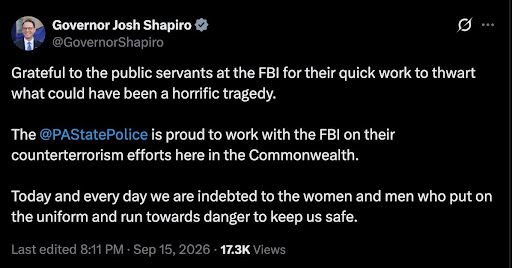
One and a half years after Governor Shapiro and his family were assaulted in their home by a domestic terrorist, he got it right when he publicly thanked the FBI and the PA State Police last Last Tuesday, Shapiro posted to X expressing his gratitude to the FBI and PA State Police for their swift action.
As someone who comes from a law enforcement family, proudly served as a federal and military prosecutor, and chaired Governor Shapiro’s Public Safety Transition Team, I’m proud of his work putting more cops on the street, including funding 16 more state police cadet classes totalling 1,600 new troopers, and his ‘smart on crime’ approach including creating the PA Violence Research Center for evidence-based community violence intervention (CVI) programs. In politics, there are workhorses and showhorses, Shapiro is a workhorse, so I was honored to sign my name to this flyer by Kennedy Democrats:

But as a prosecutor and former constitutional law professor, I also appreciate Shapiro’s positions threading the needle with balance, his correct stance on Flock cameras and empowering law enforcement when appropriate by utilizing frontier AI technology, which on the outside can look like separate news stories, but they are really part of the same political and constitutional question. Americans are becoming less interested in whether artificial intelligence is exciting or frightening in the abstract. They want to know what happens when it enters the government that already has the power to police, regulate and make decisions about their lives.
While Congress has been stagnant with AI — debating whether there should be an AI Special Committee — and President Trump suggesting an ‘AI Force’ modeled after the Space Force but appointing an AI czar, he has largely dismissed calls for increased regulation, even while technologists like Elon Musk have said there’s a 10 to 20 percent risk that advanced AI could be the end of human extinction.
Who is watching? What is being recorded? What is the machine deciding? Can somebody explain how it reached that conclusion? Is there an outside entity like the courts reviewing these decisions? And when something goes wrong, who answers for it?
Those are not anti-technology questions. They are the questions a democracy is supposed to ask whenever somebody acquires a new form of power.
Artificial intelligence is arriving faster than our rules for governing it.
We can still do something about it by keeping our families safe while abiding by our Constitution — Ben Franklin wouldn’t want it any other way — but Congress can’t continue to punt on their consequential issue of our lifetime.
The Honorable Patrick J. Murphy is a Wharton lecturer, vetrepreneur, and the 32nd Army Under Secretary after earning the Bronze Star for service in Baghdad, Iraq as an All-American with the 82nd Airborne Division — @PatrickMurphyPA on Instagram and Twitter. Murphy is a supporter of the Citizen Media Group.
 MORE FROM PATRICK J. MURPHY
