



More than a decade ago, filmmaker Shameka Sawyer had no idea that she would be in charge of a nonprofit. All she knew was that she wanted to create.
Sawyer grew up in Germantown and graduated cum laude with a bachelor’s in communication from the University of Pennsylvania. She’s long been an entrepreneur, having founded and co-founded production companies, produced community screenings for projects like the docuseries Philly D.A., and created promotional videos for Children’s Hospital of Philadelphia and the Economy League.
Listen to the audio edition here:
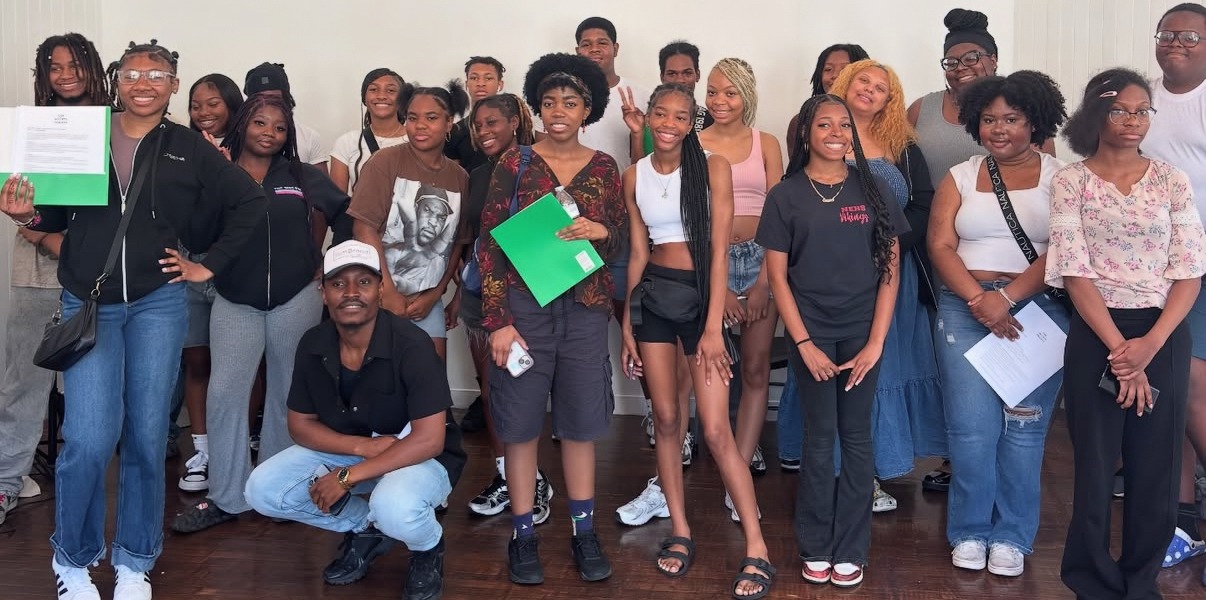
In 2014, she began a collaboration with four other filmmakers. Each was hoping to make one short film to show to their community. It wasn’t long before community members started noticing, and asking if they could make their own films. Now, over a decade later, the project Sawyer began is a Germantown-based organization that has supported over 100 similarly aspiring creators of color, ages ranging from 13 to 60 — teaching them to write scripts, film and edit footage. They’ve created documentaries, dramas and horror short films.
Some have had red carpet premieres. But all have made a dent in yet another industry that has historically been dominated by White men.
In a city that not so long ago hoped to be an East Coast Hollywood, 5 Shorts Project provides a supportive, accessible means to use filmmaking not necessarily as a way to get your name in lights or make millions, but as an outlet to go inward, and discover strength in art-making.
“If I’d known [5 Shorts Project] would have been around so long, I probably would’ve given it a different name,” Sawyer jokes. More seriously, she says, “It’s beautiful to watch people who thought [filmmaking] was not a possibility for them see their work on a screen and see the audience react to a film of theirs.”
Sawyer sees potential in all her students, but for eight weeks each summer, she leads a project that is even nearer and dearer to her heart: She teaches Philly students to create a documentary exploring solutions to gun violence.
‘Bout Mine I Matter
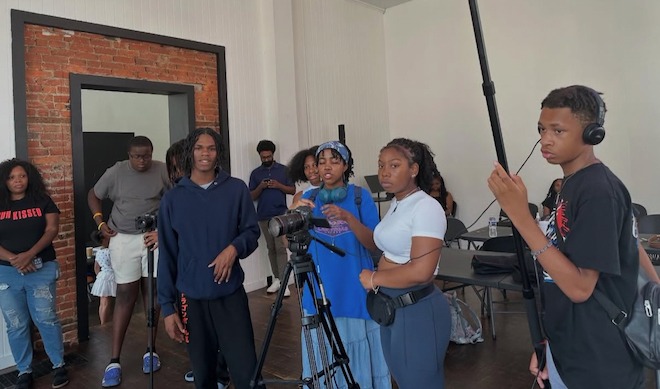
Since the summer of 2022, the ‘Bout Mine I Matter initiative has been a centerpiece of the 5 Shorts Project. The free program is geared towards Germantown teens, aged 13 to 19, who have been directly impacted by gun violence. Held at the Our House Culture Center, ‘Bout Mine I Matter students meet twice a week and receive a stipend for participating, free transportation to the venue, lunch, and once a week, group-based behavioral health counseling. Some participants have returned for all three summers.
The idea for the workshop came out of Sawyer’s own life and healing journey. In June 2020, she lost her brother, Allen Taylor Jr., to gun violence, just a block away from their family home in Germantown. Almost a year to the day after Taylor’s passing, his son was shot, in almost the same place. Sawyer’s nephew survived, but their family was permanently shaken.
Sawyer turned to the medium she knew best to help her process the pain, creating the documentary Sometimes I Cry in June. But she wanted to do even more. Taylor cared deeply about youth mentorship and had a t-shirt line before his passing he named ‘Bout Mine. Sawyer created the summer youth program to keep his memory alive by teaching youth how to express themselves while fighting against the scourge of gun violence that continues to plague our city.
“Even if we don’t have a lot of high profile power as community members, we can figure out ways to make our communities better, safer, and provide spaces for our young people to feel safe and do creative things” Sawyer reflects. “I don’t have a ton of money or connections, but I do love filmmaking.”
“It’s really hard to forget a good story, something you actually saw. People don’t have to feel like they’re to blame, but that they can be a solution.” — Shameka Sawyer, 5 Shorts Project
So far, 30 students have participated in ‘Bout Mine I Matter — and made three films in all.
The organization has received funding from a number of organizations. This year’s supporters include the Philadelphia Cultural Fund, the Independent Public Media Fund, and DATA CoLab. The latter, which is run through the District Attorney’s Office, provides eight Philly community organizations focused on nonviolence with funding and data training. In return, this summer’s documentary utilizes numbers and direct data from the researchers to inform viewers (Germantown residents and otherwise) about the impact that crime can have on communities.
This summer’s cohort was the largest so far: 20 students. Because every year focuses on a new theme, every year feels a little bit different. Previous ‘Bout Mine work has centered on policing, parent influence, and destigmatizing stereotypes around the incarceration re-entry process. This year’s film has a highly unusual focus: rodents.
Gun violence and the environment
Sanaa Holley, a senior at Northeast High School, did a summer internship with the Bloomberg Arts Program, which, through the Philadelphia Cultural Alliance, matches rising high school seniors with Philly-based arts and culture organizations. Holley was thrilled when she matched with the 5 Shorts Project. “I was like I can make movies!” she recalls thinking.
While Holley does not have direct connections to gun violence, she quickly began to feel the relevance and importance of conversations and art-making surrounding the subject.
“The program made me realize how many people have been impacted by it,” she says. “Now I think about it every time I go out.”
This year’s documentary project is Seen, which will be screened next year (date TBA). The team worked with Yale PhD candidate Gabriel Gadsden, an environmentalist whose research connects neighborhoods’ physical environments, particularly their levels of rodent populations, as contributing to elevated levels of gun violence. Gadsden’s research has 15 sites across the city. One is Cliveden Park in Germantown.
“Rodents are the canary in the coal mine,” Gadsden says. “They are indicative of poverty, of blight, of disenfranchisement, of neglect.” His mother is from Philadelphia and he grew up visiting the area. He explains his work this way: “To be an urban ecologist is to both recognize the beauty and not discount the problems.”
“Before this program, I wasn’t the biggest fan of documentaries. Now I see how important they are to society.” — Sanaa Holley, Northeast Philadelphia High School
Gadsden’s uncle is a police chaplain living in Wynnefield Heights who helped connect him to the 57 Blocks Coalition, a program that aims to reduce gun violence on the 57 hardest hit blocks in the city, including in Germantown, which is where he learned about 5 Shorts. He and Sawyer discussed collaborating, and landed on working with ’Bout Mine students. Together, they researched how beautifying neighborhood spaces strengthens community and decreases gun violence.
The students worked alongside Gadsden in Cliveden Park, getting to know the environment and shooting film. They came up with an idea to create a memorial there — to Sawyer’s brother, who was killed just across the street from the park — and other victims of gun violence. It’s all part of the healing process not only for them, but also for Sawyer, who has happy childhood memories of playing at Cliveden, but after her brother’s murder, hadn’t been able to go back.
In a case of the students teaching the teacher, Sawyer now realizes the importance of confronting the site of the trauma. “I’m not going to give that person who did this [murdered Taylor] that much power over how I see this area,” she says.
More than just filmmaking
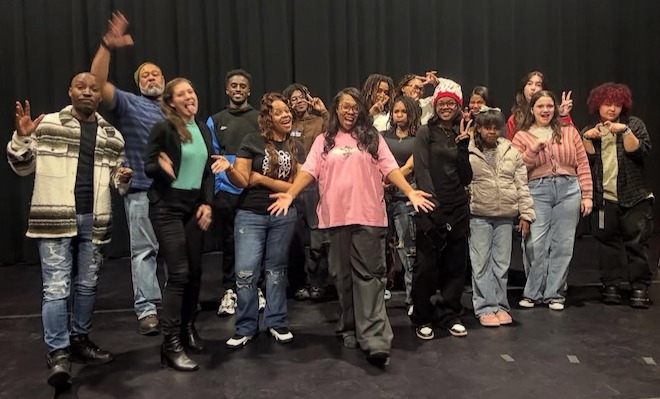
Healing is the goal of ’Bout Mine I Matter, which is why weekly, trauma-focused behavioral health counseling is a key component of the program Sawyer remembers how difficult it was for her family to find mental health resources after her brother died. “We knew we needed it, but we’re also grieving,” she says. “Who feels like searching out someone to talk to in that sort of situation?”
Through these group workshops, the youth can begin to open up about the difficult situations they are in.
Sawyer believes that filmmaking also has the potential to be a truly transformative solution — not only because the process of making the film, but also because of what happens when people leave the theater. “It’s really hard to forget a good story, something you actually saw,” she says. “People don’t have to feel like they’re to blame, but that they can be a solution.”
For her part, Holley hopes City Hall pays attention to the students’ work. “I think our city officials should be watching. The Mayor, City Council… These are people who need to see it because they are people who could make change,” she says.
Moreover, she believes in the power of filmmaking to make real change. “Before this program, I wasn’t the biggest fan of documentaries,” she confesses. “Now I see how important they are to society.”
 MORE ON PROTECTING OUR YOUTH