



Pennsylvania spends roughly $200,000 a year for each juvenile it incarcerates, according to a 2021 report from the bipartisan Pennsylvania Juvenile Justice Task Force.
That’s 50 times the cost to deliver evidence-based family therapy that could prevent kids from entering the justice system in the first place.
In Philadelphia, juvenile incarceration involves confinement in the city‑run Philadelphia Juvenile Justice Services Center or other residential placement facility.
Young people leave these facilities with lower chances of graduating high school, frayed mental health and a higher likelihood of rearrest or being shot.
The social, emotional and economic costs of incarcerating young people are compounded in Philadelphia where, on any given day, dozens of youth may be held in the Juvenile Justice Services Center after they have been sentenced because a secure facility bed is not available.
That waiting time, which can be months, is punitive and unjust because it is not credited toward their sentence.
Drawing on almost 35 years of work in Philadelphia and other cities to understand what makes neighborhoods safer, I believe the surest returns come from prevention strategies aimed at young people who are not yet enmeshed in robberies, shootings and gang activity.
Homicides in Philadelphia are at their lowest levels in 25 years. In my view, this is an opportunity to redirect even youth who are already involved in violence away from the costly and counterproductive cycle of incarceration and into targeted, relationship-focused intervention programs that are humane, voluntary and effective.
At least two such programs exist here in Philadelphia — but on a modest scale.
School-based case management at Bartram High
In Southwest Philly, John Bartram High School’s Youth Violence Reduction Initiative launched in 2023.
It was designed by former School Safety Chief and now Philadelphia Police Commissioner Kevin Bethel, School Safety Officer and Program Manager Kevin Rosa, criminal justice researcher Brandy Blasko, and me.
Students who have been involved in fights or show other risk factors for violence and street gang involvement are referred to the program.
The initiative’s core idea is simple: Earn students’ trust through consistent, credible mentorship — and step in when needed. Stepping in means teaching conflict resolution skills, running engaging workshops, buying a meal, or intervening when a fight is brewing or a student is on the verge of being expelled.
Each week, a team of administrators, counselors, school safety officers and community outreach workers, most of whom are based in the school, review every participant’s progress. They track follow-through on referrals and coordinate communication with families and school staff.
One of the most reliable turning points for high-risk youth is a stable, caring relationship with an adult who refuses to give up on them.
The tightly managed, relationship-driven safety net gives students quicker access to help and makes the school climate calmer and safer.
Prior to 2023, on average, five Bartram High students were victims of firearm assault — at least one fatally — each school year.
At the 2025 National Conference on Juvenile Justice, program leaders presented evidence of an 80 percent decrease in firearm assaults by students and a 31 percent decrease in student-on-student assaults that did not involve guns. They also reported a 92 percent decrease in gang-involved group assaults, a 67 percent drop in student-on-staff assaults and a 62 percent drop in school incidents involving police.
More rigorous analysis needs to be done to verify that the program itself produced these results and some other factor wasn’t involved.
The program costs roughly $120,000 to serve 30 to 35 teenagers over a school year. That covers two full-time case managers, one part-time program manager and a small discretionary fund. The fund can be used for things such as local trips to museums, paying guest speakers and incentives for participant milestones.
Community-based support in West and Southwest Philly
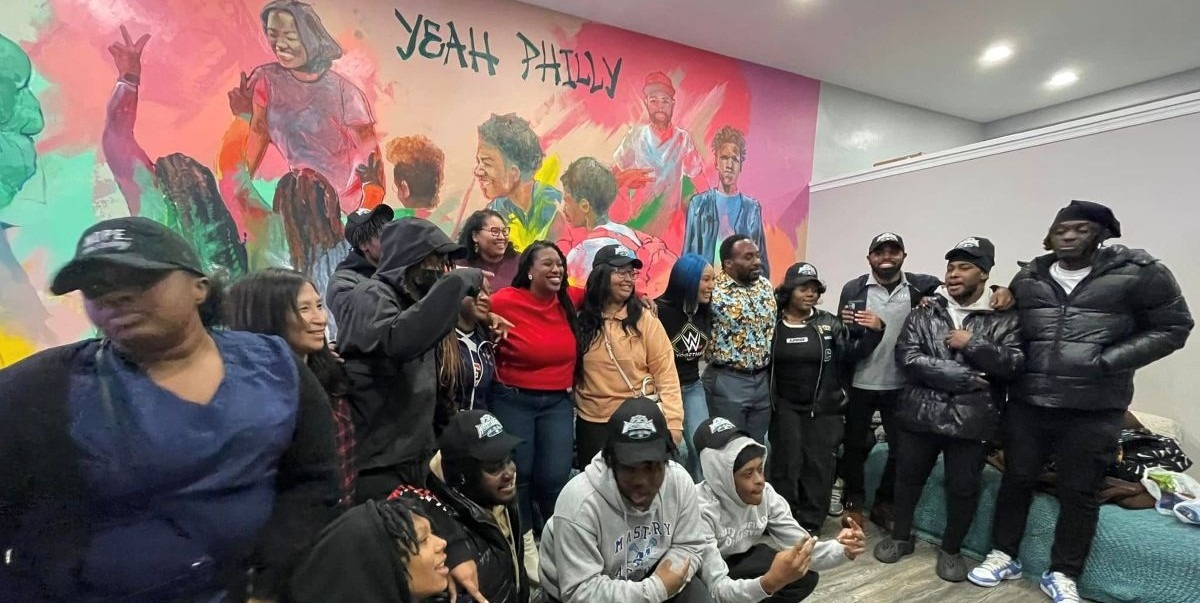
The nonprofit YEAH Philly launched its Violent Crime Initiative in late 2020 for young people ages 15 to 24 from West and Southwest Philadelphia who have been charged with a violent or gun-related offense.
It takes the same relationship-based playbook the Youth Violence Reduction Initiative uses and amplifies it.
Court advocacy, cash stipends and intensive case management stay on tap for as long as a young person wants them. Since its inception, the voluntary program has served almost 200 people. Currently, 22 Philly youth receive Violent Crime Initiative services.
Flexible funding enables case managers to address nearly any support need that arises, going well beyond standard program budgets. This could mean a young person receives full tuition support for a two-year dental technician program while also attending intensive remedial writing workshops. Meanwhile, a partnership with Project HOME can secure subsidized housing at Kate’s Place in Center City.
The approach emphasizes connection, case management and skill-building — key elements shown to help young people thrive when supported by caring, consistent adults.
I analyzed arrest data following a cohort of 93 young people who received Violent Crime Initiative services between January 2020 and April 2025. Among participants with two or more prior arrests, the rearrest rate was 60 percent. That’s compared to over 80 percent documented in a 2023 report prepared for the Philadelphia District Attorney’s office that analyzed data on Philadelphia juveniles arrested in 2016. However, we haven’t been collecting data on all of the Violent Crime Initiative participants for as long, so the two figures are not perfectly comparable.
The power of credible, caring adults
Fostering deep engagement with positive role models is not a feel-good add-on. It is evidence-based public safety policy.
Research shows clearly that one of the most reliable turning points for high-risk youth is a stable, caring relationship with an adult who refuses to give up on them. This can be a teacher, coach, grandparent or any other trusted adult who provides consistent positive support and guidance and opens doors to new opportunities.
The surest returns come from prevention strategies aimed at young people who are not yet enmeshed in robberies, shootings and gang activity.
My own research on how and why young people leave street gangs underscores just how powerful such relationships can be. I also led a three-study synthesis with colleagues from Arizona State University and the University of Colorado-Boulder that reviewed research involving 784 former gang members in 13 U.S. cities. We wanted to understand what actually moves young people out of gang life.
The clearest pattern was positive relationships. “Push” forces, such as fatigue from violence or pressure from police, opened the exit door for many. But lasting change required equally strong “pulls” toward stable, positive relationships.
Data-sharing enables early intervention
After decades of evaluating both successful and failed public safety initiatives, I can say the biggest hurdle to developing cost-effective policies that reduce youth violence is the lack of coordinated, cross-agency use of data.
Cities need more than justice system records to guide their efforts. They need integrated information from schools, housing, behavioral health and community services.
With the right tools, early warning signs such as chronic school absence, school and neighborhood fights, and gun carrying can be flagged and young people matched with evidence-based programs and services they choose to participate in, rather than being mandated by the court, before a major crisis occurs.
Philadelphia already has the technical backbone for this work.
The Integrated Data for Evidence & Action or, “IDEA,” warehouse is a secure, City-run system that links administrative records across agencies. It allows officials to analyze patterns of risk across education, justice, housing and health systems, and it is used to support policy priorities such as Mayor Cherelle Parker’s public safety goal of reducing homicides by 20 percent.
Philadelphia also uses multidisciplinary planning meetings to configure services after a juvenile is released from incarceration — but only after incarceration. The meetings bring together the young people and their families with probation officers; attorneys; school, court and community representatives; behavioral health clinicians; and case management teams to coordinate supports that ease reentry and reduce recidivism.
Philadelphia city leaders could apply this coordinated approach earlier in a young person’s life and replace expensive and counterproductive confinement with voluntary, relationship-centered programming, using data from the IDEA warehouse to address early risk, pilot new ideas and track outcomes in real time.
Caterina G. Roman is a Professor of Criminal Justice at Temple University. In addition, she consults for the Office of School Safety within the School District of Philadelphia which runs the Youth Violence Reduction Initiative. She is also supported by the Neubauer Family Foundation as the evaluation partner for YEAH Philly’s Violence Crime Initiative. She is a member of the Advisory Board for Everytown for Gun Safety’s Community Safety Fund.
The Citizen welcomes guest commentary from community members who represent that it is their own work and their own opinion based on true facts that they know firsthand.
 MORE YOUTH VIOLENCE INTERVENTION