





What a year 2025 has been. I kind of can’t believe we made it …
To end on the bright note, I wanted to try to look at some positive things that happened this year. Let’s get to it.
Urban homicides reached generational lows
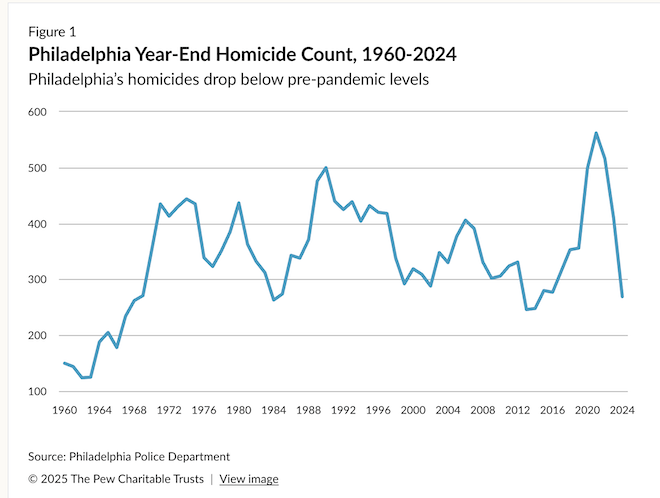
It’s worth noting that cities across the country have seen major reductions in homicides since their pandemic-era spikes. Unless there are some end-of-year tragedies, Philadelphia is on track to have its lowest homicide rate since 1967 — the last year when annual homicides were under 240.
In Baltimore, a December 1 press release from Mayor Scott’s office notes that the city’s “127 homicides represents the fewest number of homicides Baltimore has seen on record since at least 1970.” Wow, just wow.
Before you begin thinking too hard, I know that both Philadelphia and Baltimore had about 400,000 more people in 1970 than they do today, so these aren’t the absolute lowest rates per capita — but still, it’s great news.
Younger people were elected
There was a lot of fuss about Zohran Mamdani’s age — the second youngest mayor of New York ever! — but maybe we should get used to younger people taking elected office again. This year marked a kind of vibe shift in the age of people running — and importantly, winning — office.
According to Pew’s analysis at the start of 2025:
The median age of voting members of the House of Representatives is now 57.5 years. That’s down from 57.9 at the start of the 118th Congress (2023-25), 58.9 in the 117th Congress (2021-23), 58.0 in the 116th (2019-21) and 58.4 in the 115th (2017-19).
The Senate, following the death or retirement of some of its oldest members, has reversed its aging trend. The new Senate’s median age is 64.7 years, down from 65.3 at the start of the previous Congress. The median age of the Senate had previously risen for three Congresses in a row: from 62.4 (115th) to 63.6 (116th), to 64.8 (117th) and to 65.3 (118th).
The winners in this year’s most contested governors’ races — Abigail Spanberger (46) and Mikie Sherill (53) — were both more than a dozen years younger than the incumbents they replaced. Incoming Seattle Mayor Katie Wilson (43) is decades younger than outgoing Mayor Bruce Harrell (67). This bodes well. It will be helpful to have policymakers that are attuned to younger generations’ priorities, like housing, transportation, and child care among others.
2025 was a kind of normal housing market year
After so many years where the housing market was absolutely crazy, this was the year that the housing market stabilized, kind of. Housing prices rose moderately at about 3 percent. Inventory continued to grow in double digits. Sales were still very slow, but maybe that will set things up for a bigger year next year. Some predictions (below) from National Association of Realtors suggests that 2026 housing prices are still going to go up — but still around the pace of inflation — while the number of sales will increase, getting some healthy churn back into the market.
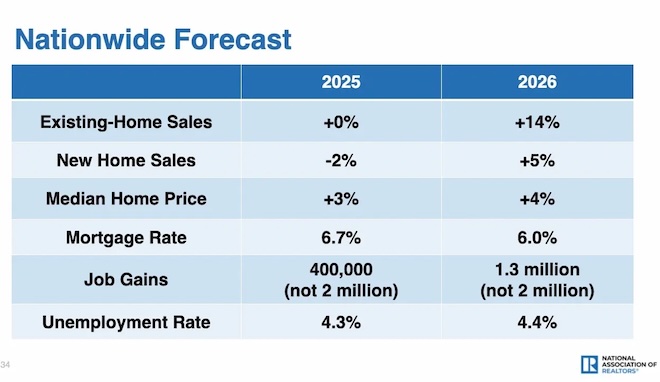
A kind of normal year after so many crazy years still means things are wildly unaffordable, we need to build more housing, and we need to do more to build renter wealth, but — at least it didn’t get so much worse this year.
Statewide regulation of kids on the internet
One of the things that gets me the most down is the sense that the tech overlords have control of our lives. It is then intriguing to see that eight states (Arkansas, California, Florida, Georgia, Louisiana, Mississippi, Ohio, and Tennessee) have enacted legislation that either bans minors from obtaining social media accounts outright and/or requires minors of certain ages to obtain parental consent in order to open accounts.
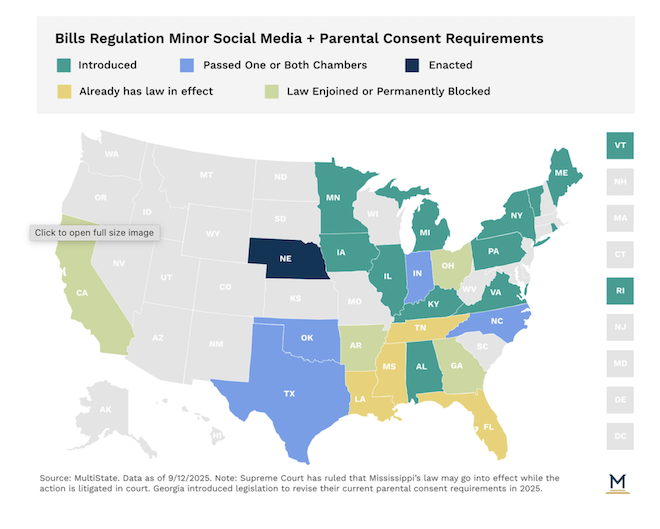
I’m not 100 percent sure that banning social media for minors is the right move — but I do think so much more needs to be done to better regulate the internet, especially for kids. Social media, gambling, porn — I think we’ll look back on the early 2000s in shock in a few decades. I’m excited to see a map like this — it kind of reminds me of seeing how YIMBY policy slowly but surely takes over different states.
Meanwhile, as I’ve written about here and here, we also need to streamline the regulation of the real world. That will make it easier to build housing, have interesting retail, and generally create the kinds of activity that will ensure a better balance between online and in-person activities.
Still, things were particularly bad in one city in 2025. My notes:
Washington, D.C. is in trouble
While we all have felt the daily impact of the Trump administration in different ways, perhaps nowhere has felt the brunt of the President’s chaotic and malicious regime as deeply as Washington, D.C. A recent report out of the Brookings Institution shows the dire impact of an array of issues in D.C. — the National Guard, DOGE and mass firings of the federal workforce. Not only is visitor demand down for D.C., Maryland and Virginia (known as the DMV), but so is local resident spending.
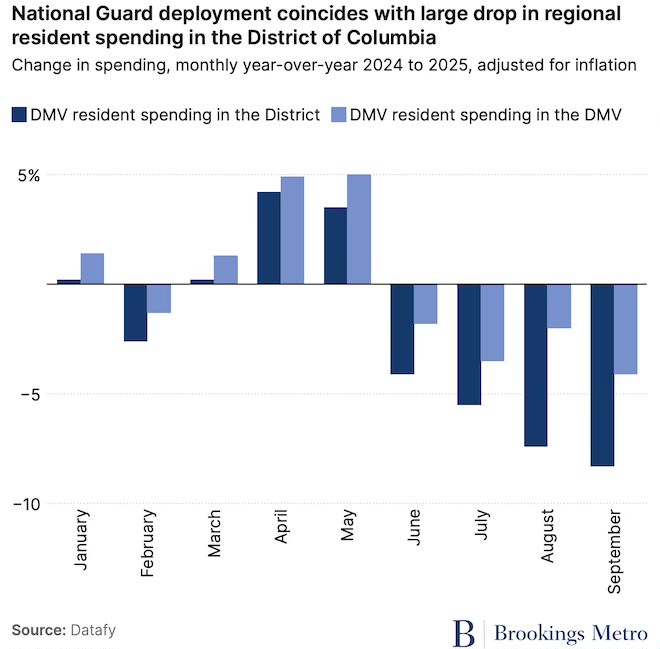
Additionally, the region is not faring well when compared with national indicators — both in terms of job losses and in terms of lower job growth. Housing is lingering on the market resulting in a large increase in for-sale listings.
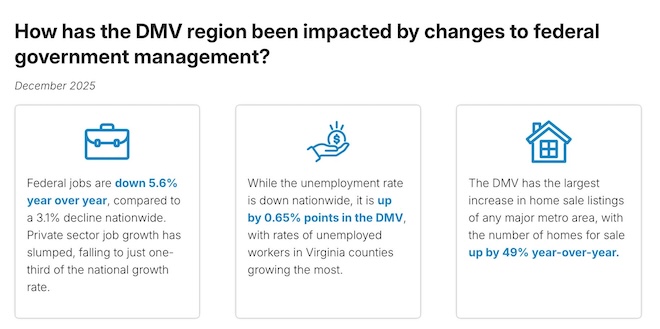
Beyond these concerns, the federal government is trying to sell off some of its several major properties in D.C., such as the HUD headquarters, altogether encompassing several million square feet of office space. These enormous vacant properties are keeping neighborhoods — and frankly the presence of federal workers — in limbo.
In addition, Washington, D.C. has been one of the hotspots for ICE arrests. According to the New York Times:
ICE had made only 85 arrests in Washington from January 20 through the end of July, according to data obtained by the Deportation Data Project. But from early August until mid-September, ICE made around 1,200 arrests, according to officials with knowledge of the data.
This downward trend for D.C. — not just its economy, but its sense of community and soul — is particularly shocking because it was one of the fastest growing cities in the 2010s. Consider that D.C. grew at a rate of nearly 15 percent — more than even Phoenix in the same period — and nearly double the national rate.
So where will D.C. go after 2025?
The only potential good news I can find here is that there is going to be a new mayor elected next year. Nine candidates have already announced they are running. Will new leadership come with new policies and programs to address the many threats to D.C. these days? It’s definitely something to look forward to in 2026.
Diana Lind is a writer and urban policy specialist. This article was also published as part of her Substack newsletter, The New Urban Order. Sign up for the newsletter here.
 MORE FROM THE NEW URBAN ORDER