


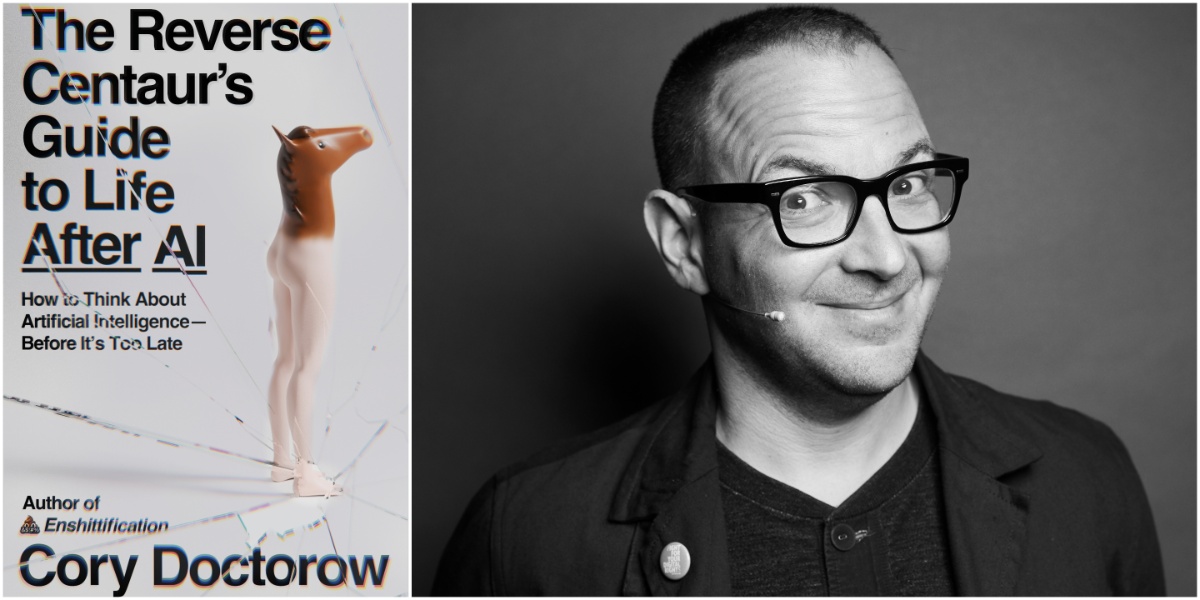


Editor’s note: Below is an excerpt from Cory Doctorow’s new book, The Reverse Centaur’s Guide To Life After AI, which he will discuss with writer and consultant David Williams on June 25, at Fitler Club. RSVP here.

I know lots of writers who use chatbots to produce fine work: they might use the chatbot as a sounding board for evaluating ideas (or variations on ideas), or to challenge them with writing prompts, or to suggest improvements. As I said, I don’t use AI that way, but I know people who do, and I like the things they write.
The difference between … a useful tool and a technological torment is the difference between a centaur and a reverse centaur.
In automation theory (the academic study of automation), a centaur is a person who is assisted by a machine. Think of a clever human’s head, arms, and hands atop a horse’s strong body. Riding a bicycle or driving a car makes you a centaur; so does using the mute button on your TV remote when an ad comes on. Wearing a hearing aid makes you a centaur, and so does using a calculator to multiply large numbers. Being a centaur can be glorious. My whole writing career has been a serious of centaur moves, from the used IBM Selectric my parents bought for me to play with when I was six or seven to the Apple II Plus we got when I was nine, which kicked off an unbroken string of better and better writing tools, with spellcheckers, version control, collaboration features, autosave, and more. Best of all, I get to choose exactly which of these features I use. I work for myself, after all, so if I don’t want to use the grammar checker (hell no), that’s my business. No one expects me to write more pages when I get a new tool. A couple of years ago, a former student of mine asked me to try out his LLM tool that would help me write dialogue and flesh out characters. I played with it for ten minutes and then never went back to it. No one told me I was being uncooperative or spoiling a grand plan to increase efficiency and realize cost savings by refusing to use AI. Sometimes, when I’m really stuck, I write with a pen in a notebook. No one cares, except me.
A reverse centaur is a human who is conscripted into acting as an assistant to a machine. There’s a classic I Love Lucy episode where Lucy and Ethel are working on an assembly line at a chocolate factory, taking bonbons off the belt and wrapping them in paper. As the belt goes faster and faster, Lucy and Ethel have to work at superhuman speed. They’re reverse centaurs: the machine can move the chocolates from one place to another, but it needs a human to pack them into the box, and the humans who act as its assistant are made to work at a pace that exceeds all human capacity until calamity ensues.
I Love Lucy played that bit for laughs. Amazon warehouse workers get the horror-movie version. They are observed by AI-equipped cameras that time their movements and monitor their “time off-task,” penalizing them if they fail to make quota. Amazon warehouse workers experience the highest level of on-the-job injuries in the U.S. warehouse sector, and many of them have to resort to urinating in bottles because a visit to the toilet would blow their quotas. An Amazon warehouse is full of machines, but there are jobs the machines can’t do, and that’s where the Amazon warehouse workers come in — they assist the machines. They are reverse centaurs, and they have been conscripted to serve as peripherals for the warehouse’s automation systems. They aren’t merely used by those Machines — they are used up.
It’s not hard to imagine how a warehouse worker might choose to use AI in their daily work — for example, a computer vision system in a pair of smart glasses system highlights an item they’re looking for in a bin (there’ve been many instances where I’ve stared directly at something without seeing it in which I would have loved this). Automation isn’t necessarily the enemy of warehouse work: there’s nothing wrong with a forklift! The difference between automation that helps a warehouse worker and automation that torments that worker is whether the worker gets to choose where, when, and how to use that automation. It’s the difference between a centaur and a reverse centaur.
The current wave of AI is full of software performing impressive feats in both parsing and generating language and images and sounds. There are lots of interesting, fun, and productive ways to use this technology.
I love the automation system in my car that warns me if I’m drifting out of my lane, and I recently discovered (the hard way!) that if the person ahead of me brakes suddenly, my car will let out a sphincter-puckering series of beeps and activate its own brake. I was pretty happy about that, even if it did come as a hell of a surprise.
Compare that with the drivers in those Amazon vans rolling around your neighborhood. They have to sign into at least nine separate apps, and they are continuously scored based on their driving performance, as assessed by various AI tools. Drivers lose points for braking or swerving (even if that’s the only way to avoid a sudden road hazard) or for deviating from the proscribed route set by the AI (even if there are obstructions or hazards). Drivers have impossible-to-meet quotas and the per-parcel compensation rate drops if they fail to meet it. Drivers are forbidden from peeing in bottles, but also given no time to urinate. The driver is just a peripheral for the van, present only because the van can’t drive itself or get your parcel onto your porch. They are a reverse centaur.
This centaur/reverse centaur distinction is the heart of the paradox at the heart of the debate about the usefulness of AI tools. When you find yourself surrounded by people swearing that a given tool is worse than useless and others swearing that it has made their lives easier and better, you can bet that the former group is made up of reverse centaurs who’ve had AI imposed upon them, the latter group is all centaurs who’ve gotten to make up their own minds about where, when, and how to use AI tools. The solution to the paradox is to stop thinking about what the gadget does, and pay attention to who the gadget does it to and who the gadget does it for. The important part isn’t the technical characteristics of the device, it’s the power relationships of the people who use the device.
…
AI hucksters want you to believe that all the things they call “AI” — an incoherent grab bag of many technologies, some of them not especially related to the rest — are coming, and that when they arrive, there is only one conceivable way that we could use them. This is just high-tech Thatcherism, the inevitabilist move of a bully who insists that they’re only doing what implacable reality demands of them.
This is a book about what AI can and cannot do, but even more important, it’s about the possible social arrangements of AI, from not using some AI technology at all, to using it in ways that let some of us choose to be centaurs, while saving our friends and neighbors from being conscripted into reverse-centaurity.
The current wave of AI is full of software performing impressive feats in both parsing and generating language and images and sounds. There are lots of interesting, fun, and productive ways to use this technology. There is nothing about the technology of AI that determines how it must be used. We can choose to use it sometimes, or never, or all the time, depending on our needs and proclivities. We don’t have to let billionaires tell us how it must be used.
Excerpted from The Reverse Centaur’s Guide To Life After AI, copyright 2026 by Cory Doctorow, published by Farrar, Straus and Giroux.
 BOK EXCERPTS FROM THE CITIZEN