

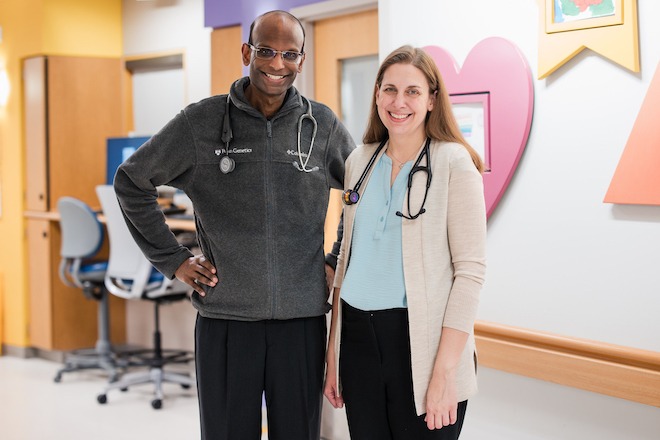
For some people, identifying their professional purpose can be a lifelong pursuit. But Dr. Rebecca “Becca” Ahrens-Nicklas’s destiny became clear during medical school.
“Once I began caring for patients with rare pediatric diseases, I immediately knew this was my calling,” she said during a recent email exchange. “I realized there are so many patients that need help, and that my combined training in both medicine and science may provide a unique skill set that could help bridge the gap between the discoveries in the lab and novel treatments for patients.”
[Editor’s note: Dr. Ahrens-Nicklas is a nominee for The Philadelphia Citizen’s “Rad Girl of the Year.” On July 30, 2025, The Citizen will present the Rad Awards, celebrating dozens of outstanding Philadelphia women and their allies. Find out more information, and get your tickets.]
Her instinct all those years ago proved correct: Earlier this year, in collaboration with colleagues at Penn Medicine, Ahrens-Nicklas successfully treated baby KJ, a patient at CHOP, with a customized CRISPR gene editing therapy (CRISPR is the super sci-fi-sounding technology that allows scientists to precisely tweak a person’s faulty gene sequence). KJ’s disease, CPS1deficiency syndrome, is a rare disorder that occurs in one out of every 1.3 million births; in babies, it has historically often meant a fatal diagnosis.
For KJ, the gene therapy was customized for his specific genetic variants — meaning it only works for him, Ahrens-Nicklas explains. The treatment was administered safely, and while he is not cured, “he is now growing well and thriving, something that wouldn’t have been possible without this intervention.” He was able to return home after spending more than 300 days in the hospital.
Watch this video to learn more about KJ’s astounding journey, and read on to learn more about the brilliant doctor Ahrens-Nicklas.
5 things to know about Dr. Rebecca Ahrens-Nicklas
- She believes in the power of collaboration — in all sectors.
“Rare disease therapy development is the ultimate team sport,” she says. “No one person has the expertise to tackle all the challenges that will inevitably arise.” To develop the first personalized in vivo gene editing therapy, she collaborated closely with Dr. Kiran Musunuru from the University of Pennsylvania. The duo have complementary skills and relied on each other at every step of the development process. Together they recruited a team of more than 100 clinical, academic and industry collaborators. “Each person played a crucial role in quickly translating the pair’s vision into a reality.”
- She believes science can change lives.
“I feel incredibly fortunate to be a physician-scientist at this time in history,” she says. “Groundbreaking fundamental discoveries about how we can regulate and correct misspellings in the genome are now moving into the clinic for the first time. Translating these basic science breakthroughs into effective treatments will transform the care of patients with rare, often-neglected, genetic diseases.” She is also grateful to the patients and families who are willing to participate in the first studies of these therapies. “These pioneers are paving the way for future generations of rare disease patients worldwide.”
- She loves Philadelphia.
After growing up in the Midwest and training in a few cities on the East Coast, Ahrens-Nicklas came to CHOP for her residency more than 15 years ago. She assumed that she would be in Philly for a few years, but her family quickly fell in love with their new hometown and decided to stay for good. And she strongly believes that this project only could have happened at CHOP and Penn.
“The combined institutions have unparalleled expertise in rare disease clinical care, translational medicine and gene therapy development,” she says. “And also, the institutions reflect the gritty, determined spirit that is characteristic of Philly. The tenacity of so many individuals was a key reason this treatment was created.” As she raises her own family in Philly, she hopes her kids will develop the resilience modeled by their hometown.
- She has strong words of encouragement to the next generation of breakthrough-makers.
“Don’t be afraid to think outside of the box and try new things,” she says. “It is such an incredibly exciting time to be a physician and or scientist. Things that were unimaginable just a few years ago, like personalized gene editing therapies, are quickly becoming a reality. Over the next few decades, who knows what great basic science discoveries will be made?” She is excited to watch the next generation translate these discoveries into transformational therapies for patients.

- She has hope for the future.
Times are tough, and the world’s problems can feel daunting. But when it comes to the potential for science to improve our lives, Ahrens-Nicklas is a believer. “I hope we will reach a point where therapies that definitively correct disease-causing genetic changes are available for any genetic disease,” she says.
“Right now, delivery of the gene editing tools is difficult [when it comes to] organs other than the liver.” This means that correction of many diseases is not possible. “However, advances are occurring every day that will expand the possibilities of this type of therapy.”
 MORE RAD PHILADELPHIA WOMEN