



Americans have varying positions on across-the-board student loan forgiveness. But most voters support the cancellation of a portion of student debt for public servants: teachers, police officers, firefighters, social workers, and others who opted for low salaries to serve the community.
In 2007, the U.S. Department of Education (DOE) set up the Public Servant Loan Forgiveness program (PSLF). If you spent 10 years on the job and made regular loan payments, your loans would be erased. But from 2007 to 2021, very few benefited from the program. Only 16,000 out of 1.3 million seeking access actually received debt forgiveness: Applying for the relief was a convoluted process.
Listen to the audio edition here:
I previously applauded the Biden administration for, in October 2021, reducing the paperwork needed to apply for a PSLF. Three months later, 70,000 borrowers had their debts wiped out, accessing $5 billion in relief.
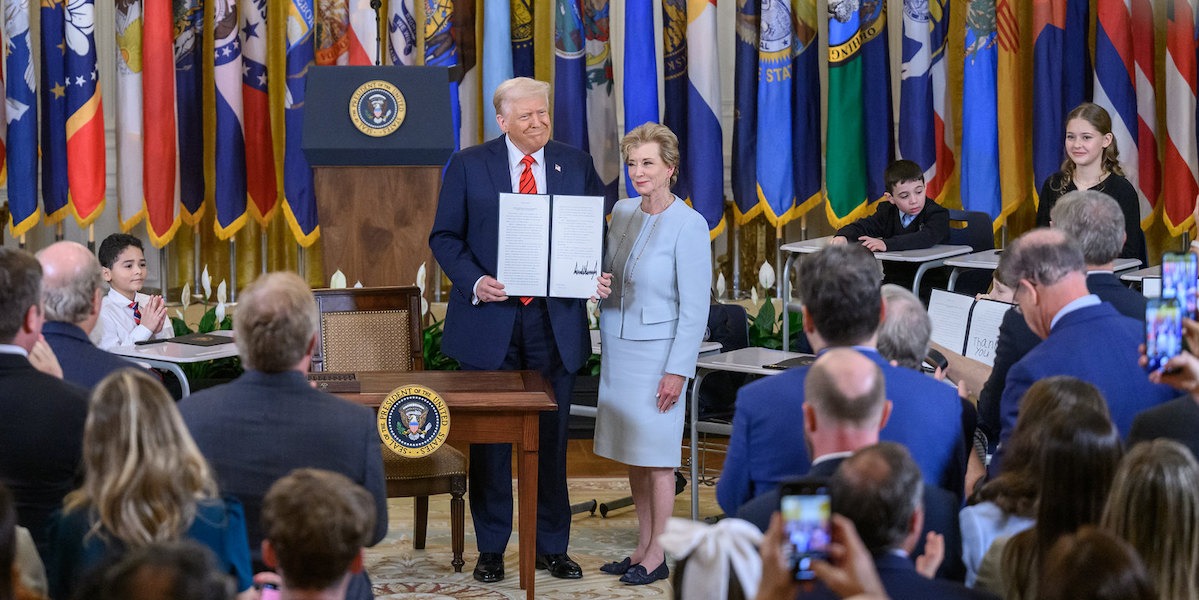
Now in 2025, the Trump DOE has brought back the red tape, and this time it’s even redder. According to an executive order signed by Trump in March, student borrowers can lose eligibility for PSLF if the organizations they work for do not reflect the administration’s partisan policies. The executive order was the basis of revised DOE regulations stopping loan forgiveness for public service employees working for organizations that provide gender affirming care, promote diversity, equity, and inclusion programs, or assist undocumented immigrants. Philadelphia public schools provide education to undocumented immigrant children. Under this new DOE policy, Philadelphia teachers could be denied public service loan forgiveness. And that’s just one example.
The Trump DOE is also targeting college student Federal Work Study programs to reflect the administration’s agenda to reduce the number of citizens who vote. In a “Dear Colleague” letter dated August 19, 2025, Christopher McCaghren, the DOE’s acting assistant secretary, prohibits using work study money for, among other things, “jobs involving partisan or nonpartisan voter registration, voter assistance at a polling place or through a voter hotline, or serving as a poll worker — whether this takes place on or off campus.” As a university president, I was proud of the large number of students who worked in a nonpartisan way to increase voter registration. Students at the three public universities comprising the University of Alaska competed to secure the largest number of new registrants. Volunteer activity and work study availability increased the number of eligible voters. Goodbye to all that.
We cannot accept the Trump administration’s double-speak, claiming that they are correcting partisan behavior by being extremely partisan themselves.
Demand that the DOE provide clarity on income-based loan payments
In July the Trump administration suspended student loan forgiveness for 3 million student borrowers who had fulfilled all legal repayment obligations and were now supposed to be free of debt. Many of those affected have been making payments for 20 to 25 years. On August 18, 11 Democratic U.S. Senators wrote a letter to DOE Secretary Linda McMahon stating, “It is unacceptable for the Trump administration to take any action that delays or denies legally mandated debt relief to borrowers that have been in repayment for over two decades or more.” (Where was PA Democratic Senator John Fetterman’s signature?)
Students at many colleges and universities in the Philadelphia area are starting classes this week. Let’s unite — Democrats, Republicans and otherwise – to encourage their studies by working to make an affordable, quality education available to all.
The DOE has added confusion to unfairness. DOE staff responded to the Senators’ letter with conflicting statements. They cited a court injunction against SAVE, a Biden program different from the longstanding Income-Based Repayment Plan (IBR), which the DOE suspended in July. IBR borrowers who have completed their required 20 to 25 years of repayment are being told to continue making payments with the possibility of later reimbursement, although no timeline has been given. In addition, the federal tax exemption for forgiven student loans expires at the end of 2025. With half the staff at DOE cut, is anyone there to give consistent answers to questions? Chaos.
And chaos is the point. It’s inevitable that callers will give up, even if it means going into default.
Envision a better day
If universities and the government could someday work together, I would like to see major reform in the whole student-loan arrangement. Too many potential students and their families suffer sticker shock when they see high tuition costs. Colleges and universities must improve communication on discounts and other opportunities to avoid indebtedness.
We need a new plan to make post-secondary education available to all. Loans are not — and have never been — the answer. Opportunities for higher education should not depend on family income. A lifetime loan burden should be unacceptable. We already have some workable approaches. When I was president of Governors State University (IL), we guaranteed that students in our Dual Degree Program (DDP) — a visionary partnership with Chicago-area community colleges — would graduate debt-free. In Philadelphia, the Temple Promise offers free tuition to low-income city residents.
Universities and government must work together — as hard as that is to imagine these days — to make it easier for Americans to attend college. In 2021 and 2023 Senator Cory Booker and U.S. Representative Ayanna Pressley proposed a national baby bonds program to give newborns $1,000 at birth and, depending on parental income, up to $2,000 every year until age 18 to help defray the cost of college; that bill has not progressed. Pennsylvania, meanwhile, has its own much smaller version, Keystone Scholars, that will seed a PA529 savings plan with $100 when a child is born; the new federal reconciliation bill has a provision to give a $1,000 “baby bonus” for every baby born in the U.S. In theory, those bonuses start families on the road to putting aside money themselves to pay for a child’s college education — though that is still only in theory.
Unfortunately, federal energy is now mainly directed at reducing the number of students going to college. The only way to change that is to keep on speaking out, contacting Congress, and voting.
I appeal to Citizen readers to confront the daily barrage of injustices, large and small. PA Republican Senator Dave McCormick should join Democrats (and PA Democratic Senator John Fetterman should join Democrats!) to protect student-loan borrowers who have been faithfully paying their debts for 20-25 years and are now being sabotaged by the Trump Department of Education. Further, the entire PA Congressional delegation should join together to protect PA students. If not, we should vote them out.
Students at many colleges and universities in the Philadelphia area are starting classes this week. Let’s unite — Democrats, Republicans and otherwise – to encourage their studies by working to make an affordable, quality education available to all.
Elaine Maimon, Ph.D., is the author of Leading Academic Change: Vision, Strategy, Transformation. Her long career in higher education has encompassed top executive positions at public universities as well as distinction as a scholar in rhetoric/composition. Her co-authored book, Writing in the Arts and Sciences, has been designated as a landmark text. She is a Distinguished Fellow of the Association for Writing Across the Curriculum.
 MORE FROM ELAINE MAIMON