



Most people remember what it felt like to be a first-time voter: that unique mix of pride, hope, excitement, and a touch of stress. For me, though, my third time voting was far more emotionally intense and subsequently memorable. Coming out of Pennsylvania’s primary election on April 23, 2024, I was left with nothing but pessimism, anger, and disillusionment. As a lifelong West Philadelphian, my frustrations weren’t tied to any one issue. Rather, they were the byproduct of circumstances that were 30 years in the making, at the point where two separate timelines — my family’s and Daniel Gwynn’s — converge into one. Allow me to explain …
Daniel Gwynn, who’s around the same age as my parents at 56, spent three decades in prison for crimes that he didn’t commit.
It all began on a freezing November night in 1994 when someone started a fire in an abandoned building on the 4500 block of Chestnut Street, killing one and injuring five others. Within 10 days, Gwynn was booked on first-degree murder, five counts of aggravated assault, and arson, despite a lack of proof that he was present at the crime scene. He gave a false confession after hours of relentless pressure from the police.
Five months later, the gentle spring weather served as the backdrop for my parents’ immigration. They left Bangladesh and settled into this neighborhood so that my mom could get her DMD from Penn Dental.
By the end of 1995 on another frigid November day, a jury ruled that Gwynn was guilty largely because of prosecutorial misconduct wherein crucial evidence that would’ve demanded acquittal was withheld from trial. The verdict was also based on faulty eyewitness testimony identifying Gwynn as the arsonist even though his face wasn’t in the photo lineup. The jurors remained stone-faced amid Gwynn’s explanation that his drug addiction exacerbated his confusion and paranoia, thereby facilitating coercion during interrogation. With all these cards stacked against him, the judge called for capital punishment.
The November three years afterward underscored a major life event for my parents: the arrival of their first child. My father joyously danced with his newborn son in his arms to “Believe” by Cher, which had come out the month prior.
Almost exactly six years later, I came into this world on the breezy afternoon of November 15, 2004. I was soon introduced to the place I still call home, located three blocks away from what used to be the derelict building that was set ablaze by a perpetrator who’s still unknown because Gwynn was expediently scapegoated.
Fast forward to November 2022: I was almost 18, walking into the school at 4501 Chestnut Street to take my SAT in preparation for college applications. I then served as a poll worker alongside my mom at our polling place situated five blocks away from 45th and Chestnut. A couple months after that, I went back to cast my first ballot, and my dad and grandma voted by mail.
While my family and I took for granted the privilege of being able to get civically engaged, Gwynn had made a bid for his freedom. Through continually rejected appeals, he asserted that he was innocent and didn’t have adequate legal representation during trial. Finally, his charges were officially dismissed on February 28, 2024.
Heading into the 2026 primary election, I’m voting for the people who can’t, for the ones in the same position that Gwynn was in up until recently.
Two months after leaving death row, he voted for the first time on April 23, 2024 (the same day that I joined the Third-Time Voters Club). Suddenly, I had to reconcile the fact that I, as a 19-year old, had more voting experience than a man 35 years my senior.
While I’ve never had the pleasure of meeting Gwynn, learning about his wrongful conviction compelled me to reflect on the liberties that he and millions more across the country are deprived of each day that they are behind bars.
Upon examining the systems that produced the glaring contrast between our respective life stories, I was heartbroken by the reality of carceral slavery and segregation. Beyond being blocked from participating in the most fundamental democratic process, incarcerated individuals are brainwashed into believing that they don’t have inherent value as human beings through the separation of families, inhumane conditions in prisons, and barriers to jobs and housing.
To Gwynn’s credit, he found strength within himself while in detention by channeling his faith and creativity into beautiful works of art. However, developing his craft and resilience shouldn’t have come at the cost of time, including missed experiences, conversations, and laughter, that he can never get back.
Today, I’m 21 years old — just barely younger than Gwynn when he was thrown in a cage with the looming threat of barbaric execution. Seeing how structural racism and classism contributed to his poverty, substance abuse, and death sentence has informed much of my writing, research, and activism as I near completion of my pre-law degree.
I never left this city, so I’m constantly reminded that Gwynn is a survivor of corrupt institutions that were never intended to support him. I further acknowledge that his belated exoneration does not undo the oppression that still occurs by design.
True restoration involves the rebuilding of societal structures to equitably uplift everyone’s physical, mental, social, and economic welfare. Besides abolishing the cruel, costly, and ineffective death penalty, governments must tackle the root causes of crime, invest in community-oriented programs, and enhance available treatment options.
Heading into the 2026 primary election, I’m voting for the people who can’t, for the ones in the same position that Gwynn was in up until recently. Moreover, I demand that candidates protect the rights of us all: BIPOC, the currently and formerly incarcerated, the poor and unhoused, queer and trans folks, women, immigrants, religious minorities, and those battling mental illnesses.
We must use our voices and work together to fight for our vision of a rehabilitative criminal justice system and a social safety net that ensures one group doesn’t advance at the expense of another, for our liberation is interconnected.
Kavi Shahnawaz is a lifelong Philadelphian studying Law & Society at Thomas Jefferson University. As a community organizer, his passions lie in civic engagement, restorative justice, and mutual aid.
In August 2024, The Citizen was devastated to learn of the passing of Erinda Sheno, a former Citizen intern and passionate young writer. The daughter of loving Albanian immigrants, Sheno attended Benjamin Rush High School and the University of Pennsylvania, where she was an active member of the writing community and of Vote That Jawn, the youth-led movement to encourage voting and civic engagement. In Sheno’s memory, the Vote That Jawn team, led by Penn professor Lorene Cary and Carson Eckhard, established the Sheno Prize in Erinda’s memory. The annual prize goes to a Philadelphia-area high school or college student for an essay about voting, democracy, immigration or Philadelphia life — issues dear to Erinda Sheno.

THE 2025 INAUGURAL ERINDA SHENO MEMORIAL PRIZE WINNERS
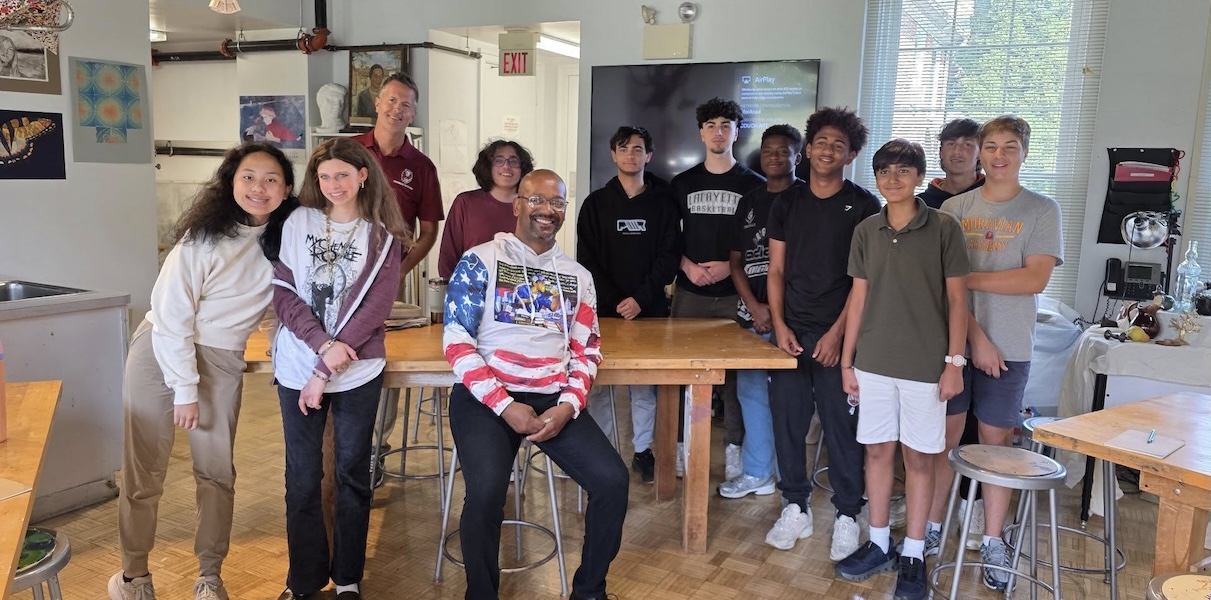
Daniel Gwynn, who was wrongly incarcerated, is now a teaching artist.