



It started with an Instagram post from StreetsDept, Philadelphia’s longtime chroniclers of street art. In a rare twist, they asked, “Who did this?!” But no one seemed to know who had installed an official-looking sign outside PAFA with a very unofficial message: “Stop parking. Ride SEPTA. Fund public transit. Sell your car.”
The answer, which emerged weeks later, was MIW — short for Make It Weird — a pseudonymous artist and activist who’s been quietly installing imitation street signs across Philadelphia and New York City.
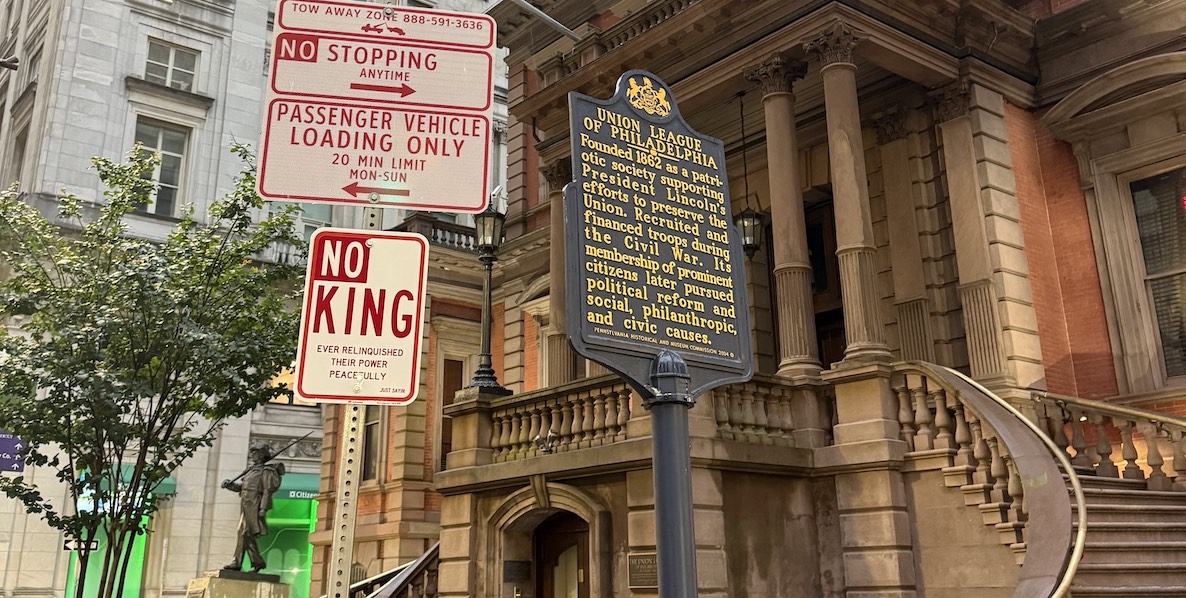
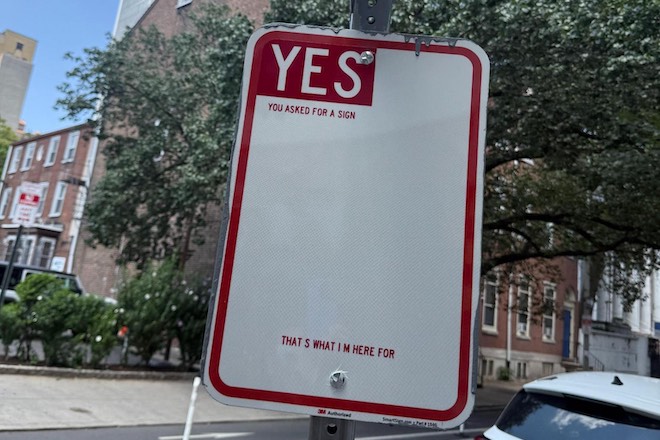
If you were looking closely, you may have noticed one of MIW’s signs across from City Hall, or outside of the Union League. Or maybe you walked right past. They look rather official, and who pays particularly close attention to the parking regulations on a block where you don’t actually intend to park? There’s no longer or obvious tell marking a sign as made by MIW, but pay close attention. If that message under the No Parking sign doesn’t quite sound like City Hall, you’ll know. That’s part of the magic.

It’s rare for an artist to arrive on a scene so fully formed, with a clear vision and the skills to execute it. MIW isn’t the first to remix street signs with humor or subversion — Francesco Garbelli, Clet Abraham, TrustoCorp, and Philly’s own Kid Hazo come to mind — but their impeccable technique and timely subject matter have struck a chord.
Since that SEPTA-themed intervention was caught by StreetsDept, MIW has launched a fast-growing Instagram account and installed signs from South Philly to Prospect Park. During the DC 33 strike, they created a series of signs in solidarity with the union and partnered with Tattooed Mom to raise funds for the strike effort.
The Philadelphia Citizen caught up with MIW (who, for several reasons, including the unsanctioned nature of their work, prefers to be anonymous) to understand where all this came from and where it might be headed next.
RJ: How long have you been doing this, and when did you realize that people were taking notice?
MIW: The sign project started in June, so it is very recent. I’ve been doing vinyl and vector designs for a long time. However, I wanted to do something a little bit more visible and a little bit more anonymous, without any commerce attached to it. I had been ruminating on the “Get Out The Bike Lane” bill not being enforced until additional signs were put up along Spruce and Pine, but ultimately the City got that sooner than me.
“When it comes to art in public spaces, I have always appreciated things that are subtle and things that are noticed not necessarily because they scream at you, but because you’re paying attention.” — MIW
By the time I actually got going, the SEPTA funding crisis had come up and I wanted to draw some attention to that. StreetsDept spotted the SEPTA sign, and that was a really exciting moment. It was, I think, the first time that somebody clearly took note.
Conrad Benner at StreetsDept has shared a few of your signs on Instagram, and he told me that it’s the more political signs that are getting the strongest response. Are you seeing the same thing?
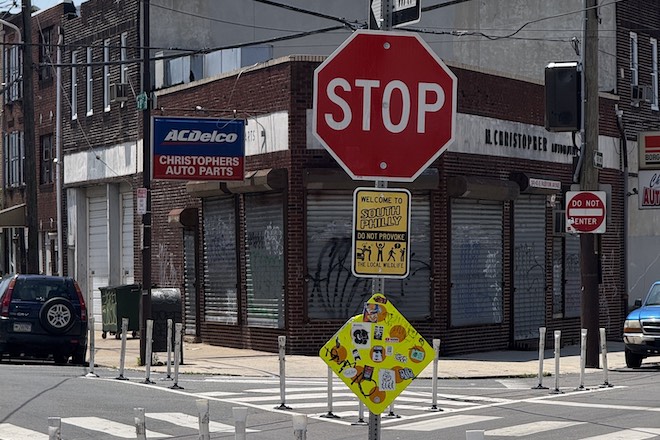
Absolutely. Those signs are timely, and people are responding to that. Fundamentally, I live here. Unions. Public transit. Democracy. Those issues are crucial for the city being a good place to live. If there aren’t good jobs and people can’t get to those jobs, this city has no future. The goofier signs are more about bringing a little bit of joy, oddity, or weirdness to daily life.
What, if anything, has the response from the City been? Are signs staying up?
I have not had any interaction with the City. And honestly, I hope not to. However, I’ve had two signs removed, one outside of the Union League and one near City Hall. The “No King” sign in front of the Union League was up for two or three days. That led me to install signs with tamper-proof equipment. And the “Stop Fucking Around” one at City Hall was also up for less than a week. Somebody from the City tried to remove it by prying it off. That didn’t work, so they called the Fire Department to cut the bolts with a sawzall. Last I heard, that sign is hanging up on a wall in the Chinatown fire station.
How do you feel about installing in some of the most highly surveilled and policed areas in Philly?
A little nervous, you know. I guess that’s that.
How many signs have you put up? Are you repeating messages?
It’s about a dozen now. I’m not interested in repeats. These are intended to be one offs. Each one unique to their place and their time.
“Unions. Public transit. Democracy. Those issues are crucial for the city being a good place to live.” — MIW
Why make signs that blend in so seamlessly that they could be missed?
When it comes to art in public spaces, I have always appreciated things that are subtle and things that are noticed not necessarily because they scream at you, but because you’re paying attention. I don’t drive anymore. I ride my bike, walk, and take public transit. When I bike, I see more than I ever used to see driving around cities. When I walk, I see even more. In those moments where you give a bit of extra time, there’s always more to see. I am making more of those opportunities for discovery. The other part is the chance to exhibit some skill, intention, and care to the thing that I’m doing.
How do you decide where to install your work?
Sometimes it’s the photograph that can be taken. I’ve also asked strangers or friends, “What do you think? Where’s this thing belong?” Sometimes I have no idea, and leaning into community has been a fun part of it for me.
Where can people see your signs, for now at least?
I include the approximate locations on Instagram, so anyone can look there. If I am aware that a sign has been taken down, I’ll add a second part to the description with RIP and the approximate date up and date down. If it’s on Instagram and it doesn’t have an RIP sign in the description, you can go to that place and you will likely see that sign.
What’s next?
I am thinking about that a lot right now. I had a fall the weekend of the Fourth, and I’ll be incapable of making or installing any more signs while my arm heals up. I am going to approach this the way that I’ve approached any advocacy I have undertaken over the last decade or so of my life, which is to sit patiently until the skills, resources, and values in your heart align on something that you know you have to do and then you do it. That’s what I’ll do next.
RJ Rushmore is a writer, curator and public art advocate. He is the founder of the street art blog Vandalog and culture-jamming campaign Art in Ad Places. As a curator, he has collaborated with Poster House, Mural Arts Philadelphia, The L.I.S.A. Project NYC and Haverford College. Rushmore’s writing has appeared in Hyperallergic, Juxtapoz, Complex and numerous books. He holds a B.A. in Political Science from Haverford College, where his thesis investigated controversies in public art.
 MORE FROM RJ RUSHMORE