


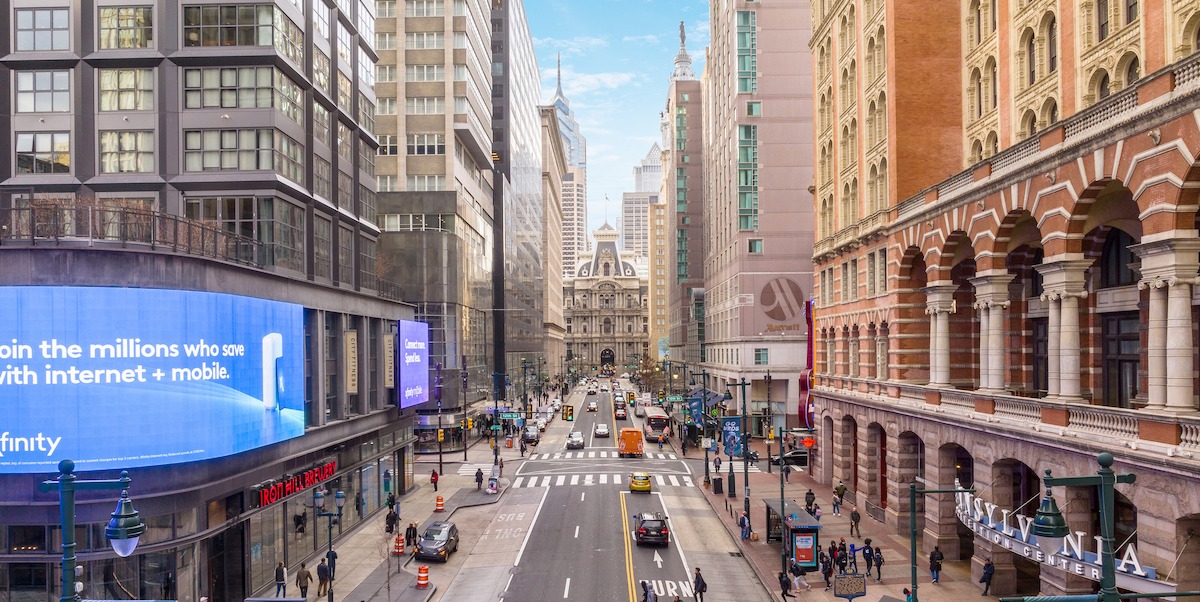


Market East has been on my mind for more than 15 years. As a young-ish project manager at Philadelphia Industrial Development Corporation, I assisted the Nutter administration with the 2009 Market East plan, which aimed to reestablish the eight city blocks between Independence Mall and City Hall as Philadelphia’s Main Street. Today, as the child with whom I was heavily pregnant during that planning process learns to drive, I’m struck by how little has materially changed along Market East.
The most notable transformation has been National Real Estate Development’s East Market project, a decade-long effort that has fully transformed an entire city block with a dense mix of diverse uses thoughtfully oriented around a human scale public realm, a blueprint worth emulating. The Fashion District’s repositioning brought new retail concepts and programming, while Brickstone Realty’s steadfast stewardship of the Lit Brothers Building created a wonderful corporate headquarters for Five Below. Yet the subsequent pandemic, as well as arena uncertainty, worked against this progress, and the corridor still struggles to achieve the vitality envisioned in 2009.
Market East possesses extraordinary, yet untapped, development potential.
That said, despite this sobering reality, I’ve never been more optimistic about Market East’s potential than I am today. The convergence of private investment, institutional commitment, public imagination, and the focus of Mayor Parker’s administration creates a window of opportunity that we must seize.
A moment of opportunity
New investments along the corridor represent calculated bets on Market East’s potential by entities with myriad choices about where to allocate capital. The Wanamaker Building has new ownership committed to renewing its grandeur while honoring its civic prominence. TF Cornerstone, a real estate development company with the boldness and tenacity to reshape the Long Island City waterfront, has teamed up with local office-to-residential conversion expert Alterra Property Group to execute its redevelopment in the wake of Macy’s closure.
Additionally, Comcast and Harris Blitzer Sports Entertainment, the ownership of the 76ers, honored their commitment to Mayor Parker and Market East. They have invested nearly $60 million in strategic land assemblages between 9th and 11th streets and have the opportunity to build at the appropriate scale for the corridor.
Market East possesses extraordinary, yet untapped, development potential. Despite SEPTA’s ongoing funding crisis, the corridor sits atop world-class transit accessibility, with 1 million people in the region with a one-seat ride to Market East. When we concentrate housing, jobs, and services around Market East’s exceptional transit infrastructure, including SEPTA’s Regional Rail and Market-Frankford Line, and PATCO, we reduce congestion and car dependency while reinforcing the use of public transportation and improving air quality.
Accordingly, developing high-density mixed-use buildings in Market East is imperative. High-density mixed-use buildings also generate the demand needed to support the neighborhood-serving retail, restaurants, and services that can animate Market East’s sidewalks.
Fortunately, the corridor’s development capacity is impressive. The permissive CMX-5 zoning allows several million square feet of maximum buildable area under current zoning. Put another way, the zoning in place could accommodate thousands of new apartments, a major hotel, and new retail and office space.
Yet walk along Market Street today, and you’ll encounter the same surface parking lots that have sat undeveloped for decades. These vacant lots, combined with quality-of-life challenges including visible homelessness and a limited police presence, have upheld a negative image, despite the corridor’s proximity to major regional assets like Thomas Jefferson University Hospital, the Pennsylvania Convention Center, Chinatown, and Reading Terminal Market.
We must focus on what makes Center City exceptional: its walkability and its human scale.
The corridor also faces economic challenges. High interest rates and construction costs, combined with elevated operating expenses in an area where safety and cleanliness concerns affect rental rates, create a situation where it costs more to build and operate new housing and commercial space than developers can charge in rent.
Breaking this cycle requires strategic intervention that addresses both the economic fundamentals and the perception challenges simultaneously. According to developer Josh Rosenbloom and others, a set of strategic incentives and investments, perhaps not unlike what Governor Shapiro unveiled for downtown Pittsburgh in October 2024, could bridge the gap between development costs and market rents to jumpstart the process, making development feasible while ensuring public benefits like more housing, revitalized public spaces, and improved safety and affordability.
An enhanced Market Street real estate tax abatement program — perhaps even spanning 6th Street to 30th Street, including both Market East and the office district — could meaningfully reduce operating costs for development. It’s worth noting here that researcher Kevin Gillen did a study for the Building Industry Association that found that for every dollar of abated property taxes, projects were bringing in $2 from sales, wage, business, and real estate transfer taxes associated with the construction and subsequent management of the building. Keystone Opportunity Zone designation, employed to accelerate development in University City and the Navy Yard, could reduce tenant occupancy costs, effectively increasing their capacity to pay rents that enable high quality development.
At the federal level, Census Tract 5, which covers nearly the entire East Market corridor from 7th Street to Broad Street, appears eligible for Qualified Opportunity Zone designation under the 2020 ACS dataset, pending gubernatorial action, which would provide significant incentives for investors. Along with RACP grants and perhaps a TIF district to support public realm improvements, a package of incentives and investments could unlock the area’s development potential.
No single anchor solution
One lesson from decades of urban planning is clear: There is no single anchor solution for Market East. No single development, however splashy, will ever solve the challenges and complexities of this corridor, which span two-thirds of a mile. Instead, we must focus on what makes Center City exceptional: its walkability and its human scale.
For the third consecutive year, USA Today’s 10Best Readers’ Choice Awards named Philadelphia the nation’s most walkable city to visit. Today’s Center City builds on the foundation left to us by William Penn and Thomas Holme’s 343-year-old plan, with dense, mixed-use development that concentrates residential high-rises, office towers, restaurants, shops, cultural venues, and services within a compact footprint where most daily needs can be met on foot.
Market East currently lacks many of these walkability ingredients. Too many blank walls, vacant storefronts, and surface parking lots interrupt the pedestrian experience. At the same time, the expansive roadway prioritizes vehicular movement at the expense of pedestrian comfort and safety. Market Street spans 100 feet from building to building with 50 feet devoted to a five-lane roadway, creating minimal separation between high-volume bus traffic and sidewalks. Market East needs continuous, varied, human-scale activity at street level. High-density mixed-use buildings can create utility and interest for pedestrians throughout the day and evening.
Building long-term momentum with short-term interventions
The festivities of 2026, including the semiquincentennial celebration, promise to bring swells of visitors walking between Independence Mall and Lemon Hill via Market East, City Hall (and Dilworth Park) and the Benjamin Franklin Parkway. Brickstone Realty, owner of the Lit Brothers Building, has rolled out the welcome mat; their gracious planters, crisp awnings, and charming window displays set exactly the right tone for visitors.
Given the time horizon required for transformative changes to Market East, implementing strategic short-term improvements is essential for Philadelphia to capitalize on increased foot traffic and create millions of positive first impressions that could catalyze lasting economic momentum.
Center City District has launched a short-term improvement program targeting 2026. Thanks to the support of Mayor Parker and Councilmember Squilla, our streetscape improvement program will refurbish at-grade transit stops, upgrade street amenities including planters, and replace aging street trees. We will commission window art that transforms vacant storefronts, while testing a pop-up retail program along Market East in partnership with Meantime, a Philadelphia nonprofit that connects local businesses with underutilized space.
These initiatives aren’t just cosmetic improvements. They’re proof-of-concept demonstrations that Market East can support the kind of vibrant street life that makes great urban places. By demonstrating a commitment to creating a high-quality public realm, these improvements signal that Market East is a priority for investing, visiting and living.
Public safety remains a foundational concern. We understand that public safety is a prerequisite for any future physical or perceptual improvements in Market East. The staff of hotels, stores, and hospitals deserve to go about their day without worrying about their personal safety. Given citywide police staffing shortages, expansion of CCD bike patrols could provide a short-term solution to security concerns.
Market East’s path forward
The corridor connecting Independence Mall to City Hall should be one of our country’s great walks. Public discourse over the past few years demonstrates that Philadelphians are eager for a brighter future for Market East. With the right combination of public leadership, private investment, and tactical interventions, we can make that vision reality.
The moment is now. Let’s seize it.
Prema Katari Gupta is President/CEO of Center City District. This article appears in the Center City Digest fall edition.
The Citizen welcomes guest commentary from community members who represent that it is their own work and their own opinion based on true facts that they know firsthand.
