


Sarah Fulton, a volunteer chapter leader with Sleep in Heavenly Peace (SHP), remembers the first time she delivered a bed to a child in need.
The girl was excited. She was four years old and had never had her own bed to sleep in. Plus, it was her birthday. She ran around the room as Fulton and the other volunteers assembled a bunk bed for her and her sister. She hugged the volunteers and asked them to snap photos of her and her sister in the bunks.
Fulton still recalls hearing the girl as the volunteers left the room: “She said, ‘‘I can’t believe I have my own bed.’”
SHP, a national nonprofit that builds and delivers beds to children, coined the term “bedlessness” to describe the phenomenon of children living without beds to sleep in. Bedlessness isn’t something many people think about. But it’s one of many basic needs that families who are struggling financially might go without. A basic twin bed frame can run anywhere from about $40 to about $140. Mattresses range from $150-$2,500. Plus the costs of sheets, pillows, comforters — it adds up quickly. Around the country, about three percent of kids don’t have their own beds, SHP estimates.
That number might seem small, but Fulton has a sobering comparison: That’s about one in every 33 kids, one kid on every school bus — more than 140,000 in all, according to the nonprofit.
A lack of a bed can contribute to poor sleep, which has ripple effects: more frequent illness, lower grades, irritability and more.
Learning about bedlessness spurred Fulton to start the New Jersey chapter of SHP in 2023. Since its launch, her chapter has steadily grown, expanding its reach around the region — and delivering 212 beds to kids around New Jersey. Here in Pennsylvania, we have three SHP chapters. The nearest to Philadelphia is in Luzerne, 111 miles away.
Solving bedlessness, starting in Idaho
Luke Mickelson, the national founder of SHP, started the organization while serving as a youth pastor in his church in Twin Falls, Idaho. He overheard a mom who was struggling financially talking about how her kids didn’t have beds.
“I had to stop. I’m like: Wait a minute did you just say they didn’t have any beds?” Mickelson recalled on an episode of The Philadelphia Citizen’s CitizenCast. “I went home that night, grabbed my tape measure, pencil and paper, went down to my daughter’s room, who had a bunk bed, and I’m measuring it, marking it. … I went and bought the wood and the tools the next day.” On his own in his garage, he built 11 beds.
As Mickelson spoke with friends and church members, he learned of more and more kids who were sleeping on couches, air mattresses, or just bare floors. In 2012, he started SHP as a nonprofit. (The name echoes the final words of the song, “Silent Night.”) It’s since grown to more than 325 chapters around the country, delivering more than a quarter million beds, and, along the way, attracting the attention of Mike Rowe’s reality Facebook series, Returning the Favor.
Fulton, who’d been involved in advocating for child welfare and adopted her son from foster care, learned of SHP when a friend in Tennessee posted about doing bed deliveries for SHP. Fulton started looking for a New Jersey chapter of SHP … only to find there wasn’t one. She still wanted to get involved, though, so she asked her husband, What if we started one?
They applied and met with the regional lead in November 2023. In March 2024, they attended their first bed build at a chapter in Troy, New York, to learn the build and delivery process, before flying to Utah in June to train to start their own chapter. Their first bed build was held in July 2024. Fulton and her husband held it in their driveway of their Morris County home.
Fighting bedlessness
SHP’s model works by having volunteers build beds and deliver them to families in need.
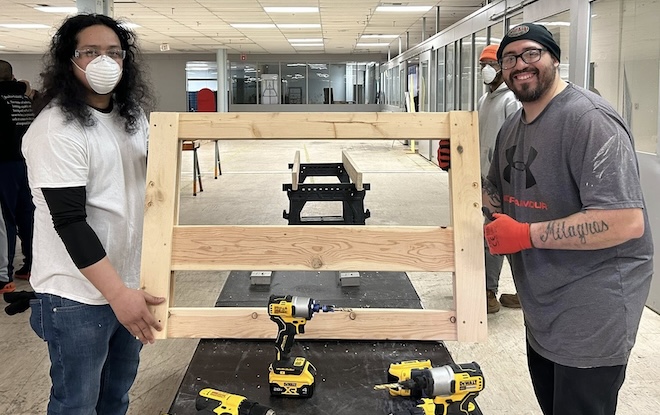
The building process uses an assembly line model Henry Ford would envy: One team of volunteers measures and saws; another drills holes; another sands. Fulton has hosted builds in parks and parking lots — it takes a lot of space to make the beds — but also school shops or garages.
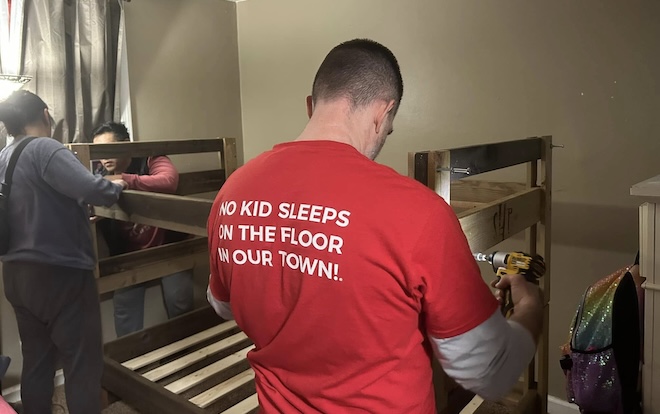
Once each individual component is finished, another team of volunteers delivers the beds to the kids’ homes and puts them together IKEA-style. They build two different models: twins and bunks. Along with the bed frames, families get mattresses, sheet sets, pillows and comforters.
Jane Oswari, a volunteer with the New Jersey chapter who leads the Mt. Laurel delivery hub, says she tries to pick out bedding based on the child’s age and interests, getting princess or butterfly comforters for girls, for instance.
“The kids are just so happy,” she says. “They’re jumping on the bed taking pictures. It’s been a great experience seeing the joy on their faces.”
Families with kids 3 to 17 can fill out a short application online to request beds. Fulton says one of the largest challenges has been getting the word out, since hers was the first Jersey chapter. She spends a lot of time contacting school districts and social services. The results are more than a safe, comfortable place to sleep, she says.
“I think they feel seen and important,” she says. Each bed “is not handed down. It’s not coming from someone else, It’s theirs and has never been used.”
Starting (and growing) a chapter
So far, Fulton’s chapter has delivered 212 beds to kids around New Jersey. They’ve consistently expanded the areas they serve, adding delivery hubs in Trenton, Mt. Laurel, Newark and Atlantic City. Fulton estimates that between 200 and 250 people have volunteered across their build events. Their next build is May 2.
Could something like this work in Philly? Fulton says she’s seen increased need in cities, and cites Trenton as an example. Philadelphia has a high child poverty rate — about 25 percent of all children — which typically correlates with a high need for basic essentials, like beds. More than 82 percent of SHP’s applicants nationally earn less than $52,000 per year.
Fulton is eager to help other chapters get started locally — or to expand her chapter’s reach by partnering with other organizations to create delivery hubs. In Toms River they partner with the youth homeless shelter Ocean’s Harbor House to deliver the beds. She feels grateful for the help the national organization provided in helping her get started — not just with how to build and deliver beds, but also setting up a website and doing outreach.
“It can feel like a lot to get started, but there’s so much support,” Fulton says. “You can ask any questions. They help guide you through.”
She recommends folks who are curious about starting a chapter contact a nearby location and “see what it’s about; be a part of the delivery.”
“They’re life changing moments,” she says, recalling one family who said their child got the “best night’s sleep that she’s ever had,” after receiving a bed. “I’m excited about helping other chapters come along.”
 MORE IDEAS WE SHOULD STEAL