

When Roe v. Wade was overturned on June 24, 2022, demand for abortions in Pennsylvania skyrocketed overnight. The Supreme Court’s decision triggered abortion bans and restrictions in 20 states. Between 2021 and 2022, the number of people traveling to PA from out-of-state for abortion care rose 41 percent. By all measures, those numbers have only risen: 26 states have made abortion illegal, heavily restricted it or threatened its legality. The Philadelphia region, with its major airport, has become a destination for abortion care seekers.
Listen to the audio edition here:
Meanwhile, in both Philly and PA, resources for care are increasingly dwindling, impacting visitors and residents alike. The Trump administration has cut funding from any organization that offers abortions and receives more than $800,000 in Medicaid reimbursements annually for reproductive care services. (The 1997 Hyde Amendment already prohibits the use of federal funds for abortions except in cases of rape, incest and endangerment of the mother’s life).
Nationwide, 20 Planned Parenthood clinics have closed since the cuts took effect. These cuts come at a time when clinics locally have already been struggling to stay open. Last year, Warminster’s Planned Parenthood closed, leaving only one clinic remaining in Bucks County. Today, PA has only 20 abortion clinics, down from 145 when Roe became law in 1973.
“This has really stopped being a political issue, and this is really just a human issue.” — Signe Espinoza, Planned Parenthood of Southeastern PA
People seeking reproductive healthcare here now face weeks-long wait times at many clinics, according to advocates at the Abortion Liberation Fund of PA, a nonprofit that fights for abortion access in the state.
After Roe’s reversal, the City of Philadelphia dedicated between $450,000 and $1.2 million annually in funding for reproductive healthcare services, including abortion and abortion counseling. But this year, Mayor Cherelle Parker eliminated that funding, sending Philadelphia “backwards,” according to Katia Pérez, interim executive director of the Abortion Liberation Fund of PA,which also operates a hotline for and distributes funds to provide assistance to people seeking abortion care. Pérez says she knows of Philly patients who have traveled to the collar counties for care.
Some state governments — recognizing the strain cities are under — have started to dedicate funding toward reproductive healthcare services. Maryland has developed a unique funding mechanism, using a specific provision of the ACA to offer more reproductive healthcare, not less — without costing taxpayers anything. Could that work for PA?
“This is a human issue.”
Mayor Parker has not publicly stated why she abruptly cut abortion funding in her FY2026 budget, and her office did not respond to requests for comment. City Council Minority Leader and At-Large Councilmember Kendra Brooks advocated for funding during 2026 budget negotiations, but also “really didn’t get an explanation,” she says, as to why the money never came through. Mayor Parker has faced accusations of kowtowing to the Trump administration’s priorities — including when she quietly eliminated citywide DEI goals for awarding contracts.
Although the City coffers have doubtless suffered from federal funding cuts, the elimination of the $1.2 million funding for reproductive health, while transformational to its recipients, seems small in the grand scheme of the City’s $6.8 billion budget. Other big cities, including Chicago and Atlanta, have continued using municipal dollars to fund reproductive healthcare services.
What’s more, study after study shows that money spent on these reproductive health services saves in myriad other ways. Colorado’s Health Department found that every dollar spent on a long acting contraceptive program saved them $5.85 in state Medicaid costs, because the state didn’t have to use those funds to cover costs associated with pregnancy or, in some cases, STI treatments. A report published in 2019 found that in the program’s first 10 years it saved Colorado between $66.1 and $69.6 million in public assistance costs as well.
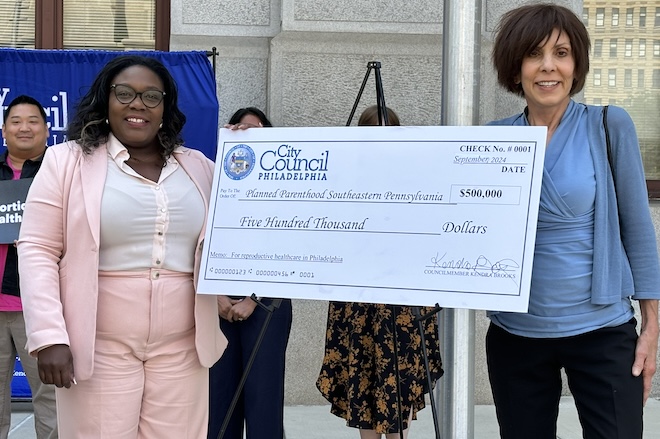
In 2022, the City gave a $500,000 grant to the Abortion Liberation Fund of PA, and the City has since expanded their funding to cover an array of reproductive healthcare costs. “For the majority of our callers, $200 to $300 can be life changing,” Pérez says. Last year, the City gave Planned Parenthood alone $500,000, which can help people afford everything from testing and treatment for sexually transmitted infections (STI) to cancer screenings.
At Planned Parenthood of Southeastern PA, one-third of all patients are insured through Medicaid. That means, under the Trump administration’s new rule, Planned Parenthood isn’t receiving insurance payments for these patients anymore. They’re continuing to provide care to Medicaid patients for free, but that causes financial strain on the organization in the long term.
“We certainly are concerned about the sustainability of [that as a] business model,” says Dayle Steinberg, the organization’s president and CEO. “Other providers’ capacity is stretched and they can’t fill the void if Planned Parenthood can’t continue to see these patients.”
Most Americans support abortion care
Cities are strapped. Federal funding for abortion and other reproductive healthcare services is getting slashed. Might states step in to fill the void?
That’s what’s happening in New York and California, both of which increased state budget support for reproductive healthcare clinics so they can continue to provide services.
What about critics who say, PA is a purple state, funding reproductive healthcare is controversial and can’t get done here? To them, Signe Espinoza, vice president of advocacy and public policy for Planned Parenthood of Southeastern PA and executive director of Planned Parenthood Pennsylvania Advocates Espinoza says, “No matter what color they say our state is, Planned Parenthood is more popular and abortion is more popular than any politician.”
“Providers’ capacity is stretched, and they can’t fill the void if Planned Parenthood can’t continue to see these patients.” — Dayle Steinberg, Planned Parenthood of Southeastern PA
The data backs her up: A 2024 survey found 79 percent of U.S. adults view Planned Parenthood positively. Ninety-six percent say people of all incomes should have access to affordable reproductive care. When abortion is on the ballot, voters tend to overwhelmingly support it, even in deep red states like Missouri, where a constitutional amendment guaranteeing the right to an abortion passed with 52 percent of the vote.
“This has really stopped being a political issue, and this is really just a human issue,” Espinoza says.
“Planned Parenthood has never been a direct recipient of state funds [in PA]. We should be. That’s the dream,” Espinoza says.
A first of its kind program in Maryland
Over in Maryland, they’ve come up with a novel solution currently in the planning stages: using unused Affordable Care Act (ACA) funds to create an abortion grant program.
Here’s how it works: When the ACA was passed in 2014, it required insurers in the marketplace to place premiums into two accounts — one that pays for all services that qualify for federal funding, and another that can pay for abortions.
Why does the second account exist? Twelve states — California, Colorado, Illinois, Maine, Maryland, Massachusetts, Minnesota, New Jersey, New York, Oregon, Vermont and Washington — require ACA plans to cover abortions. The goal of creating two accounts was to make sure federal funds wouldn’t be used to pay for abortions, per the restrictions in the Hyde Amendment.
ACA insurance marketplace enrollees in these states pay a $1 per month fee to cover the costs of abortions. In Maryland, that fund has resulted in a $25 million surplus, even after covering abortion services for everyone who needed them.
“It’s hard for a city to try to prioritize among all of their other priorities,” says Lynn McCann-Yeh, co-executive director of the Abortion Fund of Maryland, a nonprofit that helps people in MD or traveling to MD receive abortion care and supported the bill. “What makes this grant program so unique is that it’s not funded by taxpayers.”
These funds cover abortions only, whereas other measures — including Philly’s local funding — covered other forms of reproductive healthcare like contraceptives, STI testing and cancer screenings. With more funds available for abortion care, reproductive health organizations could use their existing budgets to fund those other services.
While MD Governor Wes Moore works with his State Department to get the grant program up and running,other states are already excited about the potential of replicating the program, according to McCann-Yeh. State officials in New York and Illinois have reached out.
“We know that there is a lot more need and a lot more demand than what our organization can currently offer,” McCann-Yeh says. “When this grant program is established, it will fundamentally alter the ecosystem of support that’s here in Maryland and make it way easier, less stressful, less hassle, less hustle for people to just get an abortion and get their basic healthcare.”
Can we get a hearing?
It wouldn’t be as easy to create a similar plan in PA. For starters, our ACA covers abortions only in cases of rape, incest and endangerment of the mother’s life. To copy Moore’s program, we’d first need a concerted act by a currently divided state legislature to amend how PA’s ACA operates. If legislation passed, it then would take a year or two to build up the funds to pay for abortion care. Maryland estimates $3 million will be available annually. There are about 496,551 Pennsylvanians on ACA insurance — so charging everyone covered by these plans $1 per month would amount to more than $5 million per year.
Governor Josh Shapiro has joined the lawsuit trying to block the Trump administration from defunding reproductive healthcare clinics, but it would help to have state dollars supporting these clinics, too — especially since it’s likely the federal government will continue to attack reproductive healthcare funding. Any form of state funding — whether it operates like Maryland’s program, or New York’s or California’s, where the state dedicated money towards funding Planned Parenthood in its budget — could help ease the strain on PA care providers.
Whatever happens in Harrisburg, advocates in Philly are focused on restoring local funding. In November, Philadelphia City Council passed a resolution recognizing abortion as a human right. Ipas, an organization dedicated to fighting for reproductive rights globally, has encouraged cities, states and the U.S. federal government to pass these resolutions. As a result of their work, and the work of other organizations, the UN deemed that U.S. abortion bans violate human rights. Still, as it’s a state law, and abortion is already legal in PA, the only way Philly can really drive change is by restoring City funding for reproductive healthcare or pressuring the federal government to rescind its cuts.
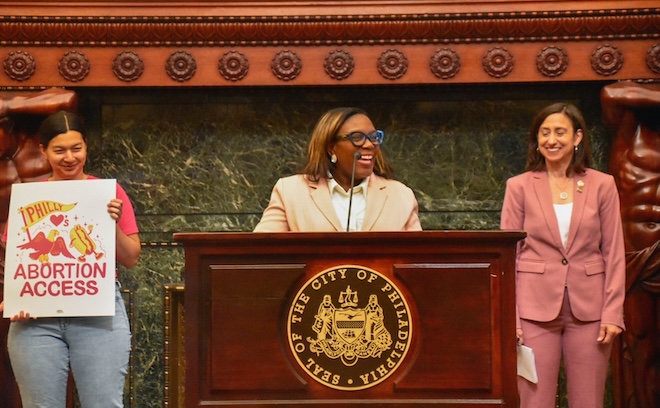
In September, Councilmember Brooks called for a municipal hearing on reproductive freedom in order to discuss the impacts of local cuts. Council has yet to schedule it. At-Large Councilmember Nina Ahmad chairs the Public Health Committee; she told The Inquirer last month that the hearing hadn’t been scheduled for the fall because they were focused on addressing cuts to SNAP, though one could potentially be held in early 2026.
“I think the conversation keeps being centered around abortion — pro-choice or pro-life. Reproductive health can start as young as eight years old, when a young girl is beginning to menstruate, all the way until you’re 88 and may still need a hysterectomy,” Brooks says. “There’s a continuum of care we need to continue to shed light on because it’s detrimental to the life of women and girls.”
 MORE ON REPRODUCTIVE HEALTHCARE