



Today, an estimated 52,000 School District of Philadelphia students are relying on SEPTA to get them to and from their first day of school. But this year, these students’ commutes differ vastly from just a few months ago. Suddenly, taking a bus, train, trolley or subway to get to class ranges from less convenient to … basically impossible.
Plagued by a multimillion dollar funding shortfall, SEPTA reduced its service by 20 percent on Sunday, August 24. The transit authority eliminated 32 bus routes, shortened 16 more, and scaled back the amount of other buses, trolleys, subways and trains they put into service. Some students will need to leave for school an hour or two earlier; some will watch as full buses pass by their stops. And those are the lucky ones: Other kids will arrive at their usual pick-up locations — and realize the bus just isn’t coming.
53 percent of Philadelphia School District families said their children would miss fewer school days if there were more convenient transportation options.
This, say observers, is a problem on top of an existing problem for Philadelphia school kids. Already, the District has a shortage of yellow bus drivers (at last count, they needed 32 more). Already, kindergarteners and students in grade seven and up are not allowed to ride yellow school buses. The transportation shortage is so bad that, post-Covid, the District has resorted to paying families with cars a flat rate of $300 per child per month to drop off and pick up their children from school.
No wonder 53 percent of Philadelphia School District families surveyed last year said their children would miss fewer school days if there were more convenient transportation options, and 78 percent said they wanted those additional options for getting their kids to school. Cue the tardiness. And truancy.
Even if state legislators pulled together a last-minute deal to fund SEPTA today, the first round of service cuts are already in effect, with no projected reversal date. So far, the School District has not shared plans to ameliorate the situation. They have, however, released an official statement offering directions to the transit authority’s website and app, and a wish: “As a District, we are hoping that SEPTA receives adequate funding to restore full service.” Cue the Philly shrug.
All of which begs the question: How the hell are all these kids going to get to school? Ideas are out there. For some students, they could help.
1. Teach more kids to bike — and get them bikes
For students who live close enough to their schools or in neighborhoods along routes where biking is safe, cycling on fair weather days can be an option. Of course, that student first needs a bicycle that they know how to ride safely. Some local organizations are slowly making that happen. Last school year, the Bicycle Coalition of Greater Philadelphia worked with Lewis Elkin Elementary School in Kensington to teach 20 fourth graders bike safety skills. At the end of the program, participants received new bicycles, locks, helmets and water bottles.
“We’ve got more kids in Kensington riding together because we taught them the rules of the road and how to ride safely,” Gale says. Gale is looking for funding to continue and expand these efforts (they applied to The Citizen’s Ideas We Should Scale for just this reason; you can watch their video here).
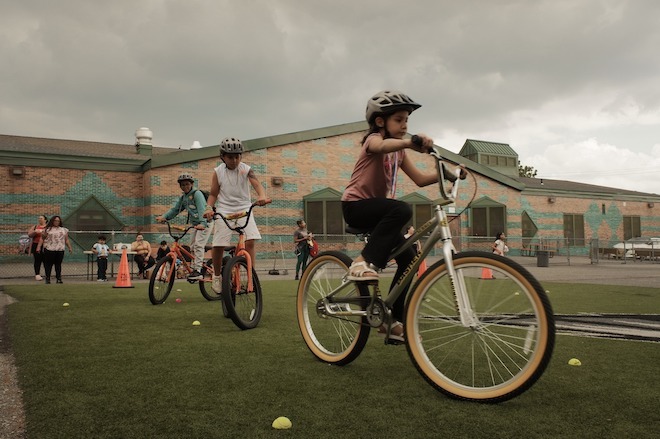
“We really want to see a Philadelphia in which every kid learns to ride by fourth grade,” Gale says.
Temple University Police Officer Leroy Wimberly runs a North Philly-based, donation-funded program that helps kids learn about bike safety and build riding confidence. Every summer, the children in his program and bike cops ride from Philly to Atlantic City. Once they’re home, the kids receive free bikes.
Other programs that help Philly kids onto bikes:
-
- Neighborhood Bike Works offers an Earn-A-Bike program for students aged 8 to 18. Students fix up a bike, learn the basics of repairs and maintenance and the ins and outs of urban riding. At the end of the program, they get to keep the bike they fixed up.
- PA ACCESS Cardholders ages 14 and up are eligible for a discounted monthly Indego pass of $8.33 (down from about $20 per month) for unlimited 60-minute rides. (For the program to work for students, they’d need both to live near and to attend a school near Indego bike stations.)
The City has other programs that teach about bike safety. Safe Routes Philly offers resources for teaching kids of all grade levels how to bike and walk safely, as well as offering resources for how students can safely take public transit. (The City’s Office of Transportation, Infrastructure, and Sustainability, which houses Safe Routes Philly, did not respond to requests for comment about how they plan to address SEPTA service reductions in their programming.)
2. Make streets safer
Of course, biking comes with its own hazards: Last year, 54 pedestrians and three cyclists were killed in traffic accidents, according to the Bicycle Coalition. Five children 17 years old or younger are hit by cars every week in Philly, according to the 2023 Vision Zero report. Kids have four times the rate of bicycle-related deaths compared to adults. Progress on Vision Zero, which seeks to end traffic fatalities, is slow going.
“Biking is a fun way to get around town, but it can be dangerous,” says Gale, whose 14-year-old will be biking to school this year. “We’re nervous about having him on the road.”
There are ways to make biking to school safer. It is legal for children under 12 to ride their bikes on sidewalks — and they should, says Gale. The City should continue to invest in bike lanes and infrastructure upgrades that help keep pedestrians safer, especially in North Philly, Northeast Philly, Northwest Philly and South Philly, where accidents are most frequent, and bike lanes are least existent.
Parents can plan safe routes from their home to their child’s school using Bicycle Coalition’s mapping tool. Gale and his colleagues say adults and kids should practice routes together before students bike on their own (Google Maps prioritizes speed; the Coalition’s tool prioritizes roads with bike lanes and lower congestion to keep cyclists safer).
The City can step in by building more protected bike lanes — and keeping parked cars out of bike lanes in general via towing and ticketing. But it’s not just cars that make cycling unsafe. Potholes and uneven pavement can cause a cyclist to fall and injure themselves. We need to repair those too. Again, not an overnight cure — and only for the vast minority of student bikers.
Over in New Jersey, Safe Routes programs are working with schools to make sure roads are safe for students. Patrick Farley is the executive director of Cross County Connection, a transportation management agency that serves Atlantic, Burlington, Camden, Cape May, Cumberland, Gloucester and Salem counties. Their School Travel Plans program brings together school leaders, police, local elected officials and municipal engineers to assess road conditions near schools and seek funding for infrastructure improvements.
“We’ll do an analysis of the area, and we’ll do a presentation, and that’s followed by us actually going and walking the streets and documenting the conditions,” Farley says. Just getting officials out walking the streets and thinking about how kids can navigate the roads has led to policy changes and infrastructure upgrades to make paths safer.
3. Form a “bike bus”’
One way to help keep kids safe while they bike: Organize groups for them to go with. Research has found that cyclists behave more safely in groups. It’s also easier for drivers to see large groups of bicyclists, and, once they do, hopefully they drive accordingly.
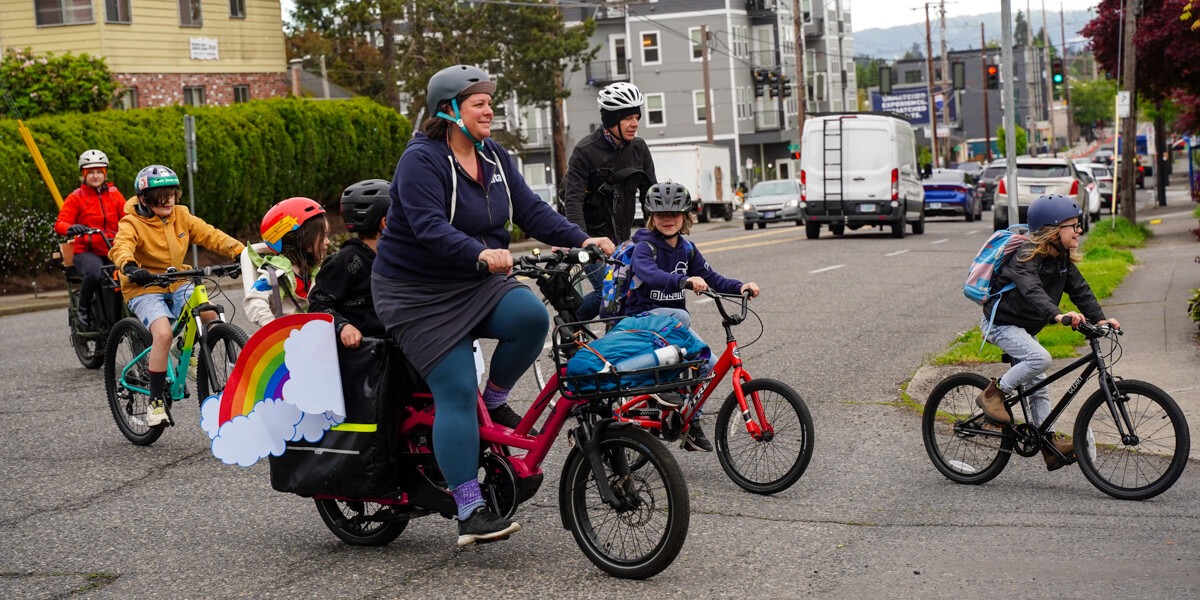
“It’s really great to see kids riding together,” Gale says. “It really is power in numbers.” Riding to school together has become known as riding in a “bike bus.” These programs generally consist of elementary school-age students riding in groups with parent leaders and chaperones. Bike buses make stops outside homes or at designated spots to pick up additional riders.
Philly currently has three bike buses, all for high-performing schools in relatively affluent, bike-friendly neighborhoods: one for Penn Alexander in the Spruce Hill neighborhood of West Philadelphia, one for Meredith Elementary School on the edge of Bella Vista in South Philadelphia and one for George W. Nebinger Elementary School in Bella Vista. In past school years, Meredith and Nebinger parents have run their bus for one month in the fall and one in the spring. Penn Alexander parents have chosen Fridays for their bike bus.
Parents interested in organizing a bike bus can use their Home and School Association to connect with each other and form a group.
4. Work with a transportation tech company to fill gaps
But biking certainly won’t work for everyone, including the upwards of 80,000 high school students who do not attend their neighborhood high schools, and not counting the thousands of 7th and 8th graders and kindergarteners who live a distance from their schools.
Children are generally ineligible for signing up for commercial carpool or rideshare services that adults use for daily commutes. There’s Uber Teen — although so far, there’s no news of Uber offering District student discounts — and commuters of all ages are bracing for a new high in surge pricing, starting August 25.
The tech company HopSkipDrive thinks they have a solution. Founded more than 10 years ago by three working moms, HopSkipDrive partners with individual school districts to provide supplemental transportation for students. Their drivers undergo background and driving record checks as part of an extensive vetting process and use their own vehicles to get students to school. Their system has already been able to help cities reduce absenteeism for students living in foster care — and works with districts to figure out how to optimize student transit.
“It’s important for school districts to look at multi-modal options. Do they have some students considering public transit? Are they looking at where it makes sense to use yellow buses when they have sufficient drivers? Are they looking at supplemental services like HopSkipDrive?” says Cindy Hamilton, a representative for HopSkipDrive. “We could bring all of those options to the table and help a school district understand what might be possible and what solutions might exist.”
Last year, HopSkipDrive was one of 13 companies the School District contracted with to supplement student transportation — at no charge to students. In the past, the District has also used cabs and small vans to get kids to school. Will they do the same this year? Maybe. So far, they’ve answered The Citizen’s transportation questions in statement form only.
A similar service, KidCaboo, operates in the Philadelphia burbs as a sort of Uber for kids, where vetted drivers charge by mileage and ride duration. (The minimum ride cost is $23.50.) Instead of partnering with schools, they work with suburban families directly. Maybe we could entice them to extend their operations to Philly — and somehow get the District to foot the bill?
There’s no substitute for SEPTA
Experts agree: All of these solutions are far from perfect. At this point, even if we could implement them all, they wouldn’t come close to filling the gaps left by reductions in SEPTA service. Like any big city, Philadelphia needs to allow families of school-age students to choose among safe, reliable public transit, yellow buses, walking, cycling and driving to get kids to school safely and reliably.
HopSkipDrive has a solution here, too. Their RouteWise AI analyzes a school district’s transportation needs and helps them optimize bus routes and figure out how to fill transportation gaps. They piloted the tool in Colorado Springs School District 11 last year — and helped improve on-time student arrival from from 85 percent to 99 percent. (Of course, Colorado Springs wasn’t facing massive transit cuts at the time.)
The point is, it doesn’t take just a village to raise a child. It takes transportation options.
“Whether you want to drive, you want to walk or use active mobility or transit, all of us should have that freedom of choice to move and a minimum expectation of arriving at our destination safely,” Gale says. In other words, all Philadelphians are hoping the School District’s wish comes true. Students want and need their SEPTA back.

MORE ON THE LATEST SEPTA SITUATION