




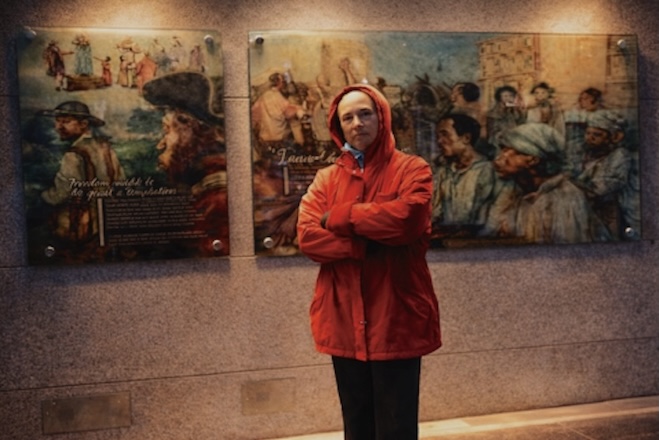
“Can I take a quick photo of you in front of the panels?”
She didn’t love the idea. Lorene Cary, celebrated writer and Penn professor, has never been drawn to spotlight or ceremony. But friendship has its own gravity, and that night, she relented.
What I remember most about that frigid December evening in 2010 was the silence, and the way Lorene held herself, not just against the cold, but against the weight of what had finally been made permanent.
There was nothing performative about the moment. No speeches. No crowd. Just the soft glow of interpretive panels at Independence Mall, and a truth that had taken years to arrive.
After years of protest, scholarship, public debate, and delay, The President’s House: Freedom and Slavery in the Making of a New Nation had become real. The site where George Washington lived and governed, just steps from where the Liberty Bell draws visitors from around the world, now told a fuller story.
For the first time, the enslaved people Washington held in his household were no longer invisible.
What made the President’s House installation so powerful was not outrage, but restraint. It did not shout. It did not accuse. It simply refused to lie.
Their names were spoken. Oney (Ona) Judge, Moll, Austin, Hercules, Richmond, Giles, Paris, Christopher Sheels, and Joe Richardson — the men and women whose lives and forced labor made the president’s household possible, and whose history was never meant to be recognized. Names long buried in account books, letters, and footnotes were now etched into public space. The exhibit did not speculate or editorialize. It documented. It named. It placed slavery exactly where it belonged, at the heart of the nation’s founding contradictions.
We stood there quietly, just yards from the Liberty Bell, visited by more than a million people each year. A site where families passed by. Travelers lingered. Some read. Some didn’t.
But the omission that had long defined America’s most celebrated civic landscape had finally been corrected. Liberty and slavery were no longer separated by silence. They coexisted here, as they had always done.
Over the years leading up to that night, Lorene had shared fragments of the journey with me: the resistance, the meetings, the moral insistence required to keep going — of the team and historians and persevering citizens. They included the artists, activists — especially members of Avenging the Ancestors Coalition — historians, lawyers, elected officials, journalists, marketers, National Park Service admin, technicians and contractors.
The easier path would have allowed for erasure. Her work was driven by scholarship and clarity, not accusation. The goal was not to diminish the Washingtons and the founders, but to tell the truth about him, and about the people whose labor sustained his public life.
That truth was never in doubt. George Washington enslaved human beings while serving as president. This is not ideology or modern reinterpretation. It is documented in his own correspondence, household ledgers, payroll records, and letters exchanged with Martha Washington. The ages, duties, movements, and even acts of resistance by the enslaved people in his household are preserved in primary sources. Their presence is as historically verifiable as Washington’s presidency itself.
On Thursday, January 22, 2026, that truth was dismantled.
Under an executive order titled “Restoring Truth and Sanity to American History,” the Trump administration directed the removal of this installation. Panels were taken down. Narratives erased. A site created through years of research and public process was stripped of the very history it existed to tell.
Removing evidence does not correct history. It falsifies it.
An executive order that claims to “restore truth” cannot eliminate documented fact without emptying the word truth of meaning. Removing evidence does not correct history. It falsifies it.
What made the President’s House installation so powerful was not outrage, but restraint. It did not shout. It did not accuse. It simply refused to lie. It trusted visitors, millions of them, to hold complexity, to feel discomfort, and to understand that democracy is strengthened, not weakened, by honesty.
That cold December night 15 years ago, Lorene stood quietly in front of an exhibit she had helped to make undeniable. The photograph I took captures no triumph, only resolve. She knew, as the historians, architects, and activists who built the site knew, that public memory is fragile, and that truth must be defended not once, but repeatedly.
History does not disappear when it is removed from view. It disappears when a nation refuses to see.
And that choice, more than any exhibit ever could, is what truly threatens the integrity of America and its history. When a nation dismantles truth to protect comfort, it is already turning away from itself.
David Topel is an author, social justice advocate, and founding board president of Philadelphia’s Attic Youth Center.
The Citizen welcomes guest commentary from community members who represent that it is their own work and their own opinion based on true facts that they know firsthand.
 MORE ON AMERICA’S LEGACY IN INDEPENDENCE PARK