




If not for one Penn immunologist’s stubbornness — an unwavering belief in ideas that others in the medical field had long dismissed — the world of cancer research would look vastly different today.
In the early-2000s, Dr. Carl June, then a newly hired medical researcher at Penn, became obsessed with a scientific problem in the subfield of gene therapy. Research papers dating back to the 80s had theorized about manipulating a person’s T cells — the highly-replicable white blood cells that are the workhorses of the immune system — and training them to attack a deadly disease, like cancer. But there was little to show for it in the real world.
Other researchers kept hitting plateaus. Sometimes, they struggled to puppeteer the T cells in the ways that they needed. Other times, the lab-altered T cells failed to multiply in the body, quickly becoming overpowered by invasive diseases.
“This is a new idea and a new way of thinking about problems we’ve been articulating for some time.” — Jeff Marrazzo, Dispatch Biotherapeutics
Then, in 2011, June and his Penn laboratory finally broke through. They successfully pioneered a method of engineering T cells — dubbed CAR-T cells — to function like heat-seeking missiles against cancer. June compared them to “serial killers” or “mass murderers” in the fight against cancer. In their clinical trials, participants’ leukemia was completely eradicated. Years later, the CAR-T treatment became the first FDA-approved gene therapy — a method of healing patients by altering the genes in their body — and entered the medical mainstream.
Meanwhile, June and his colleagues were — even after those first clinical trials — already stubbornly focused on the next frontier for CAR-T cells, as Jason Fagone wrote in Philly mag:
Scientists don’t talk about “curing” cancer. A cure is the hope so great, so seemingly out of reach, that it must never be invoked. They’ve built a wall around the word. Still, the Penn researchers — as careful as they were, as professionally sober and skeptical — couldn’t help but wonder: Was their small experiment the start of something that could one day affect thousands, tens of thousands, more? Was it revealing a secret about the human body that could point the way to treatments for other cancers, not just leukemia?
Now, more than a decade later, June has co-founded a biotech company in Philly that could be the answer to those dreams. “This is a new idea and a new way of thinking about problems we’ve been articulating for some time,” says Jeff Marrazzo, the founding chairman of Dispatch Biotherapeutics.
And on April 22, Marrazzo and June will be jointly honored for that idea as our Disruptors of the Year, at the 3rd Annual Citizen of the Year awards celebration. The event is held at the Fitler Club Ballroom. Tickets and tables available here.
On the verge of a breakthrough
CAR-T cells have eliminated leukemia and lymphoma, both blood-based cancers, from thousands of patients around the world. Those diseases, however, don’t attack the body through solid masses, like most cancers. In fact, roughly 93 percent of cancers (including breast, lung, and colorectal cancers) disable the body through solid tumors, which are invasive cells that divide uncontrollably and harm human organs. Attempts to kill solid tumors through CAR-T cells have long been theorized, but stymied by a biological roadblock. In experimental trials, CAR-T cells have been unable to destroy solid tumors without also attacking healthy tissue.
Dispatch Therapeutics may be on the verge of a technology that can solve that. “It’s a bold approach, which is needed to treat something so extraordinarily complex,“ says Marrazzo. “There is a way in which this science could be a universal strategy for treating many, many cancers.”
And, if they succeed, Dispatch could be a leader in the next generation of “Cellicon Valley” companies here in Philly. After years of growth, the local biotech sector has recently been stalled. by layoffs, closures, and a pullback of capital investment over the past two years — part of a national trend in cell and gene therapy. On top of its promise to change lives, Dispatch could reinvigorate hope in the sector becoming an economic and commercial success.
“I think this will give new energy to the ecosystem,” says Marrazzo. “For me, Dispatch presented the perfect match of compelling science that’s going to make a huge human impact and the prospect of growing and building that right here in Philadelphia.”
Moving past a scientific plateau
Shortly after stepping down from Spark Therapeutics as CEO in 2022, Marrazzo was on the lookout for his next big project. He had just finished leading Spark from its infancy as a startup to a blockbuster merger. Roche, the Swiss pharmaceutical giant, acquired Spark for a Philly record of $4.8 billion.
The sale was a windfall for Philly. Roche is currently building a 500,000-square foot “University City Gene Therapy Innovation Center,” which, the company says, will eventually employ Philadelphians with a wide array of educational attainment. On the other hand, in April, Roche laid off more than half of its Spark employees, which could signal a bigger retreat to Europe down the road.
Marrazzo, since leaving Spark, has been hyper-focused on incubating more companies that will stay here in Philly over the long haul, along with more first-time CEOs who’ll make that commitment.
“Ten years down the road, you won’t even think about the cost of cell therapy.” — Sabah Oney, Dispatch Biotherapeutics
“You know, not everyone can guarantee that their company will become the size of Spark,” says Marrazzo. “But the most important thing for the Philadelphia ecosystem is having more companies at the top of the funnel, and more big ideas. So that eventually, one of them becomes the size of Spark, and that’s how the ecosystem grows.”
In July, Dispatch emerged from stealth as a public-facing company, reportedly having raised $216 million in venture capital. Investors include the Parker Institute for Cancer Immunotherapy, founded by Sean Parker, the Napster creator and philanthropist, and directed by June, who is a co-founder of Dispatch. Other investors include ARCH Venture Partners, one of the leading biotech venture capital funds around the world. The scientific team is a collaboration between researchers from Penn, Stanford University, and the University of California San Francisco.
Marrazzo believes that the launch could coincide with a bounceback atmosphere for cell and gene therapy. Over the summer, Capstan Therapeutics, a company that came out of Penn and is focused on trying to re-program T cells in the body — instead of genetically modifying them in a lab, then reintroducing them into the body — sold for $2.1 billion.
“That’s the largest transaction ever — in the biotech industry — for a company that is still generating the human clinical data to show it has changed disease,” says Marrazzo. “That transaction has created, frankly, a new field.”
Even though cell and gene therapy briefly lost some cache with investors over the past few years, it could be primed for a turnaround in Philly. “That’s just the lifecycle of biotech, to a degree,” he says. “When breakthroughs like Capstan’s occur, all of a sudden, everyone could come rushing back in the field.”
More flare please
The team behind Dispatch did not set out to create a universal treatment for cancer tumors. They were trying to solve a narrower problem: Why can’t CAR-T cells — those heat-seeking missiles for fighting cancer — differentiate healthy tissue from tumors?
The simple answer is that the biological pieces of a tumor known to attract CAR-T cells are also present in healthy tissue. To overcome that problem, scientists around the world have been testing out different techniques to make CAR-T cells more discriminating. But the scientific co-founders of Dispatch took a different route. Rather than seek out new biological targets, they flipped the problem on its head: What if we could paint a target on the tumors?
“Of course, our founders — including Carl [June] — knew the intimate challenges with solid tumor extrapolation,” says Marrazzo.
For years, different cell-therapy strategies had been hitting hard plateaus when it came to treating solid tumors. In 2021, June’s Tmunity Therapeutics, a company spun from Penn, abruptly halted a high-profile clinical trial after the deaths of two patients who had received injections of CAR-T cells. The treatment entirely removed the cancer but also ravaged their bodies beyond repair.
Combining different strategies from other areas of gene therapy, Dispatch is patenting a brand new way of treating cancer. It’s calling this technique a “Flare platform.” The treatment relies on a viral vector (a lab-modified virus) to precisely “tag” cancerous tumors with a marker that is not present on the tumor in question or elsewhere in the body. That way, CAR-T cells can achieve their clear objective.
A trailblazing commercial success?
Cell and gene therapy companies have widely struggled to achieve scale and profitability. The cost of cell therapies has been one factor. They are more like expensive procedures than drugs you’d buy from CVS, requiring specialized doctors to create them in labs and administer. The sticker price on many cell therapies is north of $1 million without insurance. Another economic factor is that the industry has mostly focused on treatments for rare diseases, which have a limited market.
The leaders at Dispatch believe the company can be a trailblazing commercial success. “If your market is large enough, and if you build a resilient company, cell therapy will work incredibly well,” says Sabah Oney, CEO of Dispatch. “Yes, I do think about patient impact. But we’re also building a business, right? We need to survive.”
“But the most important thing for the Philadelphia ecosystem is having more companies at the top of the funnel, and more big ideas.” — Marrazzo
Oney sees a number of competitive advantages for Dispatch. For one thing, the cost of cell therapy is plummeting. According to a recent estimate by Kite Gilead Earnings, the cost of developing and producing cell therapies is supposed to be level with the cost of creating biologic medications (prescription drugs, antibiotics, etc.) by 2030. “In Biotech years, that’s basically tomorrow,” says Oney.
Secondly, Dispatch is working on a treatment that, if successful, won’t be used on a tiny sick population, but potentially on more than 90 percent of cancer patients — a large market.
And perhaps the most unheralded asset to Dispatch’s long-term success, says Oney, will be its proximity to the Philly biotech community. While the company intends to remain bicoastal, three-fourths of its 60 employees are based in Philly. Not only does Philly boast among the best talent pools in the country for cell and gene therapy researchers, but there are manufacturing entities, and other industry supports right here — which could be bolstered, down the road, by contracts from a big commercial success like what Oney envisions for Dispatch.
Already, less than a year after its first public announcement, Dispatch is receiving plaudits from peers. It was recognized as one of BioPharma’s Most Promising Startups of 2025 by the industry publication Endpoints, along with being named the 2026 Emerging Company of the Year by Life Sciences PA.
In November, the Dispatch team presented the research behind their Flare platform at the annual conference for the Society of Immunotherapy of Cancer. The company has since received FDA clearance to begin enrolling patients in its first phase of clinical trials, while also announcing star-studded partnerships with Bristol Myers Squibb and CARsgen to help supply and evaluate those studies. If those trials prove successful, Dispatch’s Flare platform could be a boon to the city’s economy.
“Ten years down the road, you won’t even think about the cost of cell therapy. That’s the way that I think about it,” says Oney.

MORE ON HEALTH ADVANCES
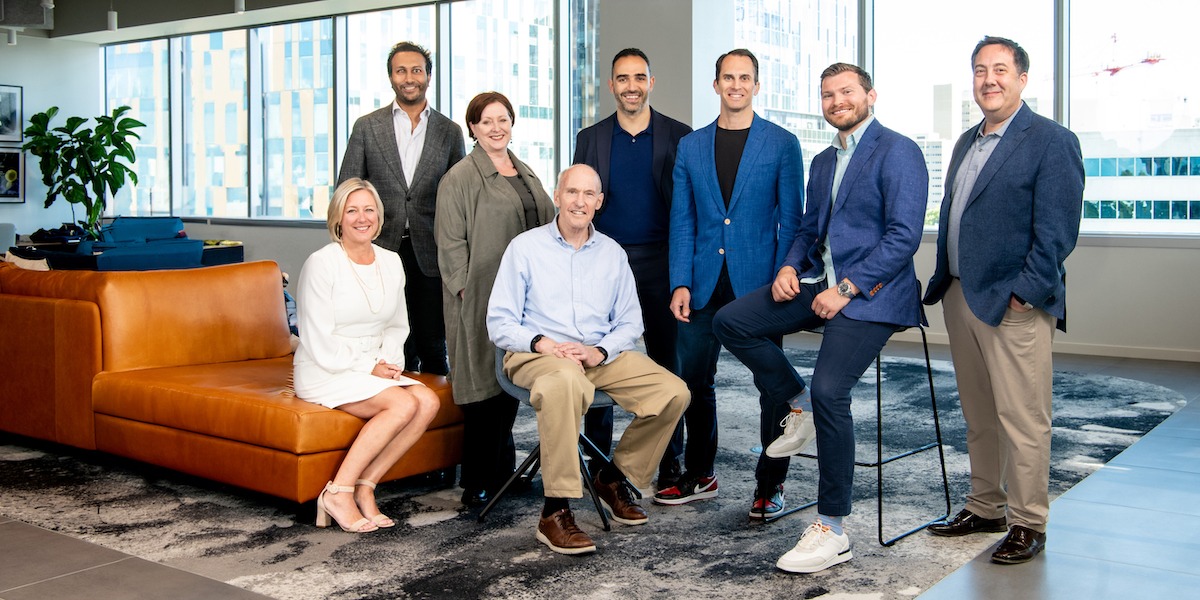
Dispatch Biotherapeutics executive team, left to right: Jennifer Flaisher, Chief People & Culture Officer; Naveen Bazaj, SVP Corporate Development; Barbra Sasu, Ph.D., Chief Scientific Officer; Carl June, MD, Academic Co-Founder and SAB member; Sabah Oney, Ph.D., CEO; Jeff Marrazzo, Founding Chairman; Lex Johnson, Ph.D., Co-Founder and Chief Platform Officer; Chris Wiwi, Ph.D., SVP Technical Operations.