

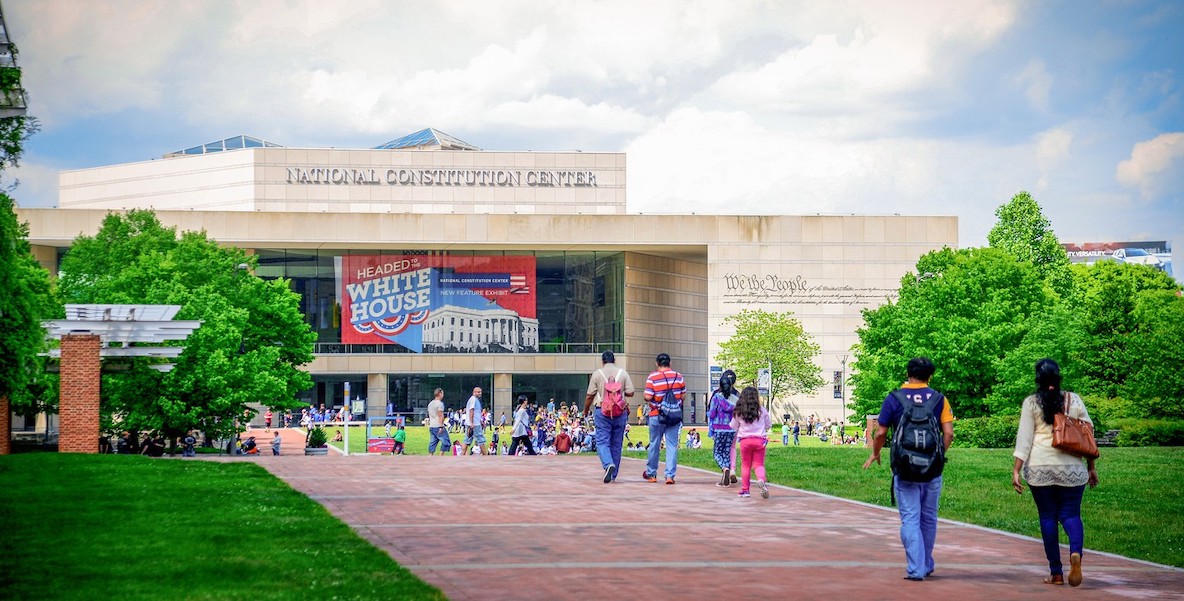


On Wednesday, September 17, Constitution Day, the National Constitution Center (NCC) will commemorate the signing of the U.S. Constitution and launch its year-long celebration of the 250th birthday of the Declaration of Independence. The Constitution Center promises interactive experiences with both documents, including a lively reading of the Constitution’s Preamble, conversations with revolutionary figures, hands-on arts and crafts activities, and a naturalization ceremony for new U.S. Citizens.
I highly recommend taking the day — or even a half day off — to learn or relearn about our nation’s founding document, and reconsider your role in defending American rights.
At 9:30am on Constitution Day, a group of 50 future Americans will take part in a public swearing-in ceremony in the Center’s auditorium. In order to qualify for citizenship, all these immigrants have demonstrated, among other things, that they speak, read, write and understand the English language; will uphold the principles of the Constitution; understand the fundamentals of the history, principles and form of government of the United States; and are of good moral character.
Our new citizens will take the following oath:
I hereby declare, on oath, that I absolutely and entirely renounce and abjure all allegiance and fidelity to any foreign prince, potentate, state, or sovereignty of whom or which I have heretofore been a subject or citizen; that I will support and defend the Constitution and laws of the United States of America against all enemies, foreign and domestic; that I will bear true faith and allegiance to the same; that I will bear arms on behalf of the United States when required by the law; that I will perform noncombatant service in the Armed Forces of the United States when required by the law; that I will perform work of national importance under civilian direction when required by the law; and that I take this obligation freely without any mental reservation or purpose of evasion; so help me God.
If you attend the morning ceremony, I guarantee you will be moved and inspired. You will see individuals who love this nation and have worked hard to be citizens.
In past years, you would have met League of Women Voters volunteers helping new citizens and attendees register to vote after this ceremony. Not this year. Last week, the U.S Citizenship and Immigration Services (USCIS) issued new policy guidance barring nonpartisan organizations from providing voter registration services at naturalization ceremonies. (Municipal and state representatives, however, are permitted to attend for voter registration purposes.)
The League of Women Voters wrote the following: “By prohibiting this public service, the USCIS has tarnished a cherished community-centered celebration. It’s an oppressive move by the Trump administration to silence new citizens and an insult to everyone who cherishes voting rights.”
Every day should be Constitution Day
In years past I’ve written urging Americans to read and understand our founding documents and for schools to incorporate the Declaration of Independence and the Constitution (including the U.S. Supreme Court decisions that have interpreted it) into the curriculum from preschool to grad school.
Our nation is distinctive in that its origin and identity are defined by a document — a practice emerging nations would go on to follow. From the start, the Constitution has been a living document, immediately amended 10 times, forming the Bill of Rights, and later adding 17 amendments, the most recent being a 1992 regulation about compensation of Senators and Representatives originally proposed in 1789.
At the heart of the U. S. Constitution is a series of promises.
The Constitution remains a work in progress. In 2025, Democratic members of Congress have been working on a 28th amendment to overturn the Supreme Court’s 2010 decision in Citizens United v. Federal Election Commission, a ruling that equates money to speech thereby protecting monetary influence on elections and elected officials.
Article V of the Constitution outlines two methods for proposing amendments: (1) A two-thirds vote of approval in both the U.S. House of Representatives and the Senate; (2) a national convention, proposed by two-thirds of state legislatures (34 states). Ratification would then occur through approval by three-fourths of state legislatures (38 states) or state conventions in 38 states. It’s a difficult process, and it’s meant to be. On Constitution Day at Philadelphia’s Constitution Center, however, visitors have an opportunity to “Sign the Giant Constitution” and write their own amendments.
Threats to a constitutional republic
After the January 6, 2021 assault on the Capitol and the unsubstantiated denial of presidential election results, I wrote, “Our Constitutional Republic is under the greatest threat since the Civil War. One reason for the danger is an absence of systematic study of the Constitution. We have to change that if we want to secure our democracy.”
In September 2025, our republic continues to be in danger.
On January 20, 2025, President Trump put his hand on a Bible and repeated the presidential oath, found in Article II, Section 1, Clause 8 of the Constitution: “I do solemnly swear (or affirm) that I will faithfully execute the Office of President of the United States, and will to the best of my Ability, preserve, protect and defend the Constitution of the United States.”
Members of Congress take a similar oath to support and defend the Constitution of the United States against all enemies, foreign and domestic.
Their promise to defend the Constitution should supercede any other promises — including partisan campaign promises.
Recent examples of all three branches of our government subverting their sworn duties to the Constitution:
-
- Articles I, II and III call for a separation of powers, yet our chief executive openly disregards and threatens members of Congress and jurists who disagree with him.
- Section 9 of Article 1 gives Congress the power to authorize federal funding. On August 29, however, President Trump announced his plan to cancel $4.9 billion in Congressionally authorized federal funding.
- The First Amendment guarantees freedom of speech, but the Department of Education has eradicated ideas, language — words like diversity, equity and inclusion — and books from public schools and universities.
- The 10th Amendment reserves to the states all powers not specifically delegated to the federal government, but the federal government has sent federal troops into California against that state’s will.
A necessary visit to the Constitution Center
On September 3, the National Constitution Center announced the launch of “Our Story Continues,” a new exhibit that explores the principles and ideas that shape our nation — and encourages reflection on how we together will write the next chapter. When you visit the NCC on September 17 (or any day), you will learn, but also practice, your role in our democracy.
The National Constitution Center is a private, nonprofit museum. While it partners with Independence National Park, it has greater autonomy than national institutions threatened by Trump’s censorship and historic cleansing. It’s essential for citizens to express opposition to politically mandated history.
At the heart of the U. S. Constitution is a series of promises. The founders signed their names to uphold and promote a document that, for some of them, contained provisions they did not like. New citizens take an oath to give up previous national loyalties and defend the U.S. Constitution. Members of Congress and the president can take office only when they swear to be faithful to the Constitution. It’s up to us as citizens to monitor these promises, those that are kept, and those that are broken.
On September 17, 1787, as the delegates left the Constitutional Convention in Independence Hall, Benjamin Franklin was asked what kind of government had been created. He famously responded, “A Republic, if you can keep it.”
On Constitution Day this year, We the People must resolve to preserve, protect, and defend the Constitution of the United States. We do that first by studying our founding document and holding elected officials accountable for preserving it.
Constitution Day is September 17 from 9am to 5pm at 525 Arch Street. Admission is free. To make group reservations, call (215) 409-6800 or email groupsales@constitutioncenter.org.
Elaine Maimon, Ph.D., is the author of Leading Academic Change: Vision, Strategy, Transformation. Her long career in higher education has encompassed top executive positions at public universities as well as distinction as a scholar in rhetoric/composition. Her co-authored book, Writing in the Arts and Sciences, has been designated as a landmark text. She is a Distinguished Fellow of the Association for Writing Across the Curriculum.
 MORE FROM ELAINE MAIMON