

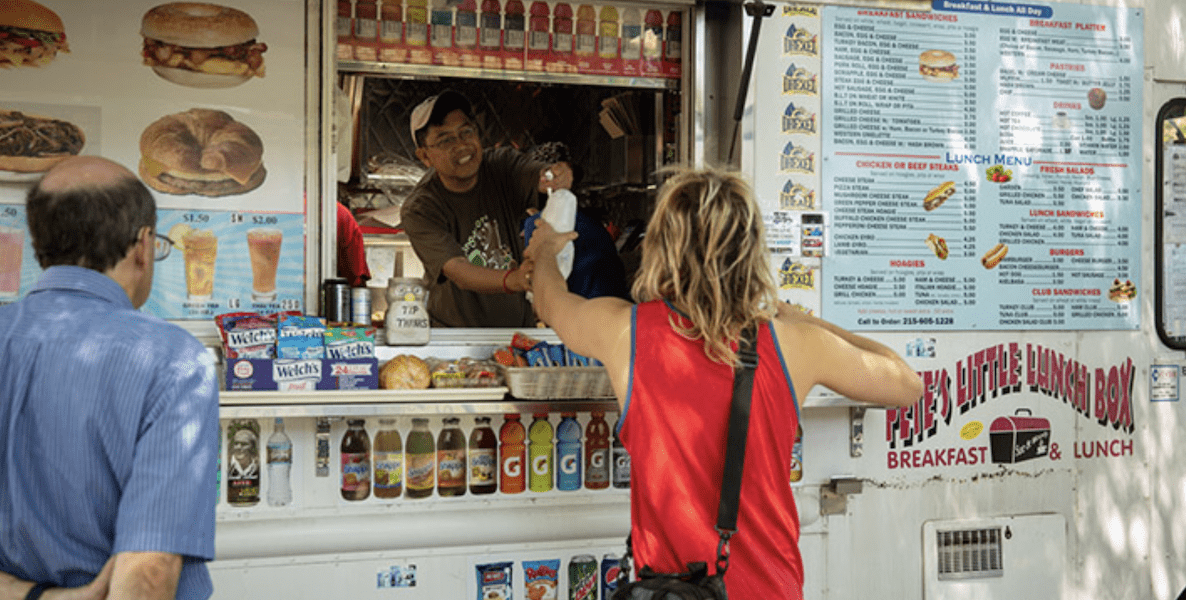


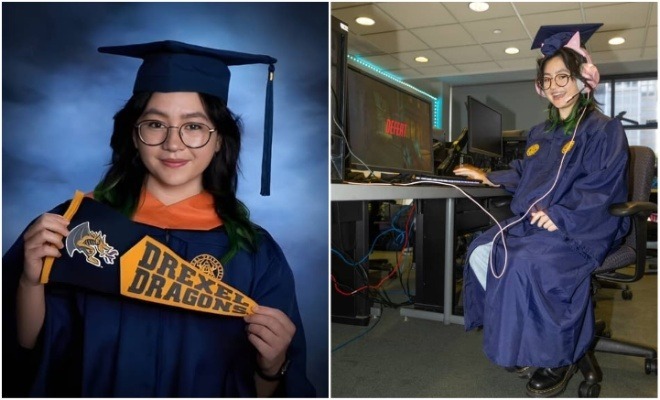
Claire Toomey, a recent Drexel graduate with a B.S. in software engineering, is no stranger to campus food trucks. Between her schedule packed with classes, internships, and meetings as the Drexel Esports president, she, like so many students, relied on mobile mom-and-pop operations to get good food quickly, conveniently and inexpensively. In time, the people in those trucks became part of her community.
“When I first came to Drexel, the food trucks were probably the biggest and best draw for me,” says Toomey. “I come from a super small town in the Poconos where our food options are limited to McDonalds and Subway, so it was great to just have these diverse food options like Halal food, Chinese food, all these amazing food trucks.”
Toomey was on vacation, scrolling through Instagram on a beach in Puerto Rico, when she saw a post about Pete’s Little Lunch Box being restricted from parking on campus overnight. Her feed filled with students and fellow soon-to-be grads expressing their disappointment over the news.
In early April, Drexel University began citing four food trucks such as Pete’s Little Lunchbox, Happy Sunshine Breakfast, and KAMI on Market Street between 33rd and 34th with $150 fines for each night that they parked there. To a longtime vendor who relies on the slim margins of making and selling students bacon, egg and cheeses or inexpensive udon noodles, such enforcement threatened to push them out of business.
For these small operations, the problem posed was more than financial: When food trucks are forced to move, access to high-traffic spots cuts into early-morning and late-night sales that hurt their bottom line. Moving also risks breaking long-standing relationships with students and staff. Relocating can be costly — more gas, more time, renting a secure space to store a truck overnight — and logistically difficult due to licensing restrictions and a limited number of alternative spots. Toomey wanted to help.
“Student organizing is so important. It’s just a very small-scale example of how broader organizing can be brought about.” — Priya Hans
“I kept looking for a petition to sign,” she says. “Eventually I was like, you know what? I’ll make the damn petition.”
At a time when student activism is making local headlines on issues from Gaza solidarity to sanctuary campus campaigns, Toomey’s mission seemed comparatively home-grown, attainable, and in line with a primary goal of education itself: Grow young people into engaged citizens.
“I grew up with friends whose families ran restaurants. I know what it’s like to build a life from nothing,” Toomey says. “It was about values. About showing up when something’s unjust. That’s what we were taught, right?”
The power (and limits) of student organizing
This wasn’t the first time Philly students coalesced around food trucks. In 2015, Drexel student Om Mahida started a petition that garnered 3,000 signatures in response to a bill proposed by City Council to restrict the number and placement of food trucks in University City. The bill was later withdrawn after public outcry.
In the late 1990s, Penn, renowned for its lunch truck scene, posed an existential threat when the administration announced plans to get rid of or strictly limit them. Students and alumni objected. Those lunch trucks are still there — and also park there overnight and reopen in the same places every school day.
Not that all locally-inspired student organizing has succeeded. In 2021, student-led protests against selling an affordable housing complex in West Philadelphia called “Save UC Townhomes” failed in their demands to preserve them. (Although the actions did call attention to the broader crisis of displacement in University City.)
“We did a sit-in, in the main building for a month and our university president still didn’t speak to us,” recalls Priya Hans, a Drexel student and organizer with Project 26, a statewide nonprofit organization that focuses on youth civic engagement.
Still, the Save UC Townhomes movement, says Hans, was “one example of how students are enthusiastic about participating in their community in the broader scope of things, even if being a student sometimes is hard to have that kind of reach.”
At a time when student activism is making local headlines on issues from Gaza solidarity to sanctuary campus campaigns, Toomey’s mission seemed comparatively home-grown, attainable, and in line with a primary goal of education itself: Grow young people into engaged citizens.
More recently, students were heavily involved in protesting City Hall’s plan to build a 76ers arena on the edge of Chinatown in Center City, through groups such as Students for the Preservation of Chinatown, Asian American United’s youth program, and the student-run Ginger Arts Center. (What impact those protests have we may never know, as NBA owners and Comcast circumvented the Mayor and City Council to make a separate plan to keep the arena in South Philly.)
Aware of these previous issues and as a member of student leadership, Toomey got in touch with the Undergraduate Student Government Association and other clubs on campus to spread the word about her petition.
Saving food trucks
In less than a week, Toomey’s petition spread across Reddit threads, Discord servers, and social media, and collected nearly 5,000 signatures, which Hans’ organization, Project 26, sent to the office of 3rd District City Councilmember Jamie Gauthier, who represents University City. Gauthier, who has her master’s in city planning from Penn, promptly agreed to sponsor legislation to allow the trucks to remain parked overnight.
At the end of May, City Council unanimously passed it.
“Food trucks are still on Drexel’s campus today thanks primarily to the students,” said Gauthier in an email. “When university leadership announced their intention to unnecessarily require food trucks to move overnight — effectively forcing them out of business — students locked arms with the small business owners and held their ground. After hearing from so many students and food truck operators about how much this meant to them, I knew I had to act.”
The vendors, including Eunhee Han, owner of KAMI, a Korean food truck that received a citation, were incredibly grateful. “This wasn’t just about me. I think of these students like my kids,” she says. With her own children having left for college out of state, Han adopted Drexel kids as her own.
But to Toomey, Hans, and other organizers, the victory meant more than saving the vendors. It meant that young people have the power to make direct impacts on their communities.
“Student organizing is so important,” says Hans. “It’s just a very small-scale example of how broader organizing can be brought about.”
 MORE STORIES OF STUDENTS MAKING IT HAPPEN