

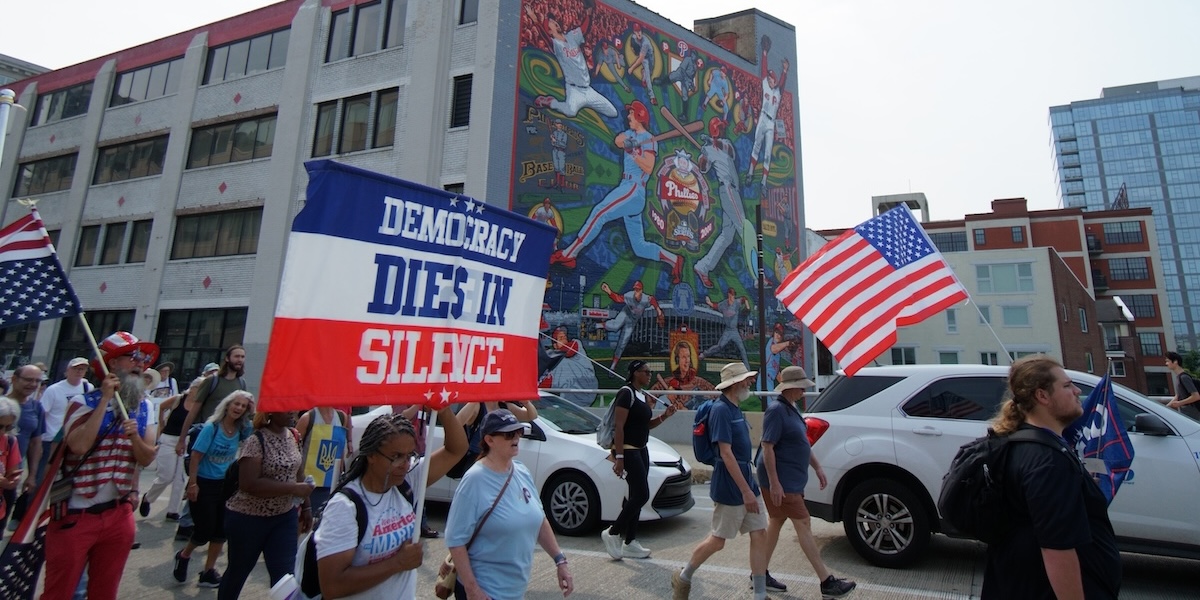


They walked 160 miles, and they’re going to walk 160 more. We Are America March (WAAM) will launch this Saturday, April 11, for a 15-day march from Philadelphia’s Independence Hall to the steps of the U.S. Capitol in Washington, D.C.
It’s not the first time either; the mastermind team behind WAAM took to the East Coast streets last September, with a nonpartisan team of 50 marchers, all standing up and marching on in the name of freedom. This time around, the core group has more than doubled, with an expected turnout of just over 100 marchers from across the nation — and the political spectrum.
“People come from California, Massachusetts, Texas. We have people joining from Oregon, from Alaska … we look out the windows every day to different landscapes, but we all believe that we need to stand together and empower each other,” says Maggie Bohara, a Philadelphian and the event’s co-founder.
Funded entirely by individual donations, they are marching together as a sign of solidarity, community, strength, and resilience, because as the team at WAAM says, “When your government lets you down, then you need to stand up.”
Overcoming kitchen blues
In the early days of 2025, Bohara felt not a day went by that didn’t have some sense of injustice attached to it: escalating ICE raids and government-sanctioned detentions, threats of martial law on the streets, mass firings across all departments in government, and an unprecedented expansion of executive power.
She was sitting in her kitchen, surrounded by family, friends and neighbors, feeling the weight of the newscycle pressing in.
“I could see what was going on in our country, what was going to be happening … and I kept asking, ‘Why? Why isn’t anyone doing anything?’” Bohara says.
That’s when her mom turned to her and said: Why don’t you do something.
It was the right setting and the right set of words to kick Bohara into gear. Wheels turning, she ruminated on the marches of social justice warriors past: 300 miles from Delano to Sacramento, the Longest Walk of 1978, the famous civil rights marches from Selma to Montgomery.
What could she do? How could she bring together like-minded people to stand up for justice and freedom?
“It’s really hard to ‘other’ somebody, to not listen to them, when they’re marching across your street, or you’re sitting across from them at a table for three square meals a day and sleeping on church floors together.” — MJ Tune
Hello, My Name Is …
Even before that day in her kitchen, Bohara couldn’t sit still. The stay-at-home mom of two was actively involved with her community, speaking out against the injustices she saw being forced upon her fellow Americans.
During her involvement with the protest-famous activist group 50501 Philadelphia, which stands for “50 protests in 50 states, one movement,” Bohara joined in creating an anti-fascist tailgate in March 2025, (accompanied by a Gritty-Trump mock-wrestling championship).
At the gathering, “Maggie and I, collectively, came together,” shares MJ Tune, a registered nurse in the city who’d go on to co-found WAAM. In just 48 hours, the pair helped pull together a stage for peaceful protest — and a bit of levity — during difficult times, attracting a crowd of over 400 and solidifying their bond.
“We never met each other before [that day] or met in person,” Tune says. “But we put this on in less than two days, we had about 400 people show up, and we featured these mock wrestling skits. [It was] just a lot of fun stuff. And then Maggie was like, ‘Hey, you want to organize a 160-mile march with me?’ And I was like: ‘Yeah, why not.’”
A logistics game
A lot goes into planning a 160-mile trek, starting with the route. Bohara, Tune and their core team — which has been anywhere from 15 to 30 activists at a time — needed to get the group from one major city to the next safely. Picking the route and having the resources to care for wounds, blisters, dehydration or other walking-related ailments had to be just as important as the message of the march.
Bohara spent countless phone calls connecting with the communities she knew they would be walking through. She spoke with townships, local law enforcement, and the communities to make sure the WAAM crew would find a safe path forward. The route itself deliberately visits towns and other small communities, where the WAAM team feels their message of community and freedom is most impactful.
“We have timetables that get sent to the local law enforcement, because we don’t want surprises,” Bohara adds.
Everyday, the core group of marchers sets off around 9am, walking the designated path till dinner time. They are often joined by members of the local community just for the day, and the group welcomes everyone interested. The WAAM team also has scheduled lunch stops throughout the route, with scouts in a car who will ride ahead to let the local Wawa or other facilities know the group is coming.
“Our marchers maintained community and camaraderie with each other. It wasn’t just a group where you come, meet, march and go home. A lot of us are in constant contact.” — MJ Tune.
Tune says setting and situation engender community, closeness. “It’s really hard to ‘other’ somebody, to not listen to them, when they’re marching across your street, or you’re sitting across from them at a table for three square meals a day and sleeping on church floors together,” she says.
That’s an important part of what they’re doing: reminding each other of their humanity. Within their ranks, the team runs the political spectrum, from a navigator who’s a former member of the Federalist Society, a registered Republican running food logistics, some identifying as liberal anarchists, to socialists, Democrats and more.
“We all believe that there’s injustice and we need to step up and stop it,” Bohara says.
In addition to security in the places they’re headed, the team also works to ensure security within walking ranks: “There’s a lot of different components to it. You have your teams of people on the ground. You also have your vehicle support,” Tune says. For this march, there will be a car in front going abotu two miles per hour, a rear scout vehicle and two large vans on either side of the group.
The vehicles act as a barrier while carrying supplies, medical care items, extra water, a place for respite and more. There’s a volunteer crew of medics with CPR certification, wound care training, and if needed, advanced skills should an emergency take place.
“We do a lot of reminders that we are a community, and it’s our responsibility to take care of each other,” says Bohara. It isn’t the Boston Marathon, after all; time isn’t the goal, and everyone is going to finish. Everyone is in it because they want what’s best for their nation.
Which is also why the WAAM team has events planned out each night, from guest speakers to teach-ins. Bohara did more than talk about road safety in all her phone calls; she also spoke with local community organizers to hear about what’s important to them. Back in September, for example, a small county in Maryland had just experienced their first school book ban. The WAAM team coordinated to have local authors join while the core marchers entered that county to discuss banned books and the impact this practice has on communities.
“What we try to say is, What is your community most invested in? What are you passionate about? What are you resisting right now and how can we help you resist?” she explains.
Aiming for change that lasts
Bohara and Tune see this upcoming march as a continuation of bringing community together while empowering the American people and reminding them that there’s power in solidarity. As a nonpartisan organization, WAAM is not demanding specific items from government officials. Instead, it aims to reconnect with communities, reach new ones, and prove that Americans are still united and committed to fulfilling the promises of freedom. Marching straight to the doors of the Capitol is symbolic, showing that change comes from a united people.
It’s also one of the reasons why the group created the Kid Constitution, a collaborative effort of more than 55 children aged three to 17 that comprises transcribed and interpreted segments of the original document.
“We have books of it that we bring with us, and we take them out at different locations and leave them with some of the community members,” Bohara explains. “The idea behind the Constitution is that it’s the blueprint to our children’s futures … most people see it and think they know what’s in it, but they’ve never actually explored it. But if you have to explain it to a child, then you need to learn the real basis of what it says.”
Additionally, WAAM has worked tirelessly on another document, a march workbook, explaining how other cities across the country can replicate the 160-mile trek in their own counties and states. Because, as both Bohara and Tune say, the efforts of their two marches do not end at the proverbial finish line.
“Everybody who marched with us [in September] went back home to their communities and took on leadership roles in some way,” Bohara says. Some went on to lead ICE watches, others spearheaded de-escalation trainings, while others still run soup kitchens.
“We all believe that there’s injustice and we need to step up and stop it.” — Maggie Bohara.
“Our marchers maintained community and camaraderie with each other. It wasn’t just a group where you come, meet, march and go home. A lot of us are in constant contact,” adds Tune.
The community and connection are what drives the WAAM team forward. They’re inviting everyone to see them off on Saturday on the steps of Independence Hall. Starting at 9am, guest speakers will kick off the two-week march. Attendees are welcome to join in the first steps through the city. Timetables and scheduled stops are also posted on their website so that people can stop in and cheer the group as they make their way to Washington, D.C.
“[Society] is more connected than ever because of technology, but we also understand each other less than ever,” says Tune. Through the march, “what we’re trying to do here is we’re trying to get people to have those conversations, to get people to connect that might not otherwise connect.”
“We share humanity. We all deserve human dignity and the people that see us [walking] also see that,” Bohara says.
 MORE DEFENDING DEMOCRACY