


The 24 people sitting down to dinner at Reading Terminal Market one Tuesday evening in 2017 were not usually dining companions. Most had never met, despite all hailing from Northeast Philadelphia. Most, it’s safe to say, would likely never have had the opportunity for a real conversation, for getting to know each other.
Listen to the interview edition here:
A dozen of the diners that evening were Syrian refugees, most of whom had fled their country’s civil war. The rest were native-born Americans of various backgrounds. The timing was fraught: In one of his first acts in his first term, President Trump issued a travel ban on several Muslim countries, including Syria, whose citizens he framed as violent criminals connected to terrorist organizations like ISIS.
“Syrians are a peaceful people,” says Nasr Saradar, a Syrian immigrant himself. “You can’t judge people by the extremists. But that’s what was happening.”
By the end of the dinner, however, Saradar says something profound took place: Communicating through translators at each table, the diners put aside their pre-conceived notions. They shared their American experiences, their dreams and their humanity. And they did it by bonding over the most basic of necessities: food. (Specifically, blackened catfish from Reading’s Down Home Diner — prepared by chef Jack McDavid, the descendant of Irish refugees — and falafel from Kamal’s Middle East Market, led by chef Hesham Barouki.)
“It’s not just food; it’s life,” says Saradar, associate director of economic development at Nationalities Services Center. “When you sit at a table, you say ‘us’ and ‘we’, not ‘me’ and ‘them’. All those hierarchies dissolve while eating.”
Saradar’s experience was part of Reading Terminal’s Breaking Bread, Breaking Barriers series, which hosted several dinners for immigrants and native-born Americans. Conceived by then-executive director Anuj Gupta, the series consisted of two dinners per group, culminating in one final meal for all 130 participants. Gupta (and others) have since held various iterations of Breaking Bread.
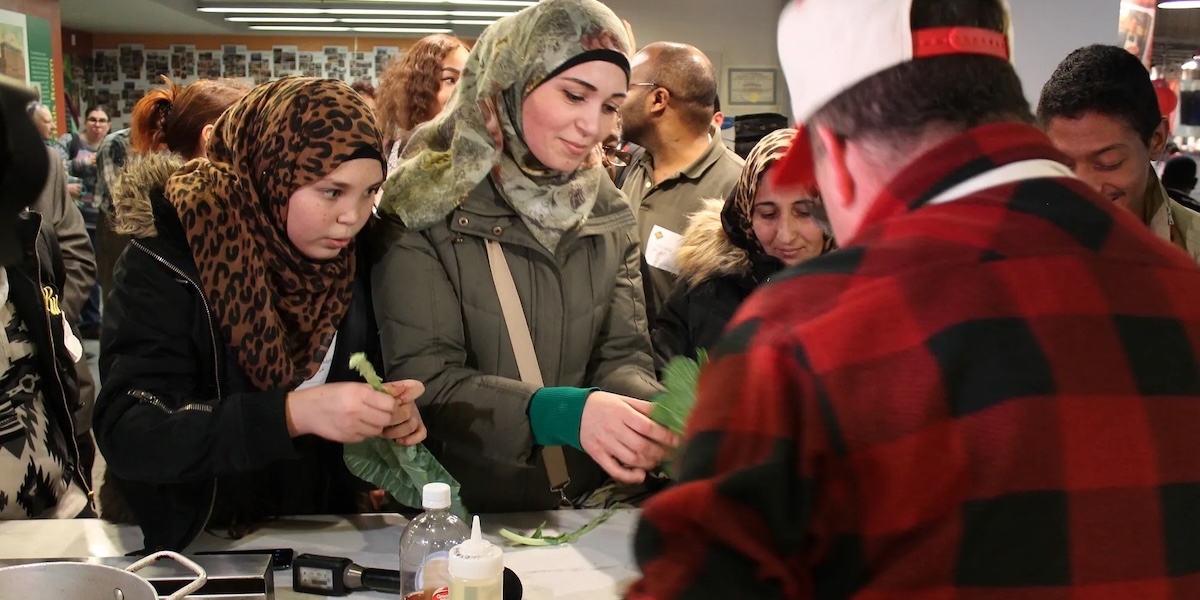
Now, as part of the city’s 250th celebrations — at another fraught moment for immigration in America — Gupta, now executive director of The Welcoming Center, is bringing the series back, with The Citizen as a media partner. This time, Gupta’s ambitions are even greater: The Welcoming Center will host in total about 1,200 Philadelphians for a series of three dinners in seven different neighborhoods, aimed at creating community connections and culminating in what Gupta is calling a “recipe for citizenship.”
“Food is one of the last things that it doesn’t matter how much money you make, doesn’t matter what language you speak, doesn’t matter what part of the world you grew up in,” Gupta says. “We are using food to cut through the things that divide us, and structure it in a way to see if we can bring this increasingly diverse Philadelphia together.”
Food is the vehicle
Gupta first created Breaking Bread in 2016 at Reading Terminal with three inspirations:
- A mandate from his board to make sure the market “was relevant to everyday Philadelphians.”
- Sociologist Elijah Anderson’s The Cosmopolitan Canopy, which devotes a chapter to “the organic chemistry” that a market like Reading Terminal can provide to its constituents.
- The knowledge that we had a “fast diversifying Philadelphia, predominantly through immigration.”
The very first dinner was for Korean business owners and the mostly Black West Philly residents around 52nd Street, in the wake of several racially-charged incidents. The cornerstone of the meal, as catered by a couple different restaurants: fried chicken, both Southern and Korean.
In 2019, at the behest of then Parks and Recreation Director Kathryn Ott Lovell, Gupta helped launch a similar series in city parks to solve a conundrum Ott Lovell had observed: Though neighborhoods were becoming increasingly diverse, friends of the park groups tended to be dominated by folks from just one or two ethnic groups, which then determined the programming of the park. “Places that should be the most accessible and democratic — parks — were not reflective of the communities they served,” Gupta says. Ott Lovell wondered, “Could we use Breaking Bread to bring more communities into their neighborhood parks and make them part of it?”
“It’s not just food; it’s life. When you sit at a table, you say ‘us’ and ‘we’, not ‘me’ and ‘them’. All those hierarchies dissolve while eating.” — Nasr Saradar
Gupta organized dinners in Germantown’s Vernon Park; Kensington’s Norris Square; Southwest’s Bartram’s Garden; and South Philly’s FDR Park. The most robust spectrum of Philadelphians participated in those dinners — until Covid hit, and the last, communal, dinner had to be cancelled. A year later, Gupta did a series virtually, with 90 neighbors from East and West Mt. Airy, who picked up food from a local restaurant, logged in to Zoom, and then broke into small groups for led conversations. It was, Gupta says, surprisingly moving.
“The things that people were willing to share with complete strangers through screens was striking,” he says. “People were just longing for some kind of connection, and this gave them a platform, using food as the vehicle.” One woman, a stranger to Gupta, started crying during the discussion, noting that the virtual dinner was the first interaction she’d had with anybody outside of her son and her immediate neighbors since the lockdown began months earlier. “It was such a pressure valve release for her, and because we’re talking about food, it gave her just this sense of comfort that she could talk about it here.”
Other organizations — including the Anti-Defamation League and Mayor Kenney’s administration — used Gupta’s Breaking Bread model over the last few years to bring people together after conflicts. (One such dinner, between Mummers and members of the Mexican and Chinese communities, resulted in Gupta being invited to strut in the New Years parade — which he finally did, this year.)
“We have very few things in common anymore,” Gupta says, noting for instance his “great” block in Mt. Airy, where the 12 young kids attend different schools, so don’t really know each other. “No matter where you’re from, you have a cuisine in your background, and when you start exploring, the similarities are quite striking.”
Healing through culinary storytelling
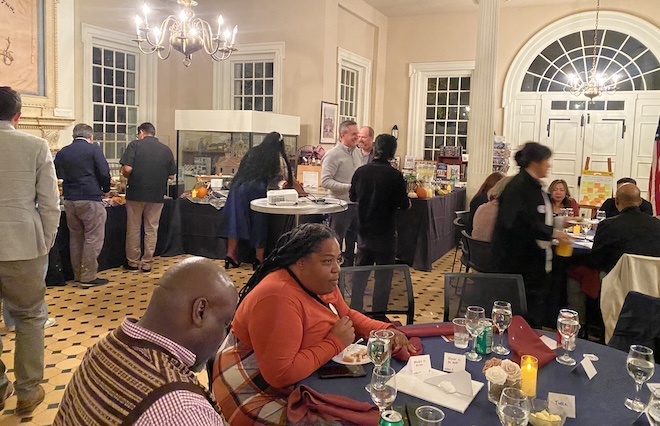
This year’s dinners, like the others, are free to attendees, thanks to a grant from the city’s Semisesquentennial Funding Collaborative (led by the Connelly Foundation), the City and the William Penn Foundation. The first one will be at Puentes de Salud in the Graduate Hospital neighborhood, with a mixture of Latino and Asian immigrants, and native born residents. The Welcoming Center will ask chefs to create dishes that tell a story they can share with participants, so they “walk away with not just a good meal, but with an understanding of the cuisines that are reflected in those communities.”
Gupta expects 90 people at each dinner, from four to six different immigrant and native born communities. Each is expected to attend three meals, broken up into tables of 10, with one or two facilitators at each table to lead a discussion. The first event will be a conversation about food; the second about what it takes to be a good neighbor; the third about what citizenship looks like in Philadelphia. A final dinner, with all 1,200 participants, will be held, hopefully outside, next fall. (Given the fraught circumstances around immigration, Gupta says the Welcoming Center is taking all precautions to keep people safe.)
Like with the other dinners in the series, Gupta has partnered with sociologists, this time at St. Joseph’s University, to study how the events have impacted participants; after every dinner, the moderators will synthesize their notes to share with the researchers, who will also conduct surveys, with an aim of creating a “recipe for citizenship”. The Citizen will help chronicle the lessons from the meals that will live on — and hopefully bloom — beyond 2026.
“The theme of citizenship is so important right now,” says Saradar. “We are all Americans. If you live here, you’re a Philadelphian. We need to know our duties as citizens of Philadelphia. We are one body, and being a Philadelphian you have to think of it that way. If one part aches, the rest of the body suffers. This is a way to make that message clear.”
Correction: An earlier version of this story incorrectly stated the name of the Down Home Diner chef. It is Jack McDavid.
 MORE IMMIGRANT LIVES IN PHILADELPHIA