

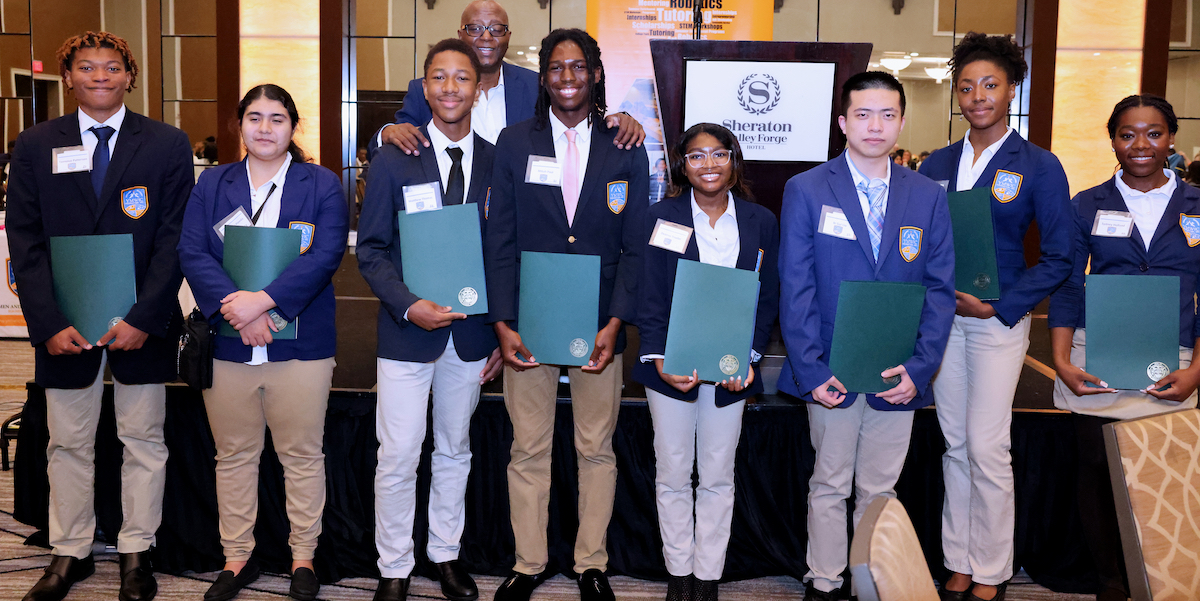


One by one, 100 students, spanning kindergarten to high school, all dressed in khaki pants and navy blue blazers, stand in a line inside a banquet hall at the SpringHill Suites in King Of Prussia. Together, they recite a credo from the Young Men and Women in Charge Foundation (YMWIC). Their voices are steady. Their postures are proud. Their words sound like a mantra.
“I am a Young Scholar in Charge!”
“I am bold and strong. I will banish fear and doubt, and I know that I am not alone in my journey towards success.”
Listen to the audio edition here:
This tradition, now in its 15th year, is the annual end-of-the-school-year banquet for students in the YMWIC, a youth program that began in West Chester and expanded across the region, including Philly. Retired engineer Richard Roberts III began the YMWIC in his home garage; today, it’s an afterschool juggernaut serving more than 400 kids annually that has supported hundreds more on the way to college and careers.
The only one in the room
Roberts grew up in middle-class West Oak Lane in the 1960s and 1970s, earned Bachelors and Masters degrees in engineering from Widener University, and spent 40 years as a professional engineer.
A lot changed in engineering and STEM in general over Roberts’ decades in the field. But one thing remained constant: He was almost always the only Black professional in the room. According to the most recent report from the American Society for Engineering Education, the field is 58 percent White, less than 14 percent Hispanic and only less than 5 percent Black.
Years ago, Roberts decided to do his part to change such statistics. In 1998, he began volunteering as a middle school mentor and tutor in the Norristown school district. He taught engineering basics and told students about his field and other growing and lucrative STEM fields. Roberts didn’t have formal teaching experience, so he used his background coaching his own children in football. But he soon saw the problem was more than just helping students understand equations, illustrating opportunities, or treating them as a winning team.
“One day, Mr. Roberts came in, he was pitching his program, and we were like: Oh, my, god. We still have a chance at college.” — Isis Emerson, YMWIC student
He needed more time with them, more resources, more structure — and realized his opportunity to do so existed not during the school day, but after school, in a more relaxed setting, where it was easier to make connections and figure out what each kid needed and where they wanted to go.
In 2012, Roberts started hosting free robotics lessons for neighborhood boys out of his West Chester home’s garage. It wasn’t long, he says, until he and family friends had created a full-fledged, all-volunteer after-school program out of his house. With a $2,000 grant from the Creative Entrepreneur Accelerator (CEA) Pennsylvania Commonwealth and the donation of some vacant office space in Exton, they made it official.
The new space had room for a few classrooms and a meeting room, and allowed the organization to expand. “We opened it up to ladies and rebranded to Young Men and Women,” Roberts says.
2,300 students … and counting
Roberts is now one of 26 teacher-mentors from STEM, education and political science fields who lead sessions in mathematics, English, and engineering, offer homework help and serve as role models — all after school — in 13 chapters serving 425 students across nine schools and districts: Chester Upland, Coatesville, Norristown, Phoenixville, West Chester, Upper Darby, William Penn and Furness and Martin Luther King high schools.
Over the past 15 years, about 2,300 students have participated in YMWIC. According to their annual report, among YMWIC alumni, 83 percent have pursued post-secondary education; 38 percent are now working professionals, and 62 percent are currently enrolled in college or higher education programs. Roberts says the organization receives funding from communities, individuals, corporations, the Commonwealth and municipalities.
A typical YMWIC program afternoon includes project support — essentially a more structured study hall with tutoring and academic coaching. The organization holds STEM workshops a few times each month. Sometimes a workshop will feature a speaker from a STEM field; other times, scholars work on projects for the Science Expo, the YMWIC’s big science fair, or take part in a hands-on group experiment.
The support YMWIC provides is more important now than ever, as federal funding decreases revenue for all manner of youth- and education-centered programs.
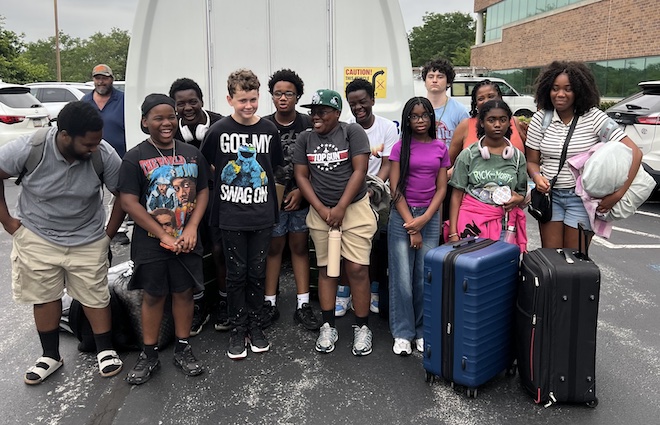
Older students go on multi-overnight college campus visits, where they immerse themselves in real college environments — and, importantly, eat onsite. Dining halls, says Veronica Mattaboni, project coordinator of the Chester Upland and Phoenixville chapter, are surprisingly important. “These kids care a lot about whether or not a place has good food,” she says with a laugh. “They’re not coming if it doesn’t.”
Throughout, the organization monitors current and former participants’ report cards and uses a leadership development unit (LDU) system to track overall participation. “Every year they’re LDU compliant contributes to their scholarship when they graduate,” says Mattaboni. “We also come back to the credo a lot. It reminds them they’ve accepted the challenge of committing to this foundation.”
Each year, the YMWIC awards the Mathew & Stephanie Kistler Family Foundation Scholarship to a graduating senior who has demonstrated strong academic performance and exceeded the requirements for the LDU. In 2025, the winner was Janis A. Bady of the West Chester Chapter. Bady now majors in dance at the prestigious Juilliard School in New York. In past years, YMWIC scholars have gone on to Penn State, the University of Pittsburgh, Temple University, West Chester University, the Georgia Institute of Technology and Drexel University.
YMWIC today
YMWIC’s headquarters is now on the second floor of West Chester University’s graduate building. Here, Roberts sits in a glass-bricked office while students in nearby classrooms learn to code and assemble robots for an upcoming competition — a culmination of weeks of STEM learning, with hours spent building, troubleshooting and collaborating.
Learning skills like communication and collaboration came just in time for Isis Emerson, who joined the program at the beginning of the Covid pandemic. Like so many students, Emerson struggled with hybrid learning and disconnection. “My world kind of fell apart; my grades tanked, and all sorts of stuff happened,” she says. “And then one day, Mr. Roberts came in, he was pitching his program, and we were like: Oh, my, god. We still have a chance at college.”
Emerson was one of two founding students of YMWIC’s Chester Upland chapter. More than just helping with her grades, Emerson says, joining YMWIC “helped me learn how to use my voice in a more effective way … It taught me that it’s okay for me to ask for help. I don’t have to handle everything by myself.” She remembers meeting an older student who gifted her a pair of sneakers. “She basically told me that she gets my struggle and that it does get better — and that’s really what I needed at the time,” she says.
Joining YMWIC “helped me learn how to use my voice in a more effective way … It taught me that it’s okay for me to ask for help. I don’t have to handle everything by myself.” — Isis Emerson
Today, she’s studying at Delaware County Community College with plans to transfer to a four-year graphic design program while launching her own line of affordable Renaissance-style clothing. This year, another student from Chester Upland became the first in the chapter to win YMWIC’s Scholar of the Year award.
“It’s been a fantastic achievement for them, but also a great motivator,” Mattaboni says. “One of our scholars even called me on the way home from the banquet and said, ‘Yeah, that award she won? That’s gonna be mine next year.’”
The support YMWIC provides is more important now than ever, as federal funding decreases revenue for all manner of youth- and education-centered programs. This May, the Trump administration pulled $10.2 million from Philadelphia’s AmeriCorps, a major nonprofit that, since 1993 has helped youth succeed in school and plan for careers and college through programs like the highly successful Philadelphia Higher Education Network for Neighborhood Development (PHENND). And that’s just Philadelphia.
Nationwide, more than 10 million children take part in after-school programs. In PA, according to Cause IQ, more than 1,600 nonprofit youth development organizations support student after-school programs that employ over 8,000 people.
The potential of a YMWIC student
Bady, the dance major at Juilliard, was in the YMWIC’s West Chester chapter. She says events like the Science Expo and the annual banquet not only introduced her to the possibilities within STEM, but also helped her grow socially and professionally. During her sophomore year of high school, she learned a big lesson while presenting her science fair project: “Your product is reflecting on you, regardless, so you might as well make it a good representation of who you are.”
Recently, at a post-performance networking reception, Bady found herself relying on what YMWIC taught her: Be confident. Make connections. So, “I tapped on somebody’s shoulder, I said, ‘Hey, how are you? Let’s talk. My name is Janis.’”
 MORE EDUCATION STORIES FROM THE CITIZEN