



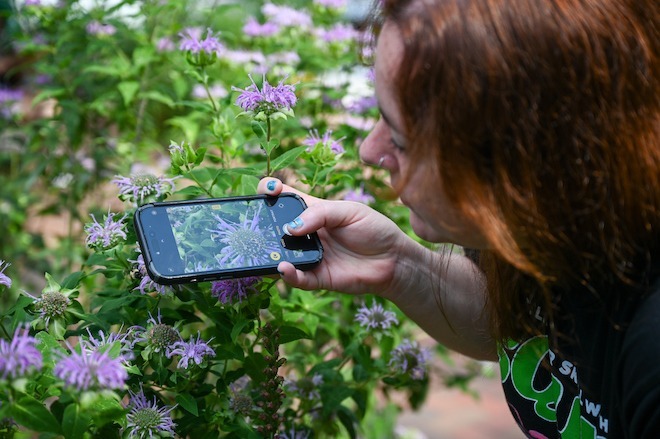
It’s not uncommon to find Sarah McAnulty in the New Jersey Pine Barrens on a summer evening, setting up bright lights to attract insects and teaching a small crowd of people about their local ecosystems.
McAnulty was inspired to bring people to this forest during Covid, when she spent a lot of time there and learned more about the ecosystem. She wanted to share her knowledge with others, and “Moth Nights” were born. Past events have attracted insects, yes, but also critters like bats and foxes.
They’re one of a number of events McAnulty has run in and around Philly over the past few years. She founded the nonprofit Skype a Scientist in 2017 and, though she has a PhD in biology and expertise in squids, she now works in science communication, helping ordinary people understand the work scientists do everyday.
“People aren’t going to change unless there’s a social component to it.” — Sarah McNulty
Her work has brought scientists into more than 50,000 classrooms around the country. Here in Philly, she’s created two murals, educated folks about climate change and deep sea research, encouraged native plantings and much more. She hopes her work, which often combines science and art, will help people better understand science, take action to protect their environment and be all-around better neighbors.
“If you can empathize with an animal who’s very, very different from you, maybe you can also empathize with people that are pretty similar to you,” McAnulty says.
From squid biologist to science communicator
McAnulty has long loved animals. She grew up in Bucks County and spent a lot of time outside as a kid. When she was eight, she watched a National Geographic special about the ocean and became obsessed with squids — their donut-shaped brains, their ability to see the direction of light. “I thought it was the coolest thing ever,” she says.
She pretty much stayed on the squid path from that moment on, earning a degree in marine science at Boston University and a PhD from the University of Connecticut. As a PhD student, she started becoming worried about how little the general public understood about issues like climate change.
McNulty was a graduate student when Donald Trump was elected for his first term. She spent a lot of time online, witnessing researchers and climate advocates share their concerns about the future. There was a disconnect, she thought, between the lengthy, jargon-filled research papers scientists use to share discoveries and the quippy tweets or glossy Instagram videos most people were communicating with online.
“Scientists were just sort of panicking online and saying, if so many people have voted for this guy, we have failed to communicate how dire climate change is,” she says. “But they weren’t really coming up with solutions.”
So McAnulty decided to create a solution of her own. She started reaching out to concerned scientists and pairing them up with K-12 classes, libraries and scout groups to give talks about their research and what they wished the general public knew about their work. She named the program Skype a Scientist.
Since its launch in 2017, Skype a Scientist has brought scientists into 50,000 classrooms across the country. Teachers can request a visit to represent a specific discipline — conservation, environmental science, astronomy, geology, chemistry, engineering — or they can browse a list of participating scientists and request a specific scientist..
Running the nonprofit is McAnulty’s full time job. She tries to pair students with scientists who come from similar backgrounds as them and tries to bring in scientists from groups who are underrepresented in STEM — be it women, queer people, people of color, or folks from rural areas. Nearly two thirds of U.S. scientists and engineers are White and 65 percent are men, per a U.S. National Science Foundation report that looked at the industry between 2011 and 2021. One of the scientists she works with, a fish biologist, grew up in Olney and he’s done talks in classrooms in North Philly.
“All of these identities really matter when you try to become a scientist, because the higher up you go, the more homogeneous it looks,” McAnulty says. “When you watch scientists on TV and in movies — this has gotten a lot better in the last decade — they have historically looked a certain way.”
Get a squid fact
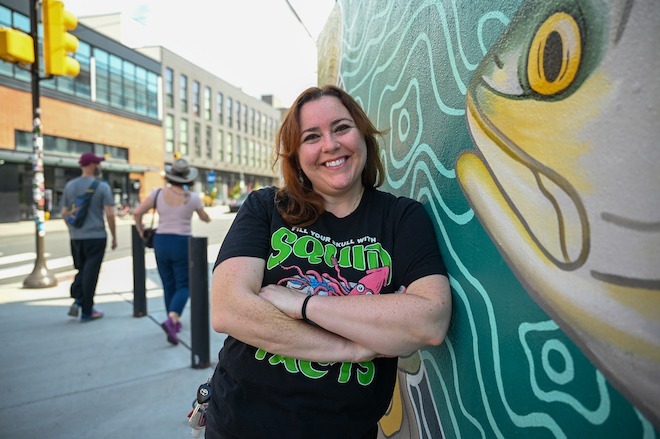
Walking through Philly, you might have noticed stickers of cartoon squid, talking on a boxy pink cell phone ala the 1990s, with the message “Text ‘SQUID’ to 1-833-SCI-TEXT” to get a fact about the creatures. These, too, are McAnulty’s work. When she moved back to Philly after graduate school, she added an in-person component to her science communication work, hosting events and making art to educate people about their ecosystem and other science-related topics.
The projects range from the fun and silly (anglerfish burlesque, anyone?) to the more action-oriented, like community paint days for the two science murals McAnulty created in the River Wards, or educational, like the Moth Nights.
The events involve an educational component. For “Deep Dive: Explore the Ocean Floor from Philly,” the evening started with an aquatic burlesque performance — you have to see it to appreciate it — then attendees toured a sea research vessel, followed by a discussion with scientists about deep sea research and then a musical comedy improv performance.
The goal is to create fun, easy ways for people to start to engage with science. Most people walking through Philly don’t really need to learn about squid — you’re not going to see them in the Schuylkill or Delaware River. But the stickers encourage people to learn something about the environment. If someone texts for a fact, they can opt to learn more about Skype a Scientist, go to the site and sign up for livestreams, where they can hear more about various creatures (she’s planned one for newts in September and whales in October).
The murals have QR codes that people can scan to learn more about creatures, like spurgeon fish, that actually do live in the Delaware River. Events are low-cost — $10 for climate change craft night — and some like Moth Night have sliding scales, some tickets are $20, others $40, to help support the work.
In-person work can also help McAnulty counter science misinformation, which she’s continued to see, both with vaccines and clean energy in recent years. She remembers a few summers ago, there was a swell of resistance to wind farms off the Jersey shore because people thought they killed whales, but that isn’t true.
“But other things in the last decade have been killing whales. The humpback whales off the coast of Jersey have been hit by boats more because there have been more of them,” McAnulty says. “The same reason you see white-tailed deer on the side of the road is why we’ve had dead whales.”
“Literally any native plant that you put out there will one step up the food chain to help a lightning bug.” — Sarah McNulty
Reaching people where they are
Philly artist Sean Martorana partnered with McAnulty for the mural at the corner of Trenton and Norris. He remembers community members coming out to help with the project, cleaning up the wall for painting, and students from the Kensington Creative and Performing Arts High School picking out the creatures. But he also remembers how many people walked by as the artists worked, and stopped to ask questions.
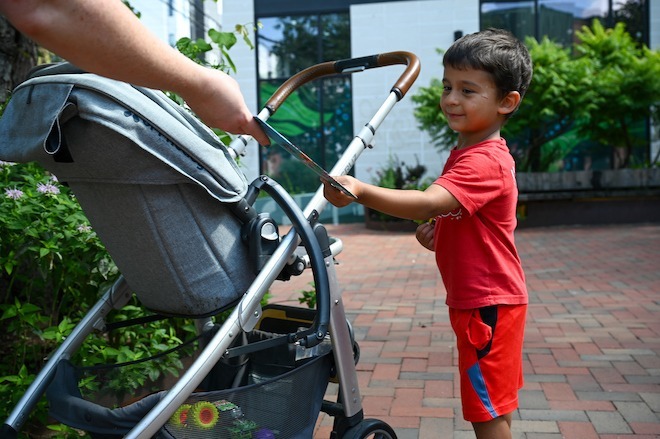
“I would be there, and I would watch people go to work, and I’d be there and watch them come home. I watched the parents pick up their kids from school,” Martorana says. “[I was] seeing how many people it will have an impact on … but also seeing parents teaching their kids about what’s in the mural. You have this constant educational thing that’s going on.”
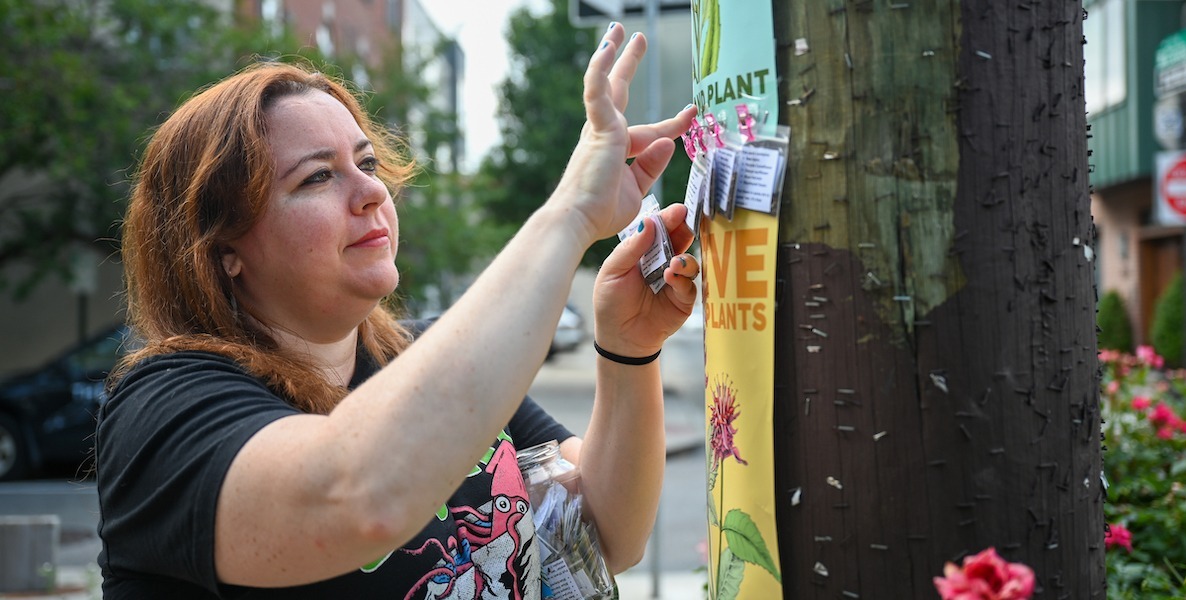
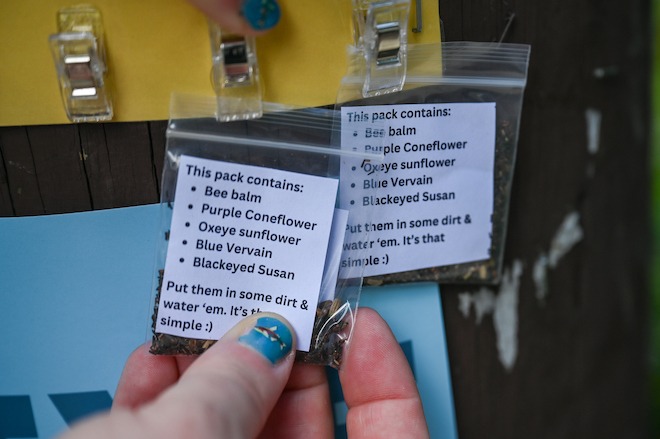
McAnulty is working on a number of projects this year. This spring, she partnered with another artist, Meg Lemieur, on posters of native plants that could be used to distribute seeds and hung them up around the city. Her work is funded largely through donations — she hasn’t gotten government funding. So raising money is always a challenge. McAnulty has created science educational resources, like posters and zines, which she sells to help fund her work.
“Funding is hard,” she says, “and it’s hard in the way training for a marathon is hard.”
She hopes that people who engage with her work, whether it’s attending a climate change crafting night at Indy Hall, or texting for a squid fact, go on to communicate with a friend, or neighbor about what they learned.
“Go use the relationships that you already have to amplify this,” she says. “People aren’t going to change unless there’s a social component to it.”
She hopes to share what she’s learned about successful, in-person initiatives in Philly with other scientists around the country so they can launch successful communication initiatives of their own. She also wants you — yes, you — to “plant one native plant” because they’re the building blocks of our ecosystem. They help pollinators, birds and other species thrive.
“It’s cheap and easy to do,” she says. “Literally any native plant that you put out there will one step up the food chain to help a lightning bug.”
 MORE RAD PHILADELPHIA WOMEN