



Two weeks ago, National Park Service workers in Philadelphia complied with an executive order from President Trump by removing informational panels that referred to slavery at the President’s House. The defacement made national headlines. It did not, however, impact the work of a Black history preserver three blocks away at the Museum of the American Revolution.
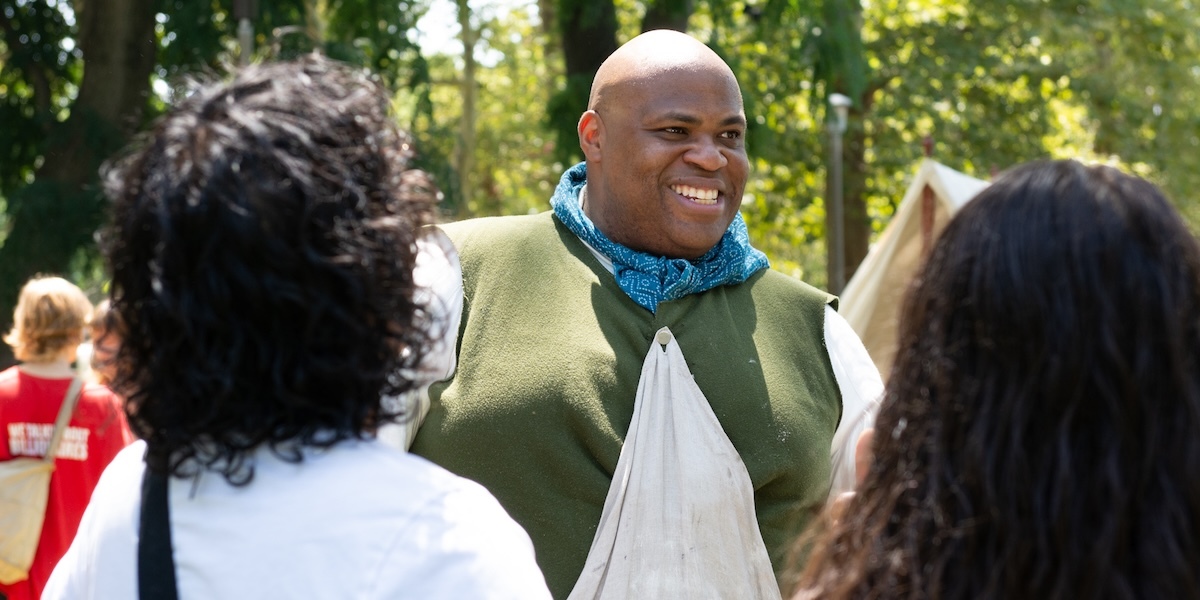
Michael Idriss, manager of the museum’s African American Interpretation Program and self-proclaimed “time traveler,” has defied decades-old and recent convention in order, he says, “to lift the voices of individuals of African descent who are often left in the margins of the Revolutionary world.”
In the current political-cultural climate, this opportunity is, to him, a privilege. And it couldn’t have happened to a more thoughtful or devoted Philadelphian.
A passion for history
Idriss’s passion for history and storytelling began with geography. The West Philly native remembers finding a 1976 almanac as a child. “I would skim through it for hours, reading up on all the cool things that happened that year,” he says. From there, “the time portal opened.” Although his elementary school, William Cullen Bryant, had a strong focus on Black history, when he and his mom would take SEPTA to visit Old City’s historic sites, it “felt like they were telling a story in which I did not see people who looked like me as active participants.”
Idriss went on to attend the former Edward Bok Vocational-Technical High School, major in history at Delaware County Community College, and transfer to Temple University, where he majored in history and minored in African American Studies / Africology.
His professors — particularly Teshale Tibebu, Aaron Smith, and Benjamin Talton — helped Idriss learn “the process of telling good, factually accurate stories,” he says. Absorbing the differing perspectives of his major and minor, he adds, “allowed me to gain a deeper understanding of the African diaspora from Ancient Kemet to the Post-Civil Rights era.”
“One thing you learn from doing this work is that we all had the short end of the stick regarding education about the 18th century.” — Michael Idriss, Museum of the American Revolution
While at Temple, Idriss took a job as a tour guide in Old City, and, he says, “I realized I was good at giving tours. It came very naturally.” He describes his style, both then and now, as “a conversation … I am not a fan of facts for the sake of facts, but of facts that provoke deeper thought about the time period and the variety of people in the Revolutionary world.”
After graduation, his passions led him to the Museum of the American Revolution, the newest major addition to the neighborhood since the Liberty Bell Pavilion. Since its founding in 2017, the $120 million attraction has been intentional about featuring populations often left out of the story. Spokesperson Beth Ann Downey describes the museum’s mission: “to uncover and share compelling stories about the diverse people and complex events that sparked America’s ongoing experiment in liberty, equality, and self-government.”
The museum opened with an original copy of African American poet Phillis Wheatley’s Poems on Various Subjects and the story of William Lee, George Washington’s enslaved valet, told during the dramatic reveal of the venue’s centerpiece, Washington’s War Tent. Since then, MoAR has doubled down on the mission with their African American Interpretive Program in 2021 and new exhibitions and exhibits featuring indigenous peoples and women.
A gig, then a fellowship, then something more
In 2019, Idriss became one of MoAR’s visitor engagement associates, a role that includes giving tours, leading virtual programs, acting as an ambassador at libraries. He completed his training in March of 2020 — just after Covid closed the museum.
When the museum re-opened, he encountered visitors who were longing for personal connections and knowledge. “One thing you learn from doing this work is that we all had the short end of the stick regarding education about the 18th century. Many of us only encountered this era for a few days to a week during our school years. So there is a thirst to know more.”
“Living history directly connects you with these stories. It dissolves the divide of 250 years.” — Rebecca Franco, Museum of the American Revolution
To be clear, he doesn’t blame teachers. “The lack of physical images, personal letters, and other items … it is easy not to appreciate the critical contributions that people of African descent, both enslaved and free, made in ways both big and small,” he says.
Idriss did well in the role, and, one year later, was unexpectedly promoted to a new one: African American Interpretation Fellow. Two years later, in 2023, he became the manager of the African American Interpretive Program. He’s more behind the scenes these days, except when he’s not.
Reliving history
Just as the streets and in the parks and sites of Old City (and Valley Forge), have historical reenactors — Betsy Ross on Arch Street; Ben Franklin in his post office, soldiers calling children to arms at 5th and Chestnut — so does the Museum of the American Revolution.
Living history interpreters take a tried-and-true approach to history sharing, and, according to Rebecca Franco, the museum’s Family Programs Manager, the program works. “There are a variety of learning styles. Some really learn a lot by reading all the labels and watching the films. But for a lot of people, especially young people, [history] still feels like something that’s removed from their lives,” she says. “Living history directly connects you with these stories. It dissolves the divide of 250 years.”
Although diversity has been baked into the Museum of the American Revolution’s mission, their interpreters originally included few African Americans. This circumstance was neither new nor unique. Historically, American historical reenactments and interpretations haven’t told the full, complex story of the Revolution — an era when one in five Americans was of African descent.
In more recent years, groups like Female RE-Enactors of Distinction in Washington, D.C., and Not Your Momma’s History in New York have worked to rectify this disparity. So has Idriss.
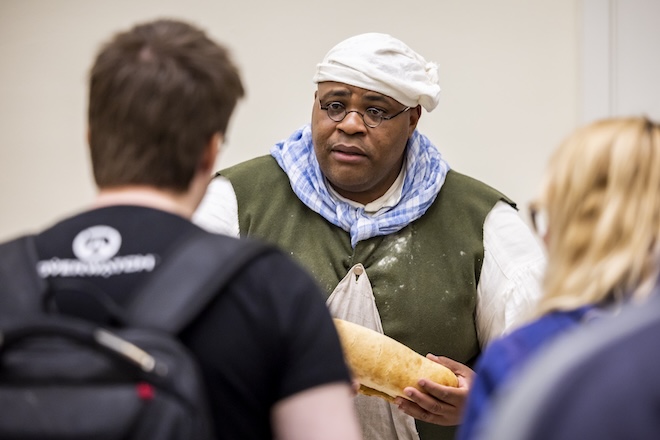
Idriss chose his own character: Philadelphian Cyrus Bustill (1732-1806). Born into slavery, with a Quaker father and an African (and possibly Indigenous) mother, Bustill worked as a baker, and earned enough money in an apprenticeship to free himself. He went on to bake for Washington’s Army, establish his own bakery, and become a founding member of the Free African Society of Philadelphia. The Bustill family became prominent, and engaged in both artisanal industry and abolitionist work. Paul Robeson is one of Cyrus Bustill’s descendants.
Idriss’s background as a tour guide was especially helpful here. And the experience was transformative.
“I didn’t realize what I was doing as a tour guide was interpretation work until I started doing interpretation work,” he says. “But doing it in costume is different. You become an actual element in the learning process, in what you’re wearing. It’s a very expressive and immersive process, and I enjoyed that immensely.”
Focusing on Black Founders
In January 2023, the museum mounted the exhibition Black Founders: The Forten Family of Philadelphia, which traced the story of James Forten (1766-1842), a wealthy sailmaker and Revolutionary War veteran, and his descendants’ roles in fighting for abolition and women’s suffrage.
Idriss’s role in the exhibition was multifaceted and centered around Forten, who as a child was present for the first public reading of the Declaration of Independence, a little-known fact that, says Idriss, “was a game changer for me. Wow. You’re telling me a free child of African descent heard the first reading? What would that mean to a young child of African descent to understand that someone who looked like them was there on that day, when the words went from closed doors to the public?”
Idriss became essential to the exhibition and its programming. He worked to secure loans of materials from Howard University, developed the James Forten walking tour and co-produced a program around the music of Francis Johnson, a Black composer during the Antebellum era. He also represented the Museum in a PBS documentary on and named after the exhibition, and produced two plays about Forten.
The plays centered on Don Troiani’s 2021 painting, Brave Men as Ever Fought, named for a quote by James Forten, who described several companies of soldiers, both of African and Indigenous descent, “As brave men as ever fought.” The first play, says Idriss, “took a sliver of his early life, at 18 years old.” The second play centered on Forten’s “work as an abolitionist, and the burning of Pennsylvania Hall in 1838, which he helped to build.”
The next generation of African American historians
Throughout, Idriss has been acutely aware that the work he does for museum visitors too seldom reaches young people. He joined in the efforts of the museum’s Living History Youth Summer Institute, created by museum President and CEO R. Scott Stephenson, and Director of Education and Community Engagement Adrienne G. Whaley. Idriss describes the summertime program as a “multi-week, multi-disciplinary look at the world of historical interpretation from the perspective of people of African descent” for youth ages 16 to 21 from across the country. (Applications open February 16 for this summer’s cohort.)
The Institute also emphasizes storytelling, and helps young people learn how to tell “the fuller story of people of African descent.” It also emphasizes facts, which can be hard to digest, especially for a young person. “We don’t sugarcoat things here,” he says.
“To see young people connect with and interpret the story of George Washington’s enslaved valet William Lee in a way that does not diminish his work but emphasizes the importance of his duties throughout the Revolutionary War, creates a spark of joy.” — Idriss
Trauma specialists come in and talk to the students about how to process their feelings, how to do this research in a healthy and sustainable way, and how to lean on others for support when they feel themselves struggling. The goal is to build a safe and supportive environment for students to engage with the circumstances that both enslaved and free Africans found themselves in. Last summer, Idriss created an abbreviated program for local youth, an effort to nurture “homegrown talent.”
Idriss’s impact
Museum Family Programs Manager Rebecca Franco describes Idriss as “vital to the Museum and its mission” of telling a more comprehensive story of the American Revolution. More than a historian, he’s a born connector. Franco continues, “He cares so deeply about the work he does in uplifting the stories of people of African descent and inspiring the next generation of historians, and you can feel that when you watch him interact with others.” That is especially true of young people, who, she says, “are staying engaged with the work, even if it’s not specifically interpretation work.”
“To see young people connect with and interpret the story of George Washington’s enslaved valet William Lee in a way that does not diminish his work but emphasizes the importance of his duties throughout the Revolutionary War, creates a spark of joy,” he says. “It is incredibly satisfying to speak with a guest who has little to no knowledge of the story of Elizabeth Freeman, walk away knowing that she helped secure her own freedom through her understanding of the Declaration of Independence, and leave them with a thirst to learn more.”
So far, one institute student has shared her experience on a panel discussion at Washington College in Chestertown, Maryland; she also wants to get into archival work after graduating from Howard University. Another wrote a paper on James Forten for Arcadia University. So far, three students have returned for a second year.
And, “Last year, we had a student from the University of California at San Diego who travelled all the way to Philadelphia to spend the summer taking in this experience. It has encouraged her to use her voice in the communication field,” says Idriss, “So it does not need to be only a historical or interpretive connection; we want to expose our participants to the many facets of museum work.
It’s a lot of work, and he’s having a great time doing it. “I get to be a time traveler to better understand and share their perspective among others here at the Museum of the American Revolution, which is pretty cool.”

MODERN TAKES ON AFRICAN AMERICAN HISTORY
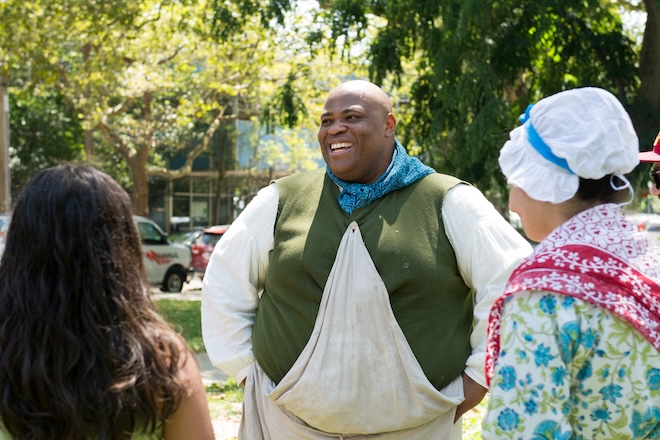
Michael Idriss, Manager of the African American Interpretation Program at the Museum of the American Revolution. Courtesy of the Museum of the American Revolution.