




Cliff Skinner walked into the Philadelphia Family Court building in 2022 determined to regain custody of his daughter. When the proceedings began, his court-appointed lawyer introduced himself and then immediately fell silent — something Skinner had demanded of him. Then Skinner politely introduced himself, informed the judge that he wanted his daughter back, and proceeded to navigate the hearing with unusual dexterity. Like a well-choreographed dance, he was eloquently prepared for every question the judge asked, and ultimately he was rewarded for his preparation.
Listen to the audio edition here:
Not only was Skinner given full custody of his daughter, but the social worker managing his daughter’s case asked him to come back to run a training for other fathers in similar situations.
“I know my rights, and I know what I’m entitled to,” Skinner says. “I’m well-trained and well-versed, because I am an outreach program manager for Daddy University.”
For the last 22 years, Daddy University has been an essential resource for thousands of Philadelphia’s fathers. Its goal is to equip local dads — regardless of race, ability, class, or religion — with the skills and knowledge required to navigate childrearing at every stage of life, and to advocate for themselves and the critical role they play in the healthy development of their children.
How to Dad 101
The tireless mastermind behind this organization is Joel Austin, a 59-year-old West Philadelphia native, Army veteran, and father of a blended family with 11 children. In 1997, Austin brought his oldest son, then five years old, to a Big Brother/Big Sister class at the hospital where he had been born. As he watched his little boy learn how to apply baby powder, change a diaper, and properly hold and swaddle a plastic doll, Austin found himself furiously taking notes because so much of the information was new to him, too.
Weeks later, Austin was still thinking about this class. “I remember wondering, When are men supposed to learn these skills? Where are these kinds of classes for fathers?” he says. Despite extensive research, he couldn’t find a single class or resource specifically for dads. So Austin decided he would build a solution to this problem himself — and the idea for Daddy University was born. “I wanted to normalize that fathers exist to do more than just earn a paycheck and take out the trash,” he says. He formally founded the company in 2004.
Two decades later, with much word-of-mouth and more than a little community flyering, Austin formed an innovative network of solutions in Philadelphia and become a nationally recognized public speaker and educator on fatherhood. “The motto of Daddy University is: We are having a baby too,” he says.
“These community organizations have far more expertise in this area than you’re ever going to see in hospitals.”
Based in Center City with five full-time staff, for-profit Daddy U. is one of the longest-running fatherhood education companies in the country, and has grown to include everything from playgroups and hairstyling classes to legal workshops and healing circles for fathers. One of Austin’s favorite events challenged expecting fathers to compete against each other to see who could install a carseat the fastest.
Encouraging this kind of skill building fills a particular void. “Nobody is born knowing how to put on a diaper,” says Dr. Derek Griffith, the director of the Program for Research on Men’s Health at the University of Pennsylvania. He says traditional socialization tends to prepare girls with caregiving skills like diaper changing and bottle feeding, whereas boys historically have been dissuaded from playing with dolls and role-playing other caregiving skills.
“You end up with 35-year-old men who don’t know how to hold a baby,” Griffith says. He argues that society exacerbates this problem because it tends to approach fatherhood with a pessimistic mindset that doesn’t give men the space to make mistakes and learn from them, which is essential to how humans learn.
Creating space for dads to “father outloud”
Daddy University’s Dad’s Legal Rights workshops, in particular, are meant to empower unmarried fathers who want to play an active role in their children’s lives. Austin says it’s typical for these sessions to have around 100 attendees and cover shared parenting, custody rights, family law, and child support law. He also teaches fathers, step by step, how to fight for their child’s rights, and is quick to become the emotional support system for these men. “Joel was with me through that whole [custody] process,” says Skinner. “He was always a phone call away. And when I got discouraged, he encouraged me to stay in the fight.” Skinner says Austin has shown up in this same way for “countless other” fathers over the years.
Outside of legal workshops, Daddy University may be best known in the local community for its annual Daddy-Daughter Dance, which just held its 14th event this past June. At its peak before the pandemic, the event attracted upwards of 600 fathers and daughters across the city, according to Austin.

Farugh Ma’at has made it a priority to attend these dances. The one in 2019 is particularly memorable for him because he and his daughters designed and sewed matching outfits that incorporated traditional African material. Austin emphatically praised Ma’at for this creative display of what he deemed “fathering out loud,” but Ma’at says he was simply mirroring what Austin had modeled for him. He had met Austin at a Daddy University Dad’s Legal Rights workshop in 2010 and had become actively involved in many of the program’s offerings over the years. “I’m a better father because of Joel, and my daughters are super amazing because of the things that I have learned from him,” says Ma’at, who has since become a Daddy University board member.
Austin also runs a nonprofit called The School of Parent Education that coaches all kinds of parents, including foster parents and grandparents who are raising their grandchildren. In addition, he says he frequently lobbies lawmakers and local government departments to adopt policies that help fathers thrive in their children’s lives. He is currently championing Pennsylvania House Bill 1499, which would automatically grant shared custody of a newborn to an unmarried father, rather than deeming him a ‘non-custodial parent’ who must petition the court, the way Skinner had to petition for custody of his daughter.
In total, Austin estimates that he has engaged with between 5,000 and 10,000 fathers over the course of his career.
Fixing a system that made dads invisible
Austin’s journey has also led him to become one of Philadelphia’s first Black male postpartum “doulos,” a term he uses for male doulas. In this role, he initially provided postpartum support to expecting parents, teaching them the essentials of infant care, techniques for stronger co-parenting communication, and how best to tag-team childrearing at each phase of life.
One tip he gives new fathers is to embrace the magic of the Adam’s apple. Austin believes that gently holding a baby against the throat while humming, so they can feel the vibration, can soothe the fussiest of babies. Austin has since expanded these efforts into an initiative called Doulos 4 Dads, where he now focuses on training other men to provide the same kinds of services to expectant couples in the Philadelphia community.
It was in this role as a doulo that Austin realized societal support for fathers needs to start in the medical clinics where couples go for pregnancy checkups and in the hospitals where their babies are delivered. Too often, Austin has noticed that fathers are completely ignored during these healthcare interactions. It was something he also experienced personally when his children were born. The doctors breezed into the room exclusively addressing “Mom” as if he were not even there. “I felt invisible. It was very upsetting,” he says.
“The motto of Daddy University is: We are having a baby too.” — Joel Austin
Austin’s observations highlight a national problem that is being studied by leading men’s health experts. “From the waiting room to the delivery unit, the environment signals that the father is relegated to a passive role,” says Dr. Emma Blackson, a postdoctoral researcher in Griffith’s program at the University of Pennsylvania. She believes that excluding fathers from healthcare systems and public health policies has negative ripple effects across the entire population.
Austin is determined to address this issue at its root and is now playing a key role in evolving healthcare processes in the tri-state area. He has partnered with hospital systems — Temple Women’s and Family Health, Chester County Hospital, New Jersey Birth Equity Alliance, Children’s Hospital of Philadelphia — to develop “paternal inclusion” programs and services that directly support fathers. This includes addressing hospital biases, administering surveys to collect more data about fathers’ experiences, adding more father-inclusive language on hospital webpages and marketing collateral, and developing a more holistic approach to domestic violence screenings. He has also consulted for hospitals in Mississippi, California, and Oklahoma, and spoken at more than 30 conferences across the country on the role fathers can play in enhancing maternal health.
Charting a path the country can follow
Griffith views organizations like Daddy University as crucial to helping experts understand how to build public policies, social programs, and health systems that better support and include fathers from the very beginning of their parenting journeys. Austin’s organization’s intimate expertise, Griffith says, is something researchers and hospitals have not developed. “The reason we know what we know and have the models we have is because they have filled the gaps and done the work,” he says. “These community organizations have far more expertise in this area than you’re ever going to see in hospitals.”
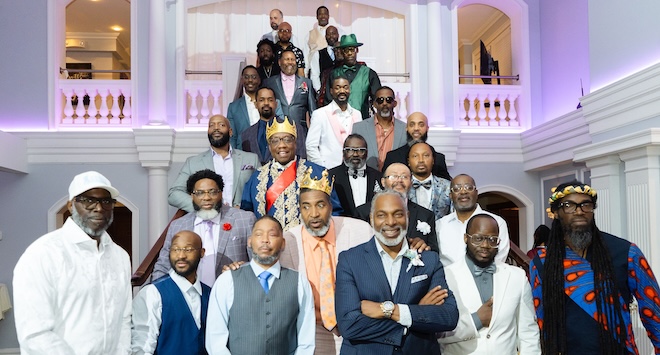
Austin is continuing to develop new models that help him reach even more fathers. This fall, Daddy University will launch Delta Alpha Delta (DAD) Inc., a social service fraternity that will aim to build a strong network of committed fathers across the country. Just like college fraternities, it will give fathers a space in their local communities to build friendships and learn from each other while also having the ability to tap into a broader national network for collaborative projects and connections.
While they are still finalizing their approach on certain aspects of the fraternity, there is one thing Austin knows he will be adamant on: All new members will be required to submit a letter of recommendation from their children — even if it’s written in crayon by a five-year-old. Austin’s team has had fun coming up with playful ideas for an initiation ceremony too, and says they have joked “about a new member having to walk on toys in the middle of the night.” If there is a more universal and unifying experience to help fathers bond than that, Austin’s team has yet to find it.
 MORE AMAZING PHILADELPHIA CITIZENS