


Eleven years ago, I got a call that no one ever wants to get: My husband had gotten into a bike accident and was in the hospital.
I ran as fast as I could to the hospital to find my husband in triage, lying on a stretcher with a rubber cast around his neck. The first thing he told me was that he wasn’t sure what would happen — and that he wouldn’t blame me if I left him. I was too squeamish to look at him closely, but out of the corner of my eye I saw his mouth was full of blood. Another person, a young woman, lay on a stretcher nearby. She too had gotten into a bike accident that morning. As doctors moved parts of her body, asking what she could feel. Nothing. She’d been paralyzed.
Listen to the audio edition here:
These are the risks cyclists take to navigate Philadelphia. My husband was lucky enough to get out with a small scar, and a $25,000 bill for dental implants. (Dental implants: Not covered by most health insurance policies.)
Others we know have not been as lucky. Two years ago, my husband’s co-worker and local Philadelphia bike advocate, Andrea Gonzalez, lost her life biking in New Jersey. Last summer, Dr. Barbara Friedes, a pediatric cancer specialist at Children’s Hospital of Philadelphia, was riding in the bike lane on Spruce Street when she was hit by a drunk driver. Friedes was wearing a helmet, following the rules; she died nonetheless.
So, for these reasons, I never bike on city streets anymore. Nonetheless, I try to support others that do.
Bike lane NIMBYism
Almost a year ago, I was asked to talk at the Philadelphia Athenaeum, which has a lovely salon of concerned citizens who meet up to discuss current affairs. I was there with Conor Descheemaker, Coalition Manager of Transit Forward Pennsylvania, to talk about transportation in the city — including bikes.
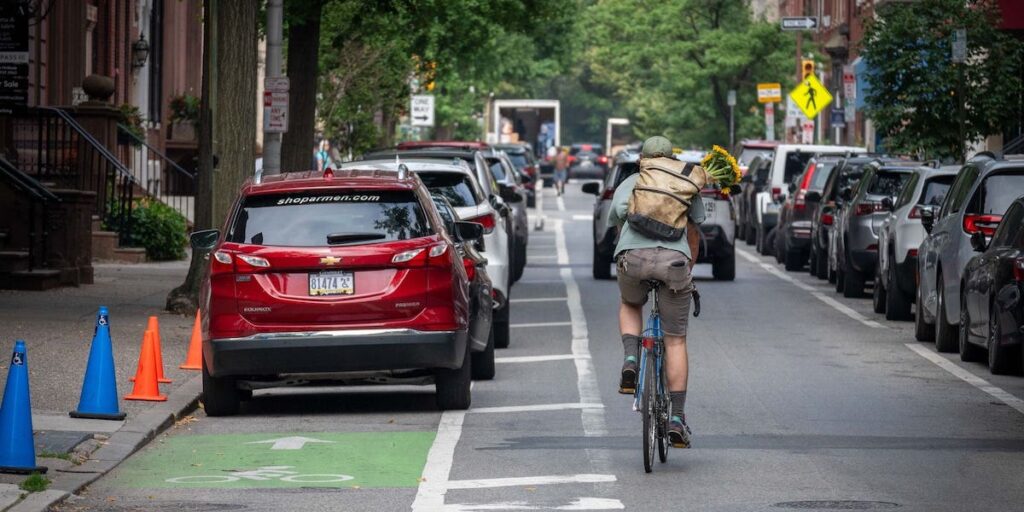
Philadelphia’s bike lane infrastructure has been slow to grow, and a vocal minority of the Athenaeum’s neighbors in Society Hill and Washington Square West have contested the relatively new bike lanes along narrow Pine and Spruce streets.
The City has fought to keep double-parked cars out of these lanes through tickets and enforcement, but the practice continues. Advocates are now trying to get concrete barriers to keep cars out of those lanes. At the event, a Society Hill resident explained that, like many of her neighbors, she is an older adult who does not bike. Why should there be a bike lane on their street when a large neighborhood demographic can’t use it?
How do you get people to look beyond their self-interest for better citymaking, whether it’s building affordable housing in their neighborhood or resilience infrastructure in some other part of the city that floods?
I felt stunned that someone in her 70s seemed so disinclined to care about others, so self-interested at this point in her life.
I explained that we support things even if we don’t use them. We pay taxes for public school even if we don’t send kids there, for example. I don’t think I mentioned that I don’t use the bike lanes either, but maybe I should have.
But I also recognized our situations are different: To her, the bike lane on her block was a direct infringement — it occupied a lane of traffic that she used to unload groceries or pick up a friend. I am less reliant on cars — and have spent something of a career involved in the movement to reduce cars in American cities — so I see the clear benefits of using our precious public land on something other than car traffic.
But the question has lingered for me: How do you convince people who don’t bike of the importance of bike lanes and bike infrastructure? I think about this a lot, in terms of other issues in our cities as well. How do you get people to look beyond their self-interest for any other aspect of citymaking, whether it’s building affordable housing in their neighborhood or resilience infrastructure in some other part of the city that floods?
The greater good
Although most Philadelphians have enthusiastically accepted bike lanes, some residents of Center City’s wealthiest neighborhoods – including members of the private group Friends of Pine & Spruce, who are suing the City over the construction of designated pickup and dropoff loading areas (ironically, an attempt to compromise with bike lane opponents). As a result, the City has been ordered to stop construction on these zones.
When I think about the woman complaining about the bike lanes, what I really think she was complaining about was the hardship of being an older adult with limited physical mobility and concerns about walking and driving in the city. She should have seen herself as an advocate for safe streets for everyone, but instead saw herself as fighting for her own bit of safety and comfort. Typical us vs. them. There’s an opportunity for bike lanes to be seen as part of a larger solution to what she wants — safer streets and sidewalks, aka Vision Zero.
The first six months of 2025 have recorded the lowest traffic fatalities since 2019, according to the Bicycle Coalition.


Though there’s no proof this is entirely due to bike lane infrastructure, bike lanes are part of the broader movement that is making our streets safer for everyone. There is a Venn diagram of connected street safety issues — good sidewalks, slower speed limits, traffic violation enforcement, public transportation and more. These are issues I bet the woman from the Athenaeum would have endorsed. Bike lanes fit in there, too, and maybe if she saw them as part of a bigger effort to transform our streetscapes, she would have been more accepting of them.
By changing the dynamic of how our streets are used, bike advocates are really advocating for all of us who want better streets and feel the need to challenge the status quo. All of us should be on the same team of transforming our streets to be safer, cleaner, and greener. It should be easy for an independent 10-year-old and an 85-year-old to get around our city. Right now, it’s not. Do bike lanes play a role in transforming our streets? Absolutely. But they’re just the beginning.
Diana Lind is a writer and urban policy specialist. This article was also published as part of her Substack newsletter, The New Urban Order. Sign up for the newsletter here.
Correction: A previous version of this post should have attributed the header photo to Dan Powers, who took it for a post in his cycling blog The Trellis and used it in Instagram.

