


The tenets of journalism include this idea of objectivity and never becoming part of the story. So we sometimes build artificial barriers between ourselves and the people we cover. I never quite bought into that notion, though I’d learn to go through the professional motions while still trying to be my authentic self. When I’d be invited closer, I’d cling to those moments, relishing the way it felt to have the veil falling between us. I’d be lying if I said I’d never shed tears with someone I was interviewing or shared knowing glances in admission of the hard truths we couldn’t deny.
Many years ago, just months into my one and only reporting internship, I found myself in one of those veil-dropping moments. I was covering police and crime for the Philadelphia Daily News. My daily routine included keeping tabs on the chatter from the police scanner perched by my desk and calling police headquarters and various law enforcement sources to see what if any bloody news was being made out in the streets. One day, I got word that a couple of teenagers had been shot and left badly wounded. For the coming weeks, I kept checking in on the case. And finally, after weeks of sniffing around and countless calls to sources, I learned that the most badly injured of the two boys was recovering in a hospital not far from the Daily News. A stranger, I talked my way into the building and up to his room, and soon, I was silenced by what I saw.
After introducing myself, I stood there, watching a snarl of tubes and wires snake from his body. They coiled across his sunken chest and belly, tangling his lanky, limp brown frame. I stared down at him, studying every contour and groove of his narrow brown face, the way his eyes beamed through a haze of medication.
The cascade of costs and consequences sparked by a bullet, purchased for as little as twenty-five cents a round, started an avalanche of millions. Not just for families like Kevin’s but for all of American society.
The incessant whoosh and beep of his breathing machine, a hulking contraption in the corner of the room, broke through the pregnant silence between us. His eyes grew wide as he labored to speak. His lips quivered.
“I have this dream,” he says. “Every night, it’s the same thing.” He’s on a basketball court dribbling and passing, cutting through the lane. He pivots, spins left, steps right, catches the ball just inside of the three-point line, and as he jumps to shoot, he’s rising, flying through the air like he has jet packs strapped to his legs. He can feel the heat melting the rubber soles off his high-top sneakers and singeing off his laces. And it feels good. Every sensation feels like it’s his first time feeling anything and everything. Then he shoots, savoring the last kiss of the ball as it floats off his fingertips. With his shooting arm still raised in the air, he watches the ball as it hangs high above the rim before it crashes down into the net.
“It’s like I’m really playing,” he says, “because I can feel everything.”
A toothy smile stretched across his face as he let out an airy, wheezy laugh. I smiled back and looked across his bed to where his mother stood, expecting her to smile, too. Instead, I found an ocean of tears welling in her eyes and her hands trembling, one clenched over her mouth and the other over her heart.
“I’m still paralyzed, but it doesn’t stop me,” he says as his mother looks away, hiding the inevitable flood of emotions. “It doesn’t stop me. Nothing can stop me. God wouldn’t give me anything I couldn’t handle.”
Silent tears tumbled down her cheeks.
“I’m going to try to live a regular life,” he says.
For a long moment, his mother and I stared deep into each other, then down onto his scarred body.
By then, I was becoming accustomed to seeing the damage that bullets do to Black bodies. They leave them hollow and lifeless. In that tangle of tubes and wires was a young man doing everything he could to stay alive.
It was late July 2003 inside a small, dimly lit room at the Jefferson Moss-Magee Rehabilitation Hospital in downtown Philadelphia. Kevin Johnson was just 19. I wasn’t too much older and nearing the end of my internship at the Daily News. A little more than a month earlier, a group of teens tried to rob Kevin for his $150 Allen Iverson basketball jersey. He and a cousin were waiting at a trolley stop in Southwest Philly when the other guys rolled up, pointed to the jersey, and told him to “give it up.” When he refused, one of them pressed a gun to the back of Kevin’s neck, just inches below his skull, and pulled the trigger. When his cousin turned to run, they shot him in the face. Both survived, but Kevin was instantly paralyzed.
All these years later, I still think about Kevin. He had such an amazing sense of optimism despite his world being torn down so violently. We were both so young back then with so much to look forward to that summer. He was working at McDonald’s and hoping to get into college by the start of the next semester. I’d managed to finally finish my four-year degree in about six and a half years and was amazed that I was actually getting paid to write. But that one bullet changed everything. It knocked Kevin off his feet and into paralysis. I’d never be the same either. Something inside of me was left frozen, too. From his bedside to the writing of these words, my life and career have been tethered to his spirit and the shock of all that he’d lost.
It wasn’t just Kevin’s infectious buoyance. Or his courageous fight to stay alive. Both of those things have certainly stuck with me in deep, meaningful ways. But what I haven’t been able to escape is the incalculability of the cost that he and his family would pay for the bullet lodged in his spine. He paid with his freedom, his mobility, and any future he and his family had ever hoped for. And for what? The robbers that shot him never even got the jersey they wanted so badly. The bloody rag had to be cut off Kevin’s back by paramedics. But what they took was priceless. They robbed his mother of a loving son who was just finding his footing in the world, his siblings of an adoring brother who’d chase them up and down the block, and the world of whoever Kevin would’ve grown to become, unbound by a wheelchair.
But there were other costs, too. From the moment that bullet dug into Kevin’s body, the tally began to tick. His medical bills mounted quickly. Before the rehab facility would discharge him, the family’s bi-level row house would need to be renovated: a special outlet for his breathing machine needed to be installed, a wheelchair ramp would need to be erected, doorframes needed widening, and the bathrooms needed to be overhauled. All of that or they’d have to move out. Or the unthinkable: send Kevin to a nursing home. He would require twenty-four-hour care to keep him alive and a specially equipped van to transport him and his hulking new wheelchair. That was just to get him home. It was money they didn’t have. Within months of the shooting, his family’s meager savings were exhausted.
The shooting threw off the family’s orbit in so many intangible ways. But the financial blow was a secondary injury that none of them had anticipated. In the coming years, the costs related to Kevin’s medical condition would be staggering, in the millions. There were the big-ticket items like the several-thousand-dollar wheelchair ramp and his wheelchair, which cost $35,000. Some of his medications were a few hundred dollars a month. There were adult diapers and supplies needed to keep his tracheostomy and breathing tubes clean. The family scraped together what they could to pay some of these bills out of pocket. Kindhearted strangers helped a lot. But the bulk of the financial costs to keep Kevin alive were paid by taxpayers through public insurance. His mother, Janice, quit her job with her then-husband’s restaurant cleaning business and took on the full-time job as Kevin’s caregiver. As the family’s debts skyrocketed, Kevin’s health plummeted.
Just one bullet. The cascade of costs and consequences sparked by a bullet, purchased for as little as twenty-five cents a round, started an avalanche of millions. Not just for families like Kevin’s but for all of American society.
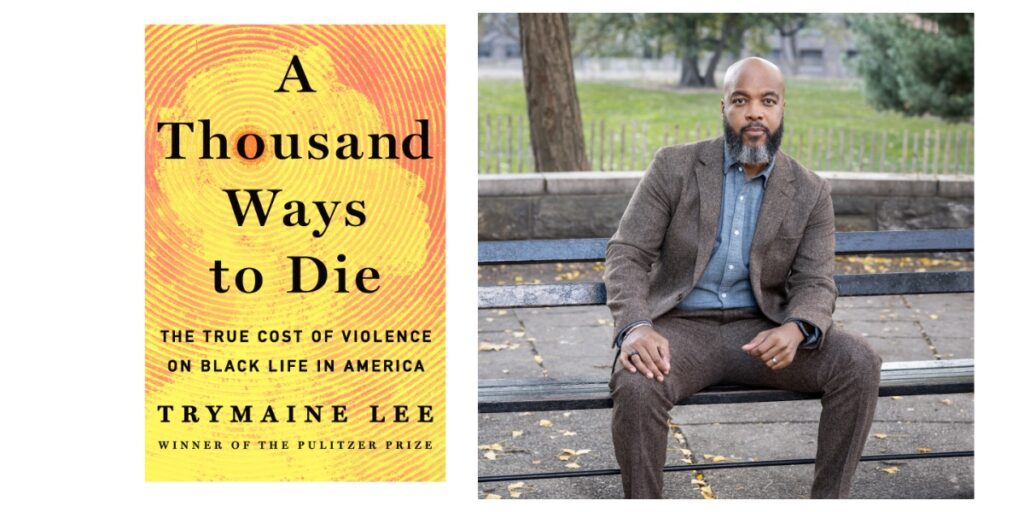
The Free Library Foundation and The Philadelphia Citizen proudly present the next in the Author Event Series: Trymaine Lee | A Thousand Ways to Die : The True Cost of Violence on Black Life in America on Thursday, September 11, at 7pm at the Parkway Central Library. You can pick up your copy of the book in advance or at the library on event night. 1901 Vine Street
From A Thousand Ways to Die: The True Cost of Violence on Black Life in America, by Trymaine Lee. Copyright ©2025 by the author, and reprinted with permission of St. Martin’s Publishing Group.


MORE BOOK COVERAGE